
Photo by Gabriel Griego on Unsplash
Demographics of Los Ranchos De Albuquerque, NM
Affluence Level in Los Ranchos De Albuquerque, NM
An upper-middle-class area. Household wealth, education levels, and homeownership run ahead of national benchmarks.
People of Los Ranchos De Albuquerque, NM
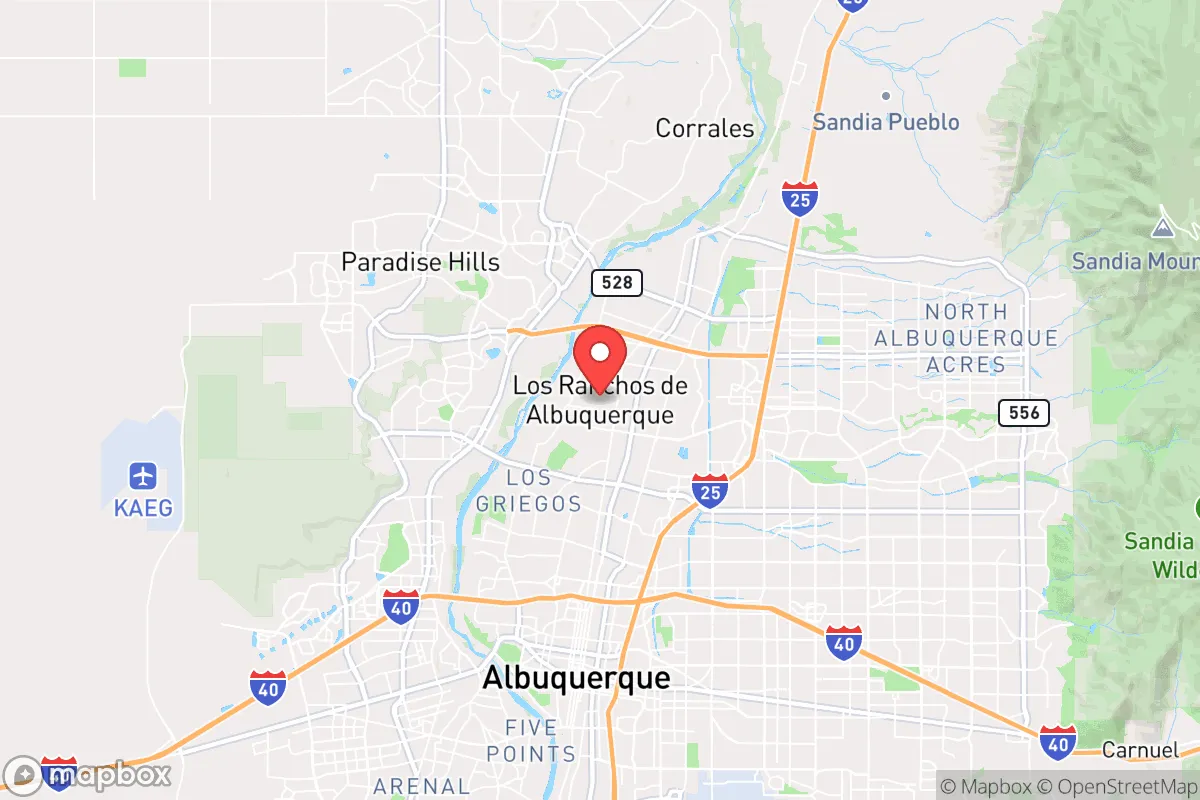
Today, Los Ranchos de Albuquerque is a small, affluent village of 5,869 residents with a distinctly bicultural character—roughly split between non-Hispanic White (48.1%) and Hispanic (42.1%) populations, with very little racial diversity beyond those two groups. The village maintains a rural, agricultural feel despite being surrounded by Albuquerque, and its identity is rooted in centuries-old land grant traditions and a modern wave of preservation-minded homeowners. With 51.8% of adults holding a college degree and a foreign-born population of just 1.3%, Los Ranchos is a highly educated, predominantly native-born community where old Hispanic families and newer Anglo arrivals coexist in a carefully protected landscape of acequias and horse properties.
How the city was settled and grew
Los Ranchos de Albuquerque was never a typical American town founded by homesteaders or railroad companies. Its origins lie in the Spanish land grant system of the early 1700s, when the King of Spain awarded large tracts along the Rio Grande to families who would farm the floodplain. The original settlers were Spanish colonists and their mestizo descendants, who established small farming communities—Los Ranchos proper, along with the adjoining historic settlements of Los Griegos and Los Duranes—each centered around a plaza and a network of acequias (irrigation ditches). These families grew wheat, corn, and chile, and the land remained in the same hands for generations. The village was never incorporated until 1958, and for most of its history it was simply a collection of rural Hispanic farming hamlets on the northern edge of Albuquerque. The population remained overwhelmingly Hispanic and Catholic, with a subsistence agricultural economy, well into the mid-20th century.
Modern era (post-1965)
The character of Los Ranchos began to shift significantly after the 1960s, driven by two forces: the expansion of Albuquerque's suburbs and the passage of the 1965 Immigration and Nationality Act, which had little direct effect here (given the tiny foreign-born share) but coincided with broader Anglo in-migration to the Southwest. From the 1970s through the 1990s, educated professionals and retirees from other states—disproportionately White and college-educated—discovered Los Ranchos as a semi-rural enclave within commuting distance of Albuquerque's jobs and Sandia National Laboratories. They bought up former farm properties, often from aging Hispanic families who sold due to rising property taxes and the declining viability of small-scale agriculture. This wave concentrated in the northern and eastern sections of the village, particularly around the Rio Grande bosque and along Rio Grande Boulevard, where larger lots and newer custom homes replaced old acequia-fed fields. Meanwhile, the historic core—the original plazas of Los Ranchos, Los Griegos, and Los Duranes—retained a higher concentration of long-established Hispanic families, though many younger members moved to Albuquerque or other states for work. The result is a village that is not segregated in the traditional sense but is subtly divided by neighborhood vintage and lot size: older Hispanic families in the smaller-lot historic plazas, newer Anglo arrivals on the larger-lot periphery. The Black (1.2%), East/Southeast Asian (0.2%), and Indian-subcontinent (0.2%) populations are negligible and scattered, mostly professionals drawn to the area's prestige and proximity to Albuquerque.
The future
Demographic trends suggest Los Ranchos will continue to slowly become more White and more affluent, though the pace is constrained by the village's strict zoning and lack of developable land. The Hispanic share has likely declined from a majority in the 1960s to its current 42.1%, and this erosion will probably continue as older Hispanic families sell to out-of-state buyers. The foreign-born population (1.3%) is far below the national average and shows no sign of increasing—there is no immigrant gateway dynamic here. The village's aging housing stock and high property values (median home prices well above $400,000) filter for buyers who are already established, typically White professionals in their 40s and 50s. The small Asian and Indian populations may grow slightly as Sandia Labs and the University of New Mexico recruit internationally, but Los Ranchos will remain overwhelmingly a two-group village of Whites and Hispanics. The key dynamic is not ethnic conflict but economic and cultural displacement: as farmland converts to hobby estates and the acequia system becomes a lifestyle amenity rather than an irrigation necessity, the village's Hispanic agricultural heritage becomes more symbolic than lived. For a conservative-leaning newcomer, this means moving into a community that values property rights, low taxes, and rural character—but one where the old families who built that character are gradually being priced out.
Los Ranchos de Albuquerque is becoming a preservationist haven for the affluent—a place where the agricultural past is curated rather than practiced. For someone moving in now, the village offers a stable, safe, and highly educated environment with strong property protections and a tangible sense of place. The trade-off is that this stability comes from a demographic narrowing: Los Ranchos is less diverse and less dynamic than the surrounding metro area, and its future depends on whether enough younger families—of any background—can afford to stay or buy in.

* Values derived from national, state, county, city and local statistics and may differ in a specific area. Last updated: 2026-04-19T19:31:06.000Z
Narrative content on this page is AI-generated and may contain mistakes. Verify any details that matter before acting on them.
ReloMaps may earn a commission from affiliate links at no extra cost to you.

