
Photo by Gabriel Griego on Unsplash
Political ClimatePolitical Climate in Los Ranchos De Albuquerque, NM
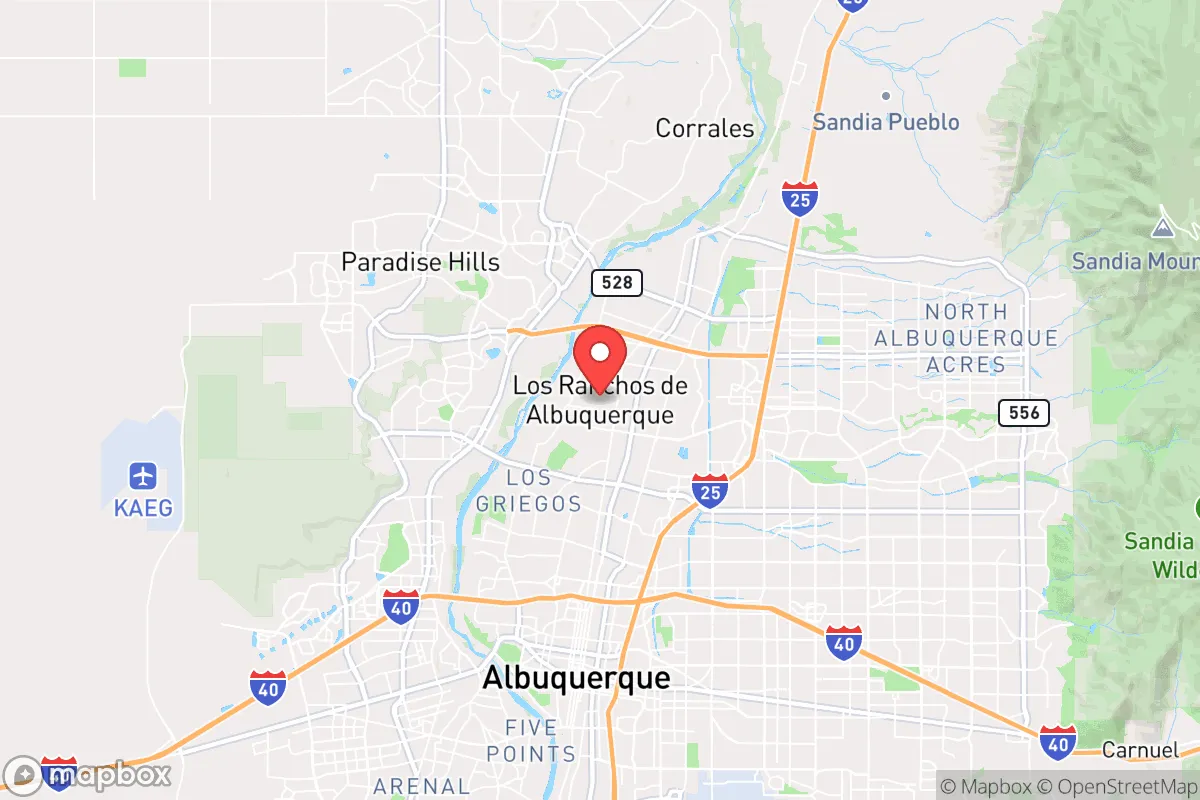
District shown is the primary district for this city’s centroid. Cities may span multiple districts.
Local Political AnalysisPolitical Analysis of Los Ranchos De Albuquerque, NM
Los Ranchos de Albuquerque leans heavily Democratic, with a Cook PVI of D+7, and that blue tint has been deepening over the last decade. Back in the 90s and early 2000s, this village was a quiet mix of old-school New Mexico Democrats and independent ranchers who valued their privacy and property rights above all else. Now, you’re seeing more transplants from out of state, especially from California and Colorado, who bring progressive voting habits with them. The shift isn’t as dramatic as in Albuquerque proper, but it’s noticeable—and concerning if you value limited government and local control.
How it compares
Los Ranchos sits in a political bubble compared to its neighbors. Head north to Corrales, and you’ll find a more balanced mix—still blue-leaning, but with a stronger libertarian streak and more pushback on overreach. Go east into Albuquerque’s North Valley, and you’re in solidly Democratic territory, where city council votes often swing toward higher taxes and more regulations. The real contrast is south and west: places like Rio Rancho and the South Valley lean more conservative, with voters who are skeptical of government expansion and protective of Second Amendment rights. Los Ranchos, by contrast, has become a place where progressive candidates win local races by comfortable margins, and the village council tends to favor environmental ordinances and growth restrictions that can feel like overreach to longtime residents.
What this means for residents
For someone who values personal freedoms and limited government, the trend in Los Ranchos is a red flag. The village has already passed stricter water-use rules and land-use codes that give officials more say over what you can do on your own property. There’s been talk of expanding rental inspection programs and adding more fees for new construction—things that sound like common-sense regulation but often end up as tools for government control. Property taxes have crept up, and while they’re still lower than in Albuquerque proper, the trajectory is clear: more oversight, more costs, less freedom. If you’re the kind of person who wants to build a shed without a permit or keep a few chickens without a zoning battle, you’ll find the political climate here increasingly frustrating.
Culturally, Los Ranchos still holds onto some of its rural character—acequias, horse properties, and a slower pace of life—but the politics are pulling it in a different direction. The village has become a haven for progressive-minded folks who want to “preserve” the area’s charm, often through more rules and restrictions. That’s a double-edged sword: it keeps out big-box development, but it also means more bureaucracy for everyday decisions. If the current trajectory holds, expect more ordinances on short-term rentals, more environmental mandates, and a local government that’s less responsive to property-rights concerns. For now, it’s still a great place to live if you keep your head down, but the political winds are blowing toward a future where personal freedoms take a back seat to government planning.

State Political ClimatePolitical Climate in New Mexico
State Political AnalysisPolitical Environment in the State
New Mexico has long been a reliably blue state in presidential elections, voting Democratic by margins of 10-11 points in 2020 and 2024, but the picture is far more complicated than a simple partisan label. The state’s political engine is driven by a coalition of Hispanic voters in the north and central counties, a growing progressive base in Albuquerque and Santa Fe, and a small but influential Native American voting bloc. Over the last 10-20 years, the state has shifted noticeably leftward on social and cultural issues, even as rural areas have hardened their conservative resistance. For a conservative considering relocation, the key takeaway is that New Mexico is a state where your vote matters most in local and county races, but where state-level policy increasingly reflects the priorities of the Albuquerque-Santa Fe corridor.
Urban vs. rural divide
The political map of New Mexico is a study in stark contrasts. Bernalillo County (Albuquerque) and Santa Fe County together cast roughly 45% of the state’s vote and lean heavily Democratic — Santa Fe County went +42 for Biden in 2020. These two metros drive the state’s blue tilt, powered by government workers, university faculty, and a growing tech-adjacent population. Meanwhile, the southeastern quadrant — Lea County (Hobbs), Eddy County (Carlsbad), and Chaves County (Roswell) — is deep red, with Trump winning Lea County by 50 points in 2024. The oil and gas industry anchors this region, and its voters are reliably conservative on taxes, energy, and gun rights. The rural north, including Taos and Mora counties, is culturally distinct — heavily Hispanic, Catholic, and historically Democratic but increasingly skeptical of progressive social policy. The Las Cruces area (Doña Ana County) is a swing region, trending blue but still competitive, with a large military and border-security presence that moderates some issues. If you’re looking for a politically like-minded community, the southeast oil patch or the rural ranching counties are your best bets; avoid Santa Fe and the Nob Hill area of Albuquerque unless you enjoy being the lone conservative at the dinner party.
Policy environment
New Mexico’s state-level policy has moved decisively left in the last decade. The gross receipts tax (essentially a sales tax on services and goods) is among the highest in the nation, with combined state and local rates often exceeding 8-9%. Property taxes are relatively low, but the state’s progressive income tax tops out at 5.9% on income over $210,000 — not California-level, but climbing. In 2023, the legislature passed a state-funded free college tuition program (the Opportunity Scholarship Act) for all residents, funded by oil and gas revenues — a classic trade-off of energy wealth for social spending. Education policy is a flashpoint: the state has some of the nation’s lowest test scores, yet the legislature has resisted school choice expansion, killing voucher bills repeatedly. The 2023 Energy Transition Act mandates 100% carbon-free electricity by 2045, which has rattled the oil and gas sector that provides a third of the state’s budget. On election law, New Mexico has automatic voter registration, same-day registration, and no-excuse absentee voting — a system conservatives view as ripe for fraud, though no major scandals have emerged. The state also has a red flag law (2019) allowing courts to temporarily seize firearms from individuals deemed a threat, which remains a sore point for gun owners.
Trajectory & freedom
On the freedom index, New Mexico is a mixed bag trending in the wrong direction. The 2021 repeal of the state’s concealed carry permit requirement (constitutional carry) was a rare win for gun rights — you can now carry a concealed firearm without a permit. But that victory was undercut by the 2023 HB 129, which bans firearms at polling places and government buildings, and the 2024 SB 5, which imposes a 14-day waiting period on all firearm purchases. Parental rights took a hit with the 2023 HB 7, which expanded the state’s anti-discrimination laws to include gender identity and sexual orientation in schools, effectively overriding local school board control and parental notification policies. Medical autonomy is under pressure: the 2021 HB 27 codified abortion access as a “fundamental right” and removed nearly all restrictions, including parental consent for minors. Property rights are relatively strong, but the state’s 2023 Land Use Planning Act gave local governments more power to restrict development, which has frustrated rural landowners. The bottom line: New Mexico is becoming less free on social and medical issues, but remains more free than neighboring Colorado or California on taxes and property.
Civil unrest & political movements
New Mexico has seen its share of political flashpoints. The 2020 protests in Albuquerque over George Floyd’s death turned violent, with the toppling of a statue of Juan de Oñate and arson at the Albuquerque Police Department headquarters. The Sanctuary State law (SB 140), passed in 2019, prohibits state and local law enforcement from cooperating with federal immigration authorities, making New Mexico a magnet for border-crossing traffic — a constant source of tension in Sunland Park and Las Cruces. The Otero County Commission made national headlines in 2022 when it refused to certify primary election results over unfounded fraud claims, a move that was eventually overruled by the state Supreme Court. The New Mexico Civil Guard, a militia group, has been active in border-area patrols, drawing both support and condemnation. On the left, the Working Families Party and Mijente have organized around police reform and immigrant rights, with significant influence in the state legislature. A new resident will notice the political signage wars along I-25 and the constant debate over oil and gas regulation — it’s a state where politics is personal and often loud.
Projection
Over the next 5-10 years, New Mexico is likely to continue its leftward drift, but with important caveats. The in-migration pattern is telling: people are moving to the state from California and Texas, but the net flow is small and concentrated in Albuquerque and Santa Fe. The oil and gas industry, which provides a third of the state budget, is under existential threat from the green energy mandates, and if production declines, the state will face a fiscal crisis that could force tax increases or spending cuts. The Hispanic electorate, which has historically been Democratic-leaning, is showing signs of drift — younger voters are more progressive, but older, rural Hispanics are increasingly voting Republican on cultural issues. The 2026 gubernatorial race will be a bellwether: if a Republican can win back the governor’s mansion (currently held by Democrat Michelle Lujan Grisham), it could slow the progressive agenda. But the legislature is likely to remain Democratic-controlled for the foreseeable future. For a conservative moving in now, expect a state that will continue to expand government programs, restrict gun rights incrementally, and maintain its sanctuary policies — but where your local vote in Hobbs, Carlsbad, or Roswell can still make a difference in county-level races.
For a conservative considering New Mexico, the practical takeaway is this: you can find a community that shares your values in the southeastern oil patch or the rural ranching counties, but you will be fighting an uphill battle at the state level. The tax burden is moderate but rising, the regulatory environment is increasingly hostile to energy and gun rights, and the cultural drift is toward progressive orthodoxy. If you value low property taxes, constitutional carry, and a strong local community, New Mexico still offers that — but you’ll need to be politically engaged to protect it. If you’re looking for a state where your vote reliably counts for conservative policies, you’re better off looking at Texas or Arizona. But if you’re willing to fight for your corner of the map, New Mexico’s rural and oil-patch counties are worth a serious look.
* Values derived from national, state, county, city and local statistics and may differ in a specific area. Last updated: 2026-04-19T19:31:06.000Z
Narrative content on this page is AI-generated and may contain mistakes. Verify any details that matter before acting on them.
ReloMaps may earn a commission from affiliate links at no extra cost to you.

