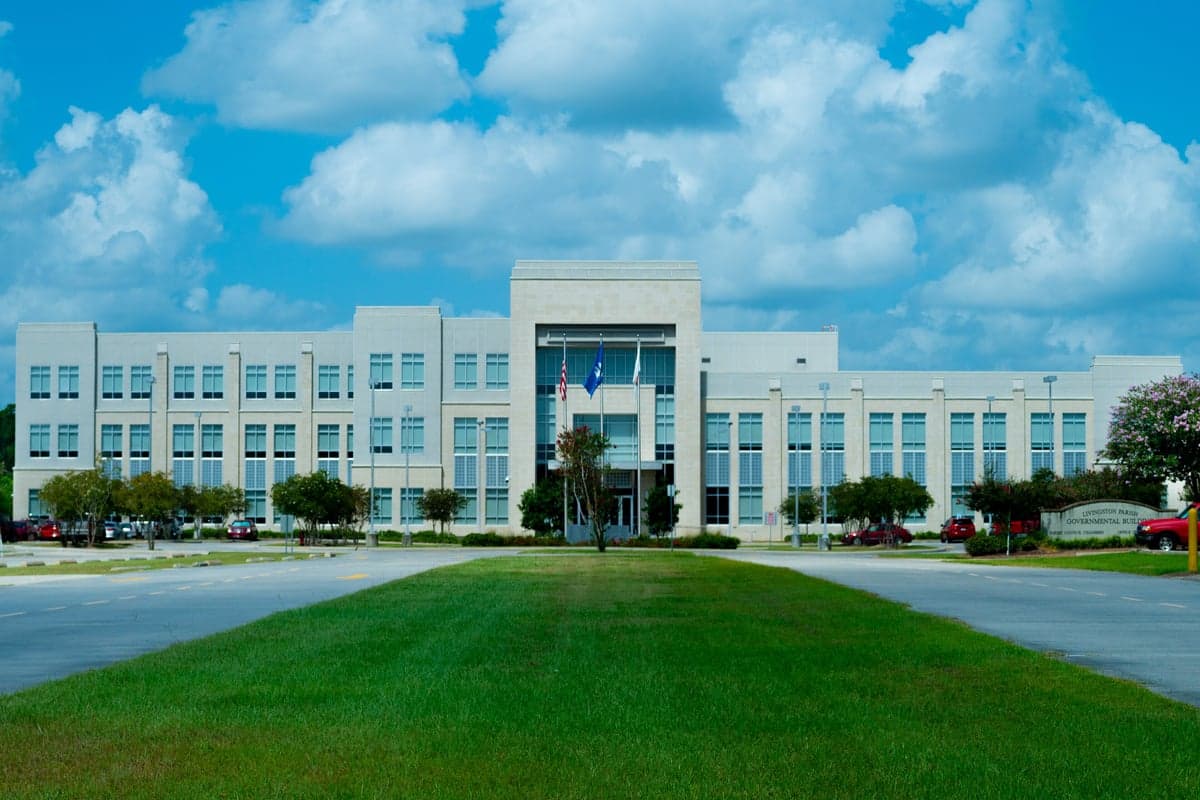
Photo: Wikipedia
Demographics of Livingston County
Affluence Level in Livingston County
A below-average socioeconomic profile. Incomes, home values, and educational attainment trail the U.S., with higher poverty and unemployment.
People of Livingston County
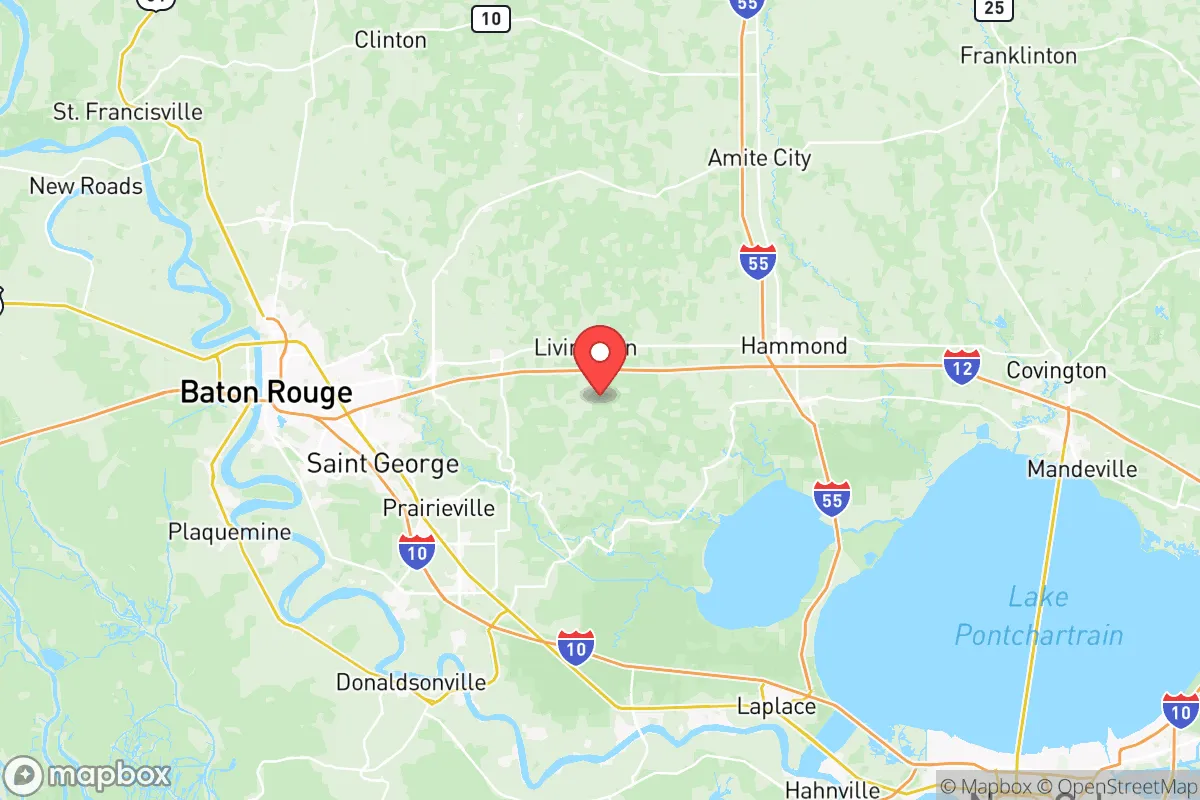
The people of Livingston Parish, Louisiana, today form a predominantly white, family-oriented population of 145,583 that is notably less diverse than the state as a whole, with a strong conservative character and a deep attachment to rural and small-town life. The parish is 81.9% white, 8.2% Black, and 6.2% Hispanic, with a foreign-born population of just 3.0% — roughly half the national average. Its residents are concentrated in the towns of Denham Springs, Walker, Livingston, and Springfield, and the parish's identity is shaped by a history of slow, steady settlement by Anglo-American pioneers, a brief timber boom, and recent suburban spillover from Baton Rouge.
Settlement & growth (pre-1960)
Before European contact, the area now known as Livingston Parish was inhabited by the Houma and Choctaw peoples, who used the region's river bottoms and pine forests for hunting and seasonal agriculture. French and Spanish colonial governments claimed the territory, but neither established permanent settlements here; the land remained a sparsely populated frontier through the Louisiana Purchase in 1803.
American settlement began in earnest after the War of 1812, when Anglo-American migrants from Georgia, the Carolinas, and Tennessee pushed into the Florida Parishes. These were primarily Scots-Irish and English yeoman farmers seeking cheap, fertile land along the Amite River and its tributaries. They established small farming communities that would become the towns of Denham Springs (founded 1828), Walker (1830s), and Springfield (1819). The parish itself was created in 1832 from parts of St. Helena Parish, named for U.S. Secretary of State Edward Livingston. The early economy was subsistence agriculture — cotton, corn, and livestock — with little plantation-style slavery due to the sandy, less fertile soils. By 1860, enslaved people made up only about 25% of the population, well below the state average.
After the Civil War and Reconstruction, the parish remained overwhelmingly rural and white. The major economic shift came in the 1880s and 1890s with the expansion of the Illinois Central Railroad, which opened the parish's vast pine forests to commercial logging. Timber companies built sawmills in towns like Killian, Port Vincent, and French Settlement, drawing in a small wave of Italian and German immigrant laborers, as well as Black workers from neighboring parishes. This timber boom peaked around 1910 and declined sharply after the virgin forests were exhausted. The population, which had grown to about 18,000 by 1920, stagnated through the Great Depression and World War II.
From the 1940s through the 1950s, the parish remained a quiet, agricultural backwater. The completion of U.S. Highway 190 and later Interstate 12 began to connect Livingston Parish more closely to Baton Rouge, but suburban growth was still decades away. The population in 1960 was just 26,000 — overwhelmingly white, native-born, and rural.
Modern era (post-1965)
The 1965 Hart-Cellar Act had little direct effect on Livingston Parish. Unlike major urban centers or Sun Belt boomtowns, the parish did not receive significant immigration from Asia, Latin America, or the Middle East. The foreign-born population today remains just 3.0%, and the Hispanic share (6.2%) and East/Southeast Asian share (0.7%) are modest. The small Indian-subcontinent population (0.1%) is negligible. The parish's demographic story in the modern era is not one of international immigration but of domestic migration — specifically, the suburban spillover from Baton Rouge.
Beginning in the 1970s and accelerating through the 1990s, white families from East Baton Rouge Parish began moving eastward into Livingston Parish, seeking lower taxes, larger lots, and a more conservative political environment. This "white flight" was driven by the desegregation of Baton Rouge schools and the perception of rising crime in the capital city. Denham Springs and Walker absorbed the bulk of this growth, transforming from small farming towns into bedroom suburbs. The parish's population more than doubled between 1970 and 2000, from 36,000 to 91,000. The Black population share, however, actually declined during this period, from about 12% in 1970 to 8.2% today, as the incoming white migrants outnumbered the existing Black population.
The 2016 flood, which devastated large portions of the parish, temporarily slowed growth but did not reverse it. Recovery and rebuilding have been robust, and new subdivisions continue to spread across the piney woods. The Hispanic population has grown modestly, from about 2% in 2000 to 6.2% today, concentrated in construction and service jobs in Denham Springs and Walker. The parish remains one of the most politically conservative in Louisiana, consistently voting Republican by wide margins.
The future
Livingston Parish is projected to continue growing, though at a slower pace than in the 1990s and 2000s. The population is expected to reach roughly 170,000 by 2040, driven primarily by continued suburban expansion from Baton Rouge and natural increase among existing residents. The parish is becoming slightly more diverse, but slowly: the Hispanic share is likely to rise to 10-12% over the next two decades, while the Black share may remain stable or increase modestly as younger families move in. The East/Southeast Asian and Indian populations will likely remain very small, as the parish lacks the professional job base or ethnic enclaves that attract these groups to larger metros.
The cultural identity of the parish is likely to remain strongly conservative, family-oriented, and rooted in evangelical Protestant Christianity. New residents are overwhelmingly domestic migrants from other parts of Louisiana and the broader South, not international immigrants, so the parish's character will evolve gradually rather than transform. The main tension will be between long-time rural residents who value the parish's quiet, undeveloped character and newcomers who want more amenities, schools, and infrastructure.
For someone moving in now, Livingston Parish offers a stable, safe, and affordable environment with strong community ties and a predictable political and cultural landscape. It is not a place of rapid demographic change or cosmopolitan diversity, but rather a place where the population is growing steadily and becoming slightly more varied while retaining its core identity as a white, conservative, family-centered suburbia. The towns of Denham Springs, Walker, Livingston, and Springfield will remain the primary population centers, with continued low-density development spreading along the I-12 corridor.

* Values derived from national, state, county, city and local statistics and may differ in a specific area. Last updated: 2026-08-08T17:10:30.000Z
Narrative content on this page is AI-generated and may contain mistakes. Verify any details that matter before acting on them.
ReloMaps may earn a commission from affiliate links at no extra cost to you.

