Photo: Wikipedia
Demographics of Natchitoches County
Affluence Level in Natchitoches County
A below-average socioeconomic profile. Incomes, home values, and educational attainment trail the U.S., with higher poverty and unemployment.
People of Natchitoches County
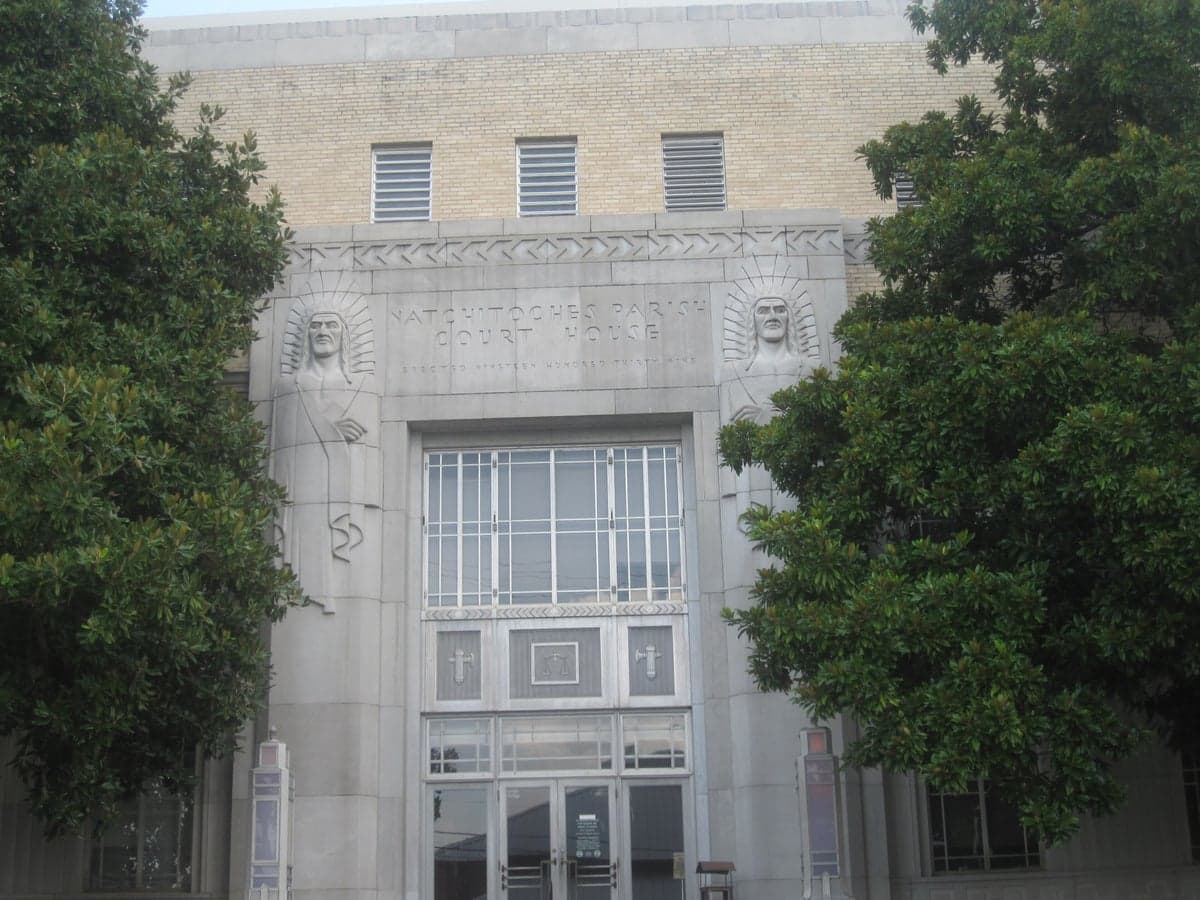
Natchitoches County today is a place of deep historical roots and a clear demographic divide, home to roughly 37,000 residents. The population is nearly evenly split between a 50.3% White majority and a 39.5% Black minority, with a very small Hispanic (3.9%) and Asian (0.4%) presence, and a foreign-born population of just 0.7%. This is a community shaped by centuries of plantation agriculture, a strong Creole and Cajun cultural undercurrent, and a modern economy anchored by Northwestern State University in the city of Natchitoches, giving the county a character that is both traditionally Southern and quietly academic.
Settlement & growth (pre-1960)
The human history of Natchitoches County begins long before the United States existed. The area was originally inhabited by the Caddo Confederacy, particularly the Natchitoches people, from whom the county takes its name. French explorers and traders, led by Louis Juchereau de St. Denis, established a permanent settlement at Fort St. Jean Baptiste in 1714 in what is now the city of Natchitoches, making it the oldest permanent settlement in the entire Louisiana Purchase territory. This French outpost was a critical trading hub with Spanish Texas, and the early population was a mix of French soldiers, trappers, and enslaved Africans brought to work the tobacco and indigo plantations that soon lined the Cane River.
After the Louisiana Purchase in 1803, American settlers began arriving, primarily from the Upper South states of Kentucky, Tennessee, and Virginia. These were largely Scots-Irish and English families who brought a plantation-based, slave-dependent cotton economy. By the 1820s and 1830s, the fertile bottomlands along the Red River and Cane River were carved into large cotton plantations, and the county's Black population grew rapidly through the domestic slave trade. The Civil War and emancipation shattered this system, but the demographic structure it created—a large, rural Black population and a smaller, land-owning White planter class—persisted through Reconstruction and into the Jim Crow era.
Following the Civil War, the county's economy shifted toward sharecropping and tenant farming. The small town of Campti became a regional trading center for cotton and timber, while Cloutierville, an older Creole settlement, remained a center for the mixed-race Creole population descended from French and Spanish colonists and enslaved women. The arrival of the railroad in the late 19th century spurred modest growth in the city of Natchitoches, which became the county's commercial and political hub. The early 20th century saw the establishment of Louisiana State Normal School (now Northwestern State University) in 1884, which began drawing a small but steady stream of educated professionals and faculty to the county, diversifying the White population slightly. The Great Depression and the mechanization of agriculture in the 1930s and 1940s pushed many Black residents out of the rural areas and into the city of Natchitoches or out of the county entirely as part of the Great Migration to northern industrial cities.
Modern era (post-1965)
The post-1965 era in Natchitoches County has been defined not by new immigration—the foreign-born share remains negligible at 0.7%—but by internal demographic shifts and suburbanization. The 1965 Hart-Cellar Act, which transformed the nation's immigration patterns, had almost no direct impact here. Instead, the county's story is one of slow population decline from a mid-20th-century peak, as young people left for jobs in larger Louisiana cities like Shreveport, Baton Rouge, and Houston, Texas.
The most significant modern demographic change has been the gradual suburbanization of the county's population around the city of Natchitoches itself. Newer subdivisions have developed on the outskirts of the city, particularly along the Louisiana Highway 1 corridor heading south toward Iatt and north toward Allen, drawing middle-class White families out of the historic city core. Meanwhile, the historic Black neighborhoods in the city of Natchitoches—areas like the St. Augustine Parish district and the MLK Drive corridor—have seen population aging and some out-migration, though they remain culturally vital. The small towns of Goldonna and Ashland in the northern part of the county have seen their populations shrink as the timber industry mechanized and family farms consolidated.
The university has been the primary engine of stability. Northwestern State University brings in a steady flow of students from across Louisiana and Texas, many of whom are White and Black, which keeps the county's racial balance from shifting further toward an older, whiter rural demographic. The Hispanic population, while still small at 3.9%, has grown modestly since 2000, largely through Mexican and Central American immigrants working in the poultry processing plants in nearby towns like Natchitoches and in the region's construction and landscaping sectors. The Asian population (0.4%) and Indian population (0.2%) are tiny and concentrated almost entirely among university faculty and medical professionals at the local hospital.
The future
The demographic trajectory of Natchitoches County points toward continued slow decline and modest diversification. The county's population has hovered around 37,000 for the past two decades, and projections from the Louisiana State Census Data Center suggest it will remain flat or decline slightly through 2040. The White population is aging and shrinking, while the Black population is slightly younger but also experiencing out-migration of young adults to larger cities. The Hispanic share is likely to grow slowly, perhaps reaching 6-8% by 2040, as the poultry and service industries continue to attract immigrant labor, but the county lacks the economic dynamism to draw large numbers of new residents.
The most likely future is one of increasing concentration in the city of Natchitoches and its immediate suburbs, with the rural areas of the county—places like Provencal and Robeline—continuing to lose population. The university will remain the anchor, and its student body may become slightly more diverse, but the county's cultural identity will remain deeply rooted in its French-Creole and African American heritage, with a conservative, rural Southern character prevailing outside the university bubble. New residents moving in now will find a place where the past is very much present, and where community life revolves around the Cane River, the university, and the annual Natchitoches Christmas Festival.
For someone moving to Natchitoches County today, the bottom line is this: you are choosing a small, historically rich, and racially balanced community where the pace of life is slow, the cost of living is low, and the cultural identity is proudly traditional. It is not a place of rapid growth or demographic upheaval, but rather a stable, rooted community where the French and African American legacies of the 18th and 19th centuries still shape daily life. The county offers a genuine sense of place, but it requires an appreciation for its quiet, conservative rhythms and its deep, sometimes complicated, history.

* Values derived from national, state, county, city and local statistics and may differ in a specific area. Last updated: 2026-09-15T13:57:53.000Z
Narrative content on this page is AI-generated and may contain mistakes. Verify any details that matter before acting on them.
ReloMaps may earn a commission from affiliate links at no extra cost to you.

