
Photo: Wikipedia
Political ClimatePolitical Climate in Tangipahoa County
Showing district-level results — no local-only data available.
Local Political AnalysisPolitical Analysis of Tangipahoa County
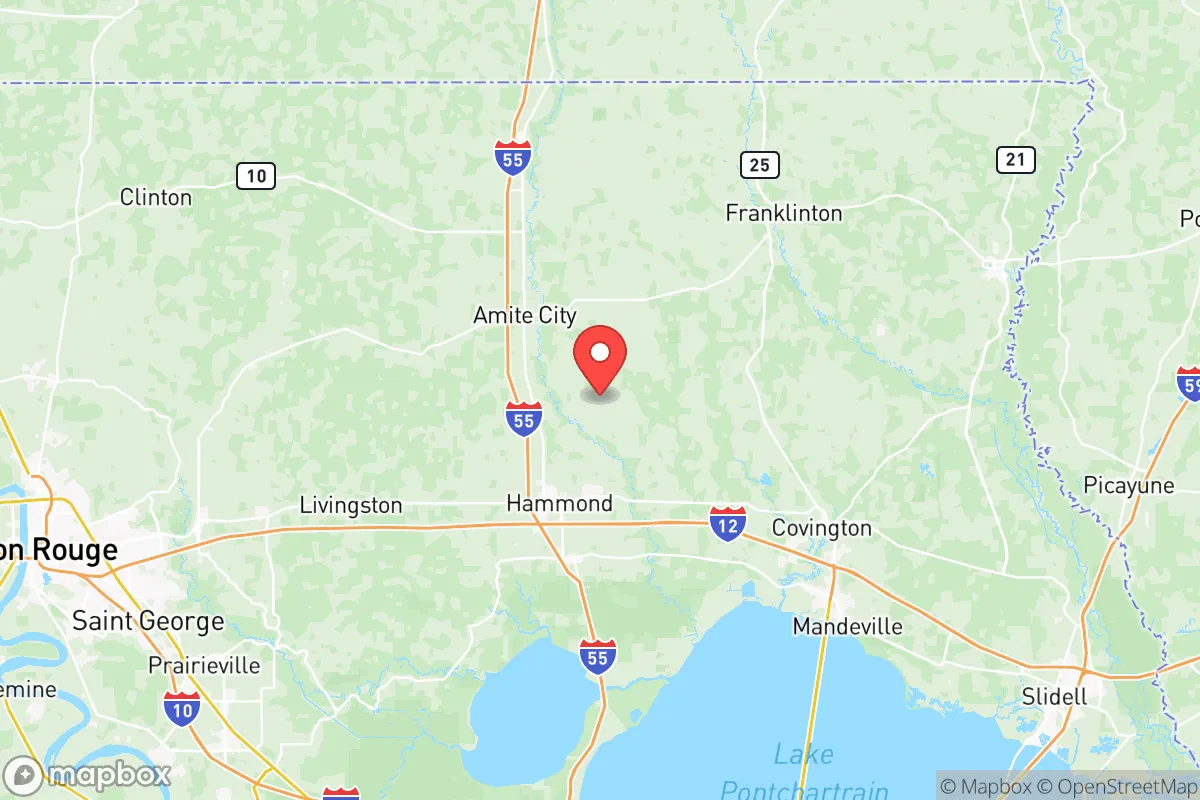
Tangipahoa Parish leans heavily Republican, with a Cook Partisan Voting Index of R+18, making it one of the most reliably red parishes in Louisiana. This wasn't always the case—twenty years ago, the area was a classic Southern swing region, with Democrats winning local races and the parish backing Bill Clinton in 1992 and 1996. The shift accelerated after 2008, driven by white working-class voters moving rightward on cultural and economic issues, and by 2020, Donald Trump carried the parish by over 30 points. The trajectory is still moving right, but the pace has slowed as the growing college town of Hammond introduces a small but persistent blue pocket.
How it compares
Compared to Louisiana as a whole, Tangipahoa is significantly more conservative. The state itself has a Cook PVI of R+12, meaning the parish is about six points redder than the statewide average. This gap is most visible in presidential races: while Louisiana has voted for the Republican candidate by 15-20 points in recent cycles, Tangipahoa has delivered margins closer to 30-35 points. The difference comes down to demographics—the parish has a smaller Black population (about 30%) than the state average (33%), and its white voters are more uniformly conservative than those in, say, the New Orleans suburbs. Within the parish, the political geography is stark: Hammond, home to Southeastern Louisiana University, is the only town where Democrats can compete, with precincts around campus often splitting 50-50 or even leaning blue. Ponchatoula and Amite City are reliably red but not extreme, while Independence and Kentwood are deep red, often voting 70%+ Republican. The rural precincts along the Mississippi state line are the most conservative, with turnout driven by gun rights and opposition to coastal restoration taxes.
What this means for residents
For conservative residents, the political climate is comfortable and affirming. Local government—the parish council, school board, and most municipal offices—is dominated by Republicans, and policy tends to favor low taxes, limited regulation, and traditional social values. The sheriff's office and district attorney are both conservative, and there's little appetite for progressive criminal justice reforms. For liberal residents, the reality is more about finding community than winning elections. Hammond's university district provides a social and political counterweight, with a Democratic club, a local Indivisible chapter, and a handful of progressive-leaning coffee shops and bookstores. Statewide issues like abortion access and LGBTQ rights are deeply unpopular here, but local elections often turn on bread-and-butter concerns—road funding, drainage, and school quality—where partisan labels matter less. The biggest practical impact of the R+18 lean is on primary elections: because the parish is so safe for Republicans, the real competition happens in the GOP primary, meaning moderate and conservative voters have outsized influence, while Democratic voters have little say in most races.
Culturally, Tangipahoa's conservatism is more about independence than ideology. There's a strong strain of libertarian-leaning skepticism toward both parties, especially in the strawberry-farming communities around Ponchatoula and the timber country near Kentwood. You'll hear folks complain about "big government" regardless of who's in charge, and local politics often revolves around keeping taxes low and maintaining local control over schools and land use. The parish is also notably more religious than the state average, with a heavy concentration of Southern Baptist and Pentecostal churches that shape public discourse on moral issues. One distinctive policy outcome: Tangipahoa was one of the first parishes in Louisiana to pass a Second Amendment sanctuary resolution in 2021, and it has consistently resisted state-level mandates on everything from COVID-19 restrictions to coastal restoration funding. For newcomers, the political climate means adjusting to a place where conservative values are the baseline, but where personal relationships and local issues often matter more than national party labels.

State Political ClimatePolitical Climate in Louisiana
State Political AnalysisPolitical Environment in the State
Louisiana has long been a fascinating outlier in Southern politics — culturally conservative and reliably Republican in presidential elections, but with a stubborn streak of populist Democratic holdouts at the state and local level that makes it less predictable than its Deep South neighbors. Over the past 20 years, the state has shifted from a competitive purple state (voting for George W. Bush twice, then flipping to John McCain by 19 points in 2008) to a solidly red one, with Donald Trump carrying it by nearly 19 points in 2020 and by a similar margin in 2024. But the real story is beneath the presidential numbers: Louisiana’s political identity is a blend of evangelical Protestant conservatism in the north and west, Cajun and Catholic pragmatism in the south, and a powerful Black Democratic voting bloc concentrated in New Orleans and Baton Rouge that keeps statewide races closer than the national map suggests.
Urban vs. rural divide
The political map of Louisiana is a textbook case of the urban-rural chasm. New Orleans (Orleans Parish) is the state’s most reliably Democratic stronghold, delivering 80-85% of its vote to Democratic presidential candidates, driven by a large Black population and a progressive white professional class. Baton Rouge (East Baton Rouge Parish) is more competitive — the city itself leans Democratic, but the surrounding suburbs like Prairieville and Denham Springs are deeply red, giving the parish a slight Republican lean overall. Lafayette, the heart of Acadiana, is a bellwether: it votes Republican but with a moderate, culturally Catholic flavor that sometimes backs Democrats in local races. The rural north — places like Shreveport (Caddo Parish) is a Democratic island in a sea of red, while Monroe (Ouachita Parish) and Alexandria (Rapides Parish) are solidly Republican. The Florida Parishes (north of Lake Pontchartrain, including Mandeville and Covington) are among the fastest-growing and most conservative areas in the state, with St. Tammany Parish routinely voting 70%+ Republican. The rural bayou parishes like Terrebonne and Lafourche are culturally conservative but economically populist, often backing Republicans for president while electing conservative Democrats to local offices.
Policy environment
Louisiana’s policy environment is defined by a low-tax, low-service model that appeals to conservatives but frustrates those wanting robust public investment. The state has no state property tax on vehicles or inventory, and homestead exemptions keep residential property taxes among the lowest in the South. The state income tax is a flat 3% for most filers (down from a progressive 6% in recent years), and sales taxes are high — averaging over 9.5% when local add-ons are included, among the highest in the nation. Education policy is a mixed bag: Louisiana has a robust school choice system with vouchers and charter schools, but public school performance ranks near the bottom nationally. The state’s healthcare system is heavily reliant on Medicaid expansion (adopted in 2016 under a Democratic governor), covering about 40% of the population, but rural hospital closures have been a persistent problem. Election laws are moderately restrictive: voter ID is required, early voting is available for 7 days, and no-excuse absentee voting is not permitted. The state has a unique “jungle primary” system where all candidates, regardless of party, run on the same ballot, with a runoff if no one gets 50% — this often produces more moderate general election matchups.
Recent policy direction
Under Republican Governor Jeff Landry (elected in 2023), Louisiana has moved aggressively to the right on multiple fronts. Gun and self-defense law is among the most permissive in the country: the state enacted constitutional carry in 2024, allowing concealed carry without a permit, and has strong Stand Your Ground protections. Parental and education rights saw a major win with the 2024 passage of a school voucher expansion (the LA GATOR Scholarship program) that makes nearly all students eligible for state-funded private school tuition. The state also passed a law requiring public schools to display the Ten Commandments in classrooms (2024), which is being challenged in court. Speech and privacy are generally protected, though the state has no comprehensive data privacy law. Medical and bodily autonomy is sharply restricted: Louisiana has a near-total abortion ban with no exceptions for rape or incest, and the state has criminalized the provision of abortion pills by mail. Property rights are strong, with no statewide rent control and relatively few zoning restrictions outside major cities. Taxation has been trending downward: the flat income tax was phased in starting in 2024, and the state is considering eliminating the income tax entirely. Voting and ballot access saw a tightening in 2024 with a new law requiring a government-issued ID for all voting (previously, a utility bill could suffice), and the state has purged inactive voters from rolls more aggressively.
Civil unrest & political movements
Louisiana has a history of political flashpoints, but recent years have been relatively calm compared to states like Oregon or Texas. The most visible protests in the last decade were the 2016 Baton Rouge protests following the shooting of Alton Sterling by police, which drew national attention and resulted in the killing of three police officers by a gunman from out of state. More recently, the 2024 Ten Commandments law sparked smaller protests and legal challenges, but no widespread unrest. Immigration politics are less heated here than in border states — Louisiana has no sanctuary cities, and the state legislature passed a law in 2024 requiring local law enforcement to cooperate with ICE. Secession and nullification rhetoric is minimal, though there is a strong strain of “Cajun libertarianism” that resists federal overreach on environmental and energy regulations. Election integrity controversies have been relatively muted compared to states like Georgia or Arizona; Louisiana’s paper ballot system and post-election audits have maintained broad trust. The most visible political movement is the rise of the Louisiana Republican Party under Landry, which has consolidated power by purging more moderate GOP legislators and pushing a hardline agenda on cultural issues.
Projection
Over the next 5-10 years, Louisiana is likely to become even more Republican and more culturally conservative, driven by two trends: the continued out-migration of Black residents from New Orleans and Baton Rouge to other states (particularly Texas and Georgia), and the in-migration of white retirees and remote workers to the Florida Parishes and the Northshore. The state’s Democratic Party, already weak, will become increasingly confined to New Orleans and a few Black-majority districts. The income tax elimination push, if successful, would make Louisiana even more attractive to conservative relocators but would further starve public services. The biggest wild card is climate change: as hurricanes intensify and coastal erosion accelerates, the state’s population may shift northward, potentially reshaping the political map. A new resident moving in now should expect to find a state that is deeply red, culturally traditional, and increasingly aligned with the national GOP on cultural issues, but with a unique local flavor that resists easy categorization.
For a new resident, the bottom line is this: Louisiana offers a low-tax, low-regulation environment with strong gun rights and school choice, but with weak public services, high sales taxes, and a healthcare system under strain. Conservatives will find a welcoming policy environment and a like-minded community in most areas outside of New Orleans. Liberals will find a challenging political climate but vibrant cultural scenes in New Orleans and Lafayette, and a strong sense of community that transcends politics. The state’s trajectory is clearly rightward, but its unique blend of Cajun pragmatism, Catholic social conservatism, and Black Democratic resilience means it will never be as uniformly red as Mississippi or Alabama. If you’re moving here, pick your parish carefully — the difference between Orleans and St. Tammany is as stark as the difference between two states.
* Values derived from national, state, county, city and local statistics and may differ in a specific area. Last updated: 2026-09-29T18:28:21.000Z
Narrative content on this page is AI-generated and may contain mistakes. Verify any details that matter before acting on them.
ReloMaps may earn a commission from affiliate links at no extra cost to you.

