Photo: Wikipedia
Demographics of Lovell, WY
Affluence Level in Lovell, WY
A middle-class area roughly in line with national averages across income, home values, education, and employment.
People of Lovell, WY
The people of Lovell, Wyoming, today number 2,590, forming a tight-knit, predominantly white community with a distinctive rural character shaped by agriculture and a strong Latter-day Saint (Mormon) heritage. The city’s population density is low, and its identity is marked by a high degree of ethnic homogeneity — 91.9% white, 6.4% Hispanic, and negligible shares of other groups — alongside a below-average college attainment rate of 19.3%. Lovell is not a diverse or rapidly changing place; it is a stable, family-oriented community where generational roots run deep and newcomers are often drawn by work in farming, energy, or the nearby Bighorn Canyon recreation area.
How the city was settled and grew
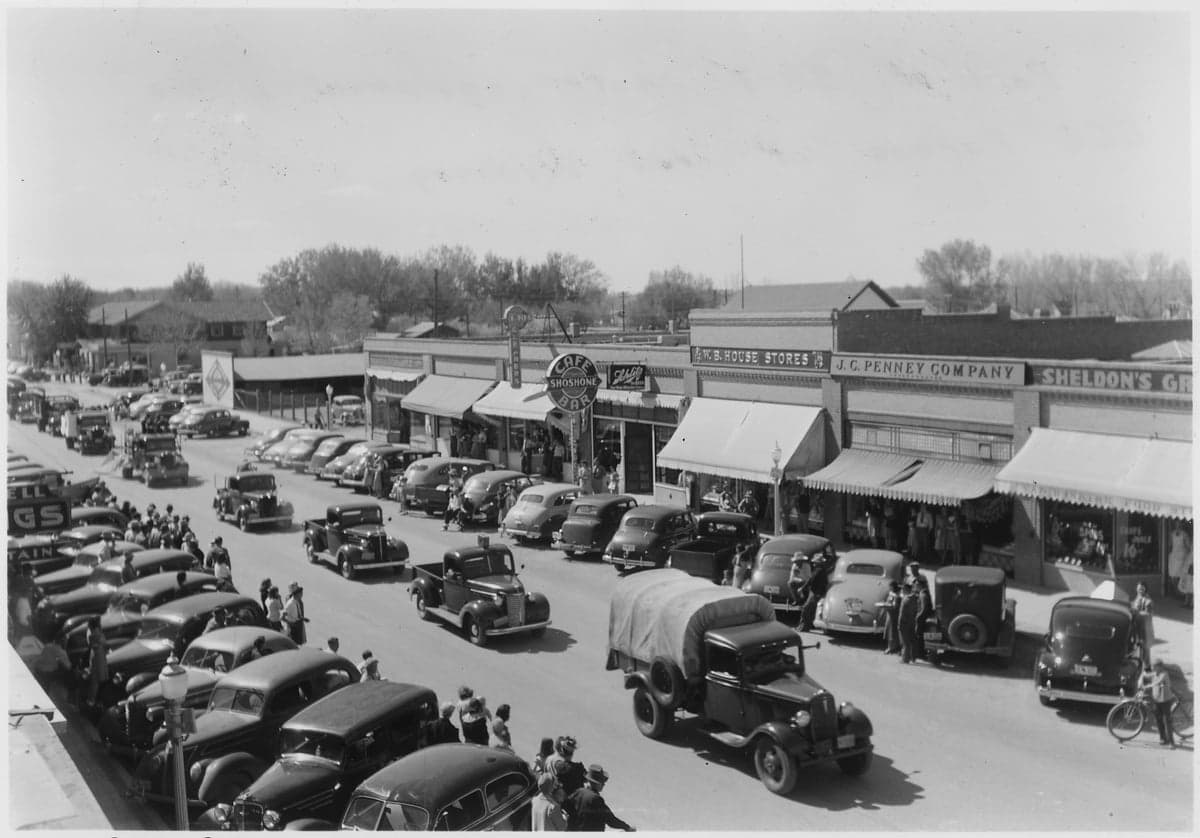
Lovell’s settlement history is relatively recent and tightly tied to the expansion of irrigation agriculture in the Big Horn Basin. The area was originally inhabited by Crow and Shoshone peoples, but the first permanent Euro-American settlers arrived in the 1880s, drawn by the promise of homesteading land under the Desert Land Act and the Carey Act. The town itself was platted in 1900 by the Lovell Land and Irrigation Company, which constructed the Shoshone River canal system to turn arid sagebrush into productive farmland. The earliest settlers were predominantly of Northern European stock — English, German, and Scandinavian — and many were members of the Church of Jesus Christ of Latter-day Saints, who migrated from Utah and Idaho to establish farming communities. These founding families built their homes in what is now the Old Town District, centered around the original Main Street and the historic Lovell Mercantile building. A second wave arrived in the 1910s and 1920s, drawn by the sugar beet industry and the construction of the Chicago, Burlington & Quincy Railroad spur. These workers, many of them German-Russian and Mexican laborers, settled in the South Side area near the railroad tracks and the sugar factory, creating a modest ethnic enclave that remains the core of Lovell’s Hispanic population today. By 1930, the population had reached roughly 1,500, and the town’s character as a conservative, agricultural, and predominantly LDS community was firmly established.
Modern era (post-1965)
After the 1965 Hart-Cellar Act, Lovell saw virtually no immigration-driven diversification. The foreign-born population today is a mere 0.2%, and the city’s demographic story since the 1970s has been one of domestic stability rather than ethnic change. The Hispanic share, at 6.4%, is almost entirely descended from the earlier Mexican and German-Russian labor waves, with little new immigration. The white population has remained dominant, and the small East/Southeast Asian (0.2%) and Black (0.4%) communities are almost entirely tied to temporary professional or military-related stays, not permanent settlement. Suburbanization in Lovell has been modest, but new single-family homes have been built in the North Heights neighborhood, a hillside area developed in the 1980s and 1990s that attracted younger LDS families seeking larger lots and views of the Bighorn Mountains. The West End, near the Lovell High School and the hospital, became the preferred area for professionals and retirees. Meanwhile, the South Side has remained the most ethnically distinct part of town, with a higher concentration of Hispanic families and a more working-class character. The city’s population peaked at around 2,700 in the 1990s and has since declined slightly, reflecting out-migration of younger adults to larger cities in Wyoming and Colorado for education and employment.
The future
Lovell’s population is likely to continue its slow decline or stagnation over the next 10–20 years. The city is homogenizing rather than diversifying: the white share is stable, the Hispanic share is plateauing, and there is no sign of significant new immigrant or domestic in-migration from outside the region. The college-educated share, at 19.3%, is low and unlikely to rise quickly, as most young people who pursue higher education do not return. The Old Town District and South Side are aging, while North Heights and West End may see modest infill from retirees and remote workers seeking affordable housing and a quiet lifestyle. The city’s future depends heavily on the viability of local agriculture and the nearby energy sector (oil and gas in the Bighorn Basin), as well as the ability of the Lovell school system and LDS church community to retain families. Without a major economic catalyst, the population will likely remain below 2,500 by 2040.
For someone moving in now, Lovell offers a stable, safe, and culturally conservative environment where neighbors know each other and community life revolves around church, school, and outdoor recreation. It is not a place of rapid change or demographic excitement — it is a place where the past still shapes the present, and where newcomers are expected to integrate into an established, homogeneous social fabric. If you value quiet, predictability, and a low cost of living, Lovell may fit. If you seek diversity, urban amenities, or a growing job market, look elsewhere.

* Values derived from national, state, county, city and local statistics and may differ in a specific area. Last updated: 2026-04-21T11:21:31.000Z
Narrative content on this page is AI-generated and may contain mistakes. Verify any details that matter before acting on them.
ReloMaps may earn a commission from affiliate links at no extra cost to you.

