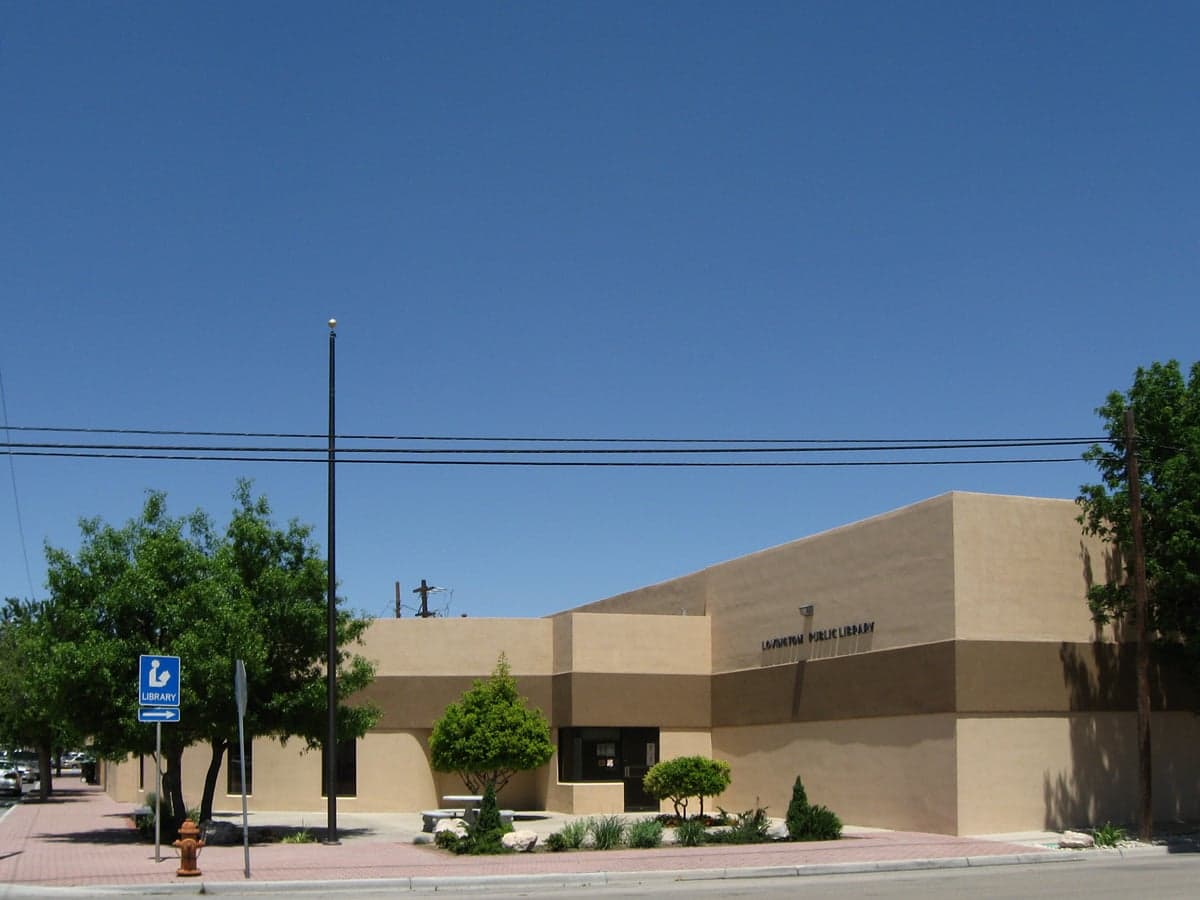
Photo: Wikipedia
Demographics of Lovington, NM
Affluence Level in Lovington, NM
A low-income area with significant economic hardship. Household wealth and educational attainment are well below national averages.
People of Lovington, NM
Lovington, New Mexico, is a majority-Hispanic city of 11,444 residents where 67.4% of the population identifies as Hispanic or Latino, 27.7% as White alone, and 3.2% as Black. The city has a notably low college attainment rate of 9.6% and a foreign-born share of 13.7%, reflecting its roots as a working-class agricultural and oil-patch community. Its people are characterized by deep generational ties to the land and a pragmatic, conservative-leaning culture shaped by ranching, farming, and energy extraction. The population density is low, and the city retains a small-town feel where extended families and church networks form the core of social life.
How the city was settled and grew
Lovington was founded in 1908 as a railroad town on the Pecos Valley and Northeastern Railway, which opened the High Plains to homesteaders. The original settlers were primarily Anglo-American ranchers and farmers from Texas and the Midwest, drawn by the promise of free land under the Homestead Act and later the availability of irrigated cotton farming. The Old Town district, centered around Main Street and the original depot, was built by these early Anglo families, who established the town's first churches, schools, and mercantile stores. By the 1920s, the discovery of oil in the nearby Hobbs field brought a second wave of workers, many of whom settled in the North Lovington neighborhood, a working-class area of small frame houses and company-built cottages. During the Dust Bowl and Great Depression, additional Anglo families arrived from Oklahoma and the Texas Panhandle, seeking work on cotton farms and in the nascent oil industry. These groups formed the backbone of Lovington's civic and business leadership for decades, and their descendants remain concentrated in the Country Club Estates area, a newer subdivision east of town developed in the 1960s and 1970s.
Modern era (post-1965)
After the 1965 Immigration and Nationality Act, Lovington experienced a significant demographic shift as Mexican-American families moved from rural colonias and South Texas into agricultural and oil-field jobs. The Southwest Barrio, a historically Hispanic neighborhood south of the railroad tracks, grew rapidly during the 1970s and 1980s as these families established roots. By the 1990s, the Hispanic share of the population had surpassed the Anglo share, driven by higher birth rates and continued immigration from Mexico. The Sunset Heights subdivision, built in the 1980s and 1990s, became a mixed-income area where upwardly mobile Hispanic families bought homes, while the Westside area near the high school remained predominantly Anglo and middle-class. The Black population, though small at 3.2%, is concentrated in the East Lovington area near the old cotton gin, a legacy of African-American farmworkers who arrived during the 1940s and 1950s. The East/Southeast Asian community (0.3%) and Indian subcontinent community (0.4%) are tiny and dispersed, with no distinct ethnic enclave; most are professionals in healthcare or education who arrived after 2000. The foreign-born share of 13.7% is almost entirely Hispanic, with the majority being Mexican nationals who work in agriculture, construction, and oil-field services.
The future
Lovington's population is slowly homogenizing into a predominantly Hispanic working-class city, with the Anglo share declining steadily as younger generations leave for college and urban jobs. The Hispanic population is growing through natural increase and continued immigration, but the city's overall population has been flat or slightly declining since the 2010 census, as the oil industry's boom-and-bust cycles discourage long-term settlement. The Southwest Barrio and Sunset Heights are becoming more uniformly Hispanic, while Country Club Estates and Westside are aging and seeing fewer young Anglo families. The East/Southeast Asian and Indian communities are likely to remain negligible, as Lovington lacks the professional job base to attract them. The Black population is also stable but not growing, as younger African-Americans move to larger cities like Lubbock or Albuquerque. Over the next 10-20 years, Lovington will likely become even more Hispanic and more economically stratified, with a growing divide between long-established families in newer subdivisions and newer immigrants in older neighborhoods. The low college attainment rate (9.6%) suggests limited upward mobility, and the city's future depends on whether the oil and gas sector can sustain employment or whether the population will continue to slowly drain to regional hubs.
For someone moving in now, Lovington is a stable, family-oriented community where Hispanic culture and conservative values dominate, but economic opportunity is tied to volatile industries. The city is not diversifying ethnically; it is consolidating into a majority-Hispanic identity with a shrinking Anglo minority. New residents should expect a tight-knit, church-centered social environment where extended family networks are paramount, and where the public schools and local economy reflect the working-class character of the population.

* Values derived from national, state, county, city and local statistics and may differ in a specific area. Last updated: 2026-04-19T11:37:09.000Z
Narrative content on this page is AI-generated and may contain mistakes. Verify any details that matter before acting on them.
ReloMaps may earn a commission from affiliate links at no extra cost to you.

