
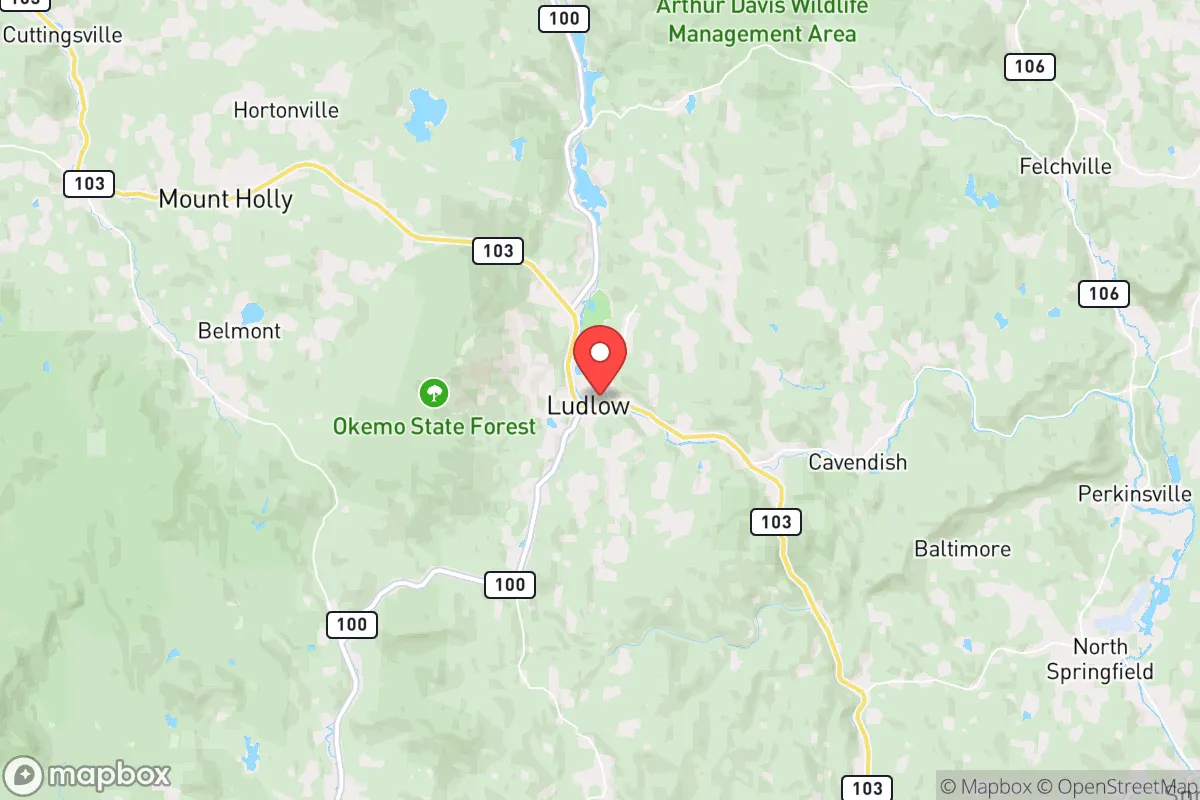
Photo by Ulrike R. Donohue on Unsplash
Demographics of Ludlow, VT
Affluence Level in Ludlow, VT
A middle-class area roughly in line with national averages across income, home values, education, and employment.
People of Ludlow, VT
Ludlow, Vermont, is a small, tight-knit community of 755 residents that remains overwhelmingly white (96.2%) and native-born, with a foreign-born population of just 1.7%. The town’s character is defined by its dual identity as a historic mill village and a modern ski destination, centered around the Okemo Mountain Resort. With 34.1% of adults holding a college degree, Ludlow attracts a mix of second-home owners, outdoor enthusiasts, and families seeking a quiet, rural lifestyle in a state known for its independent, libertarian-leaning political culture.
How the city was settled and grew
Ludlow’s original population was drawn by the Black River’s water power in the late 18th and early 19th centuries. The town was chartered in 1761 and settled primarily by Yankee farmers from southern New England, who cleared land for agriculture and built the first homes along the river valley. By the mid-1800s, the arrival of the railroad and the rise of the machine-tool industry transformed Ludlow into a manufacturing hub. The Fletcher & Parker Company and later the Ludlow Manufacturing Company attracted waves of French-Canadian and Irish immigrants, who settled in the Mill District along the Black River, building the dense, worker-owned homes that still line Depot Street and Main Street. A smaller number of Italian and Polish families arrived in the early 1900s, clustering in the Pleasant Street and High Street neighborhoods near the mills. These groups formed the backbone of Ludlow’s Catholic parishes and labor unions, creating a distinct working-class identity that persisted through the mid-20th century.
Modern era (post-1965)
The 1965 Immigration and Nationality Act had virtually no effect on Ludlow’s demographics, as the town’s remote location and lack of industrial growth after the 1970s did not attract new immigrant streams. Instead, the modern era has been defined by domestic in-migration driven by the ski industry. The opening of Okemo Mountain Resort in the 1950s, and its major expansion in the 1980s and 1990s, drew affluent second-home buyers from the Boston and New York metropolitan areas. These newcomers concentrated in the Okemo Mountain Access Road area and the Fox Run subdivision, where newer, larger homes sit on wooded lots. Meanwhile, the historic Mill District and Downtown Ludlow have seen a gradual shift from year-round working-class residents to a mix of service-industry workers and seasonal renters. The town’s Hispanic population remains tiny at 1.2%, and there are no recorded Black, East/Southeast Asian, or Indian-subcontinent residents, according to the most recent data. The population has declined from a peak of roughly 1,200 in the 1960s, as manufacturing jobs disappeared and younger locals moved away for employment.
The future
Ludlow’s population is likely to continue its slow decline or stabilize at a low level, as the town faces the same headwinds as much of rural Vermont: an aging population, limited job opportunities outside of tourism and construction, and a high cost of housing relative to local wages. The town is not homogenizing or tribalizing into distinct ethnic enclaves, because it has never been diverse. Instead, the primary demographic tension is between long-term residents—many of whom trace their families back to the French-Canadian and Irish mill workers—and newer, wealthier second-home owners who spend only part of the year in town. The foreign-born population is unlikely to grow significantly, as Ludlow offers few of the economic or social networks that attract immigrants to larger Vermont towns like Burlington or Rutland. The next 10–20 years will likely see continued pressure on affordable housing, as more historic homes are converted to vacation rentals, and a gradual thinning of the year-round population.
For someone moving in now, Ludlow offers a stable, safe, and overwhelmingly white community with a strong sense of place, but it is not a place of demographic change or growth. The town is becoming more oriented toward seasonal tourism and less toward year-round family life, which means newcomers should expect a quiet, insular environment where community connections take time to build. The bottom line: Ludlow is a picturesque but shrinking village where the past weighs heavily, and the future belongs to those who can afford to live there full-time.

* Values derived from national, state, county, city and local statistics and may differ in a specific area. Last updated: 2026-05-01T14:09:12.000Z
Narrative content on this page is AI-generated and may contain mistakes. Verify any details that matter before acting on them.
ReloMaps may earn a commission from affiliate links at no extra cost to you.

