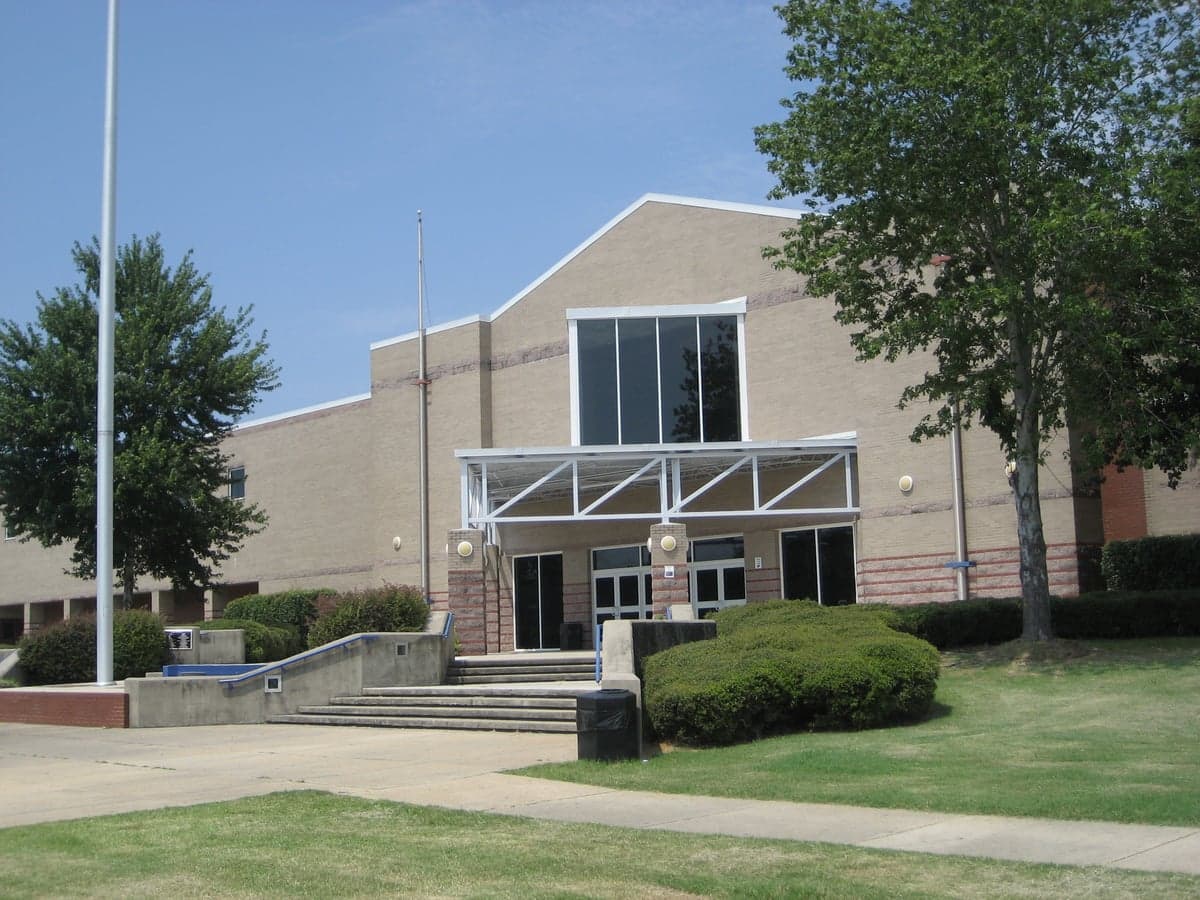
Photo: Wikipedia
Strategic Assessment of Madison, MS
Workable tactical position. Some exposure to population density or targets, but generally defensible in a crisis.
What does the Strategic Assessment tell us?
Our Strategic Assessment grades tactical survivability of an area. Major population centers, military targets, fallout zones, natural disasters, and border exposure all drive risk — lower exposure means a more defensible position in a crisis.
This is heavily inspired by Joel Skousen's Strategic Relocation book. Highly recommended you checkout the book ($)What does this tell us?
Our Strategic Assessment grades tactical survivability of an area. Major population centers, military targets, fallout zones, natural disasters, and border exposure all drive risk — lower exposure means a more defensible position in a crisis.
This is heavily inspired by Joel Skousen's Strategic Relocation book. Highly recommended you checkout the book ($)Strategic Pillars

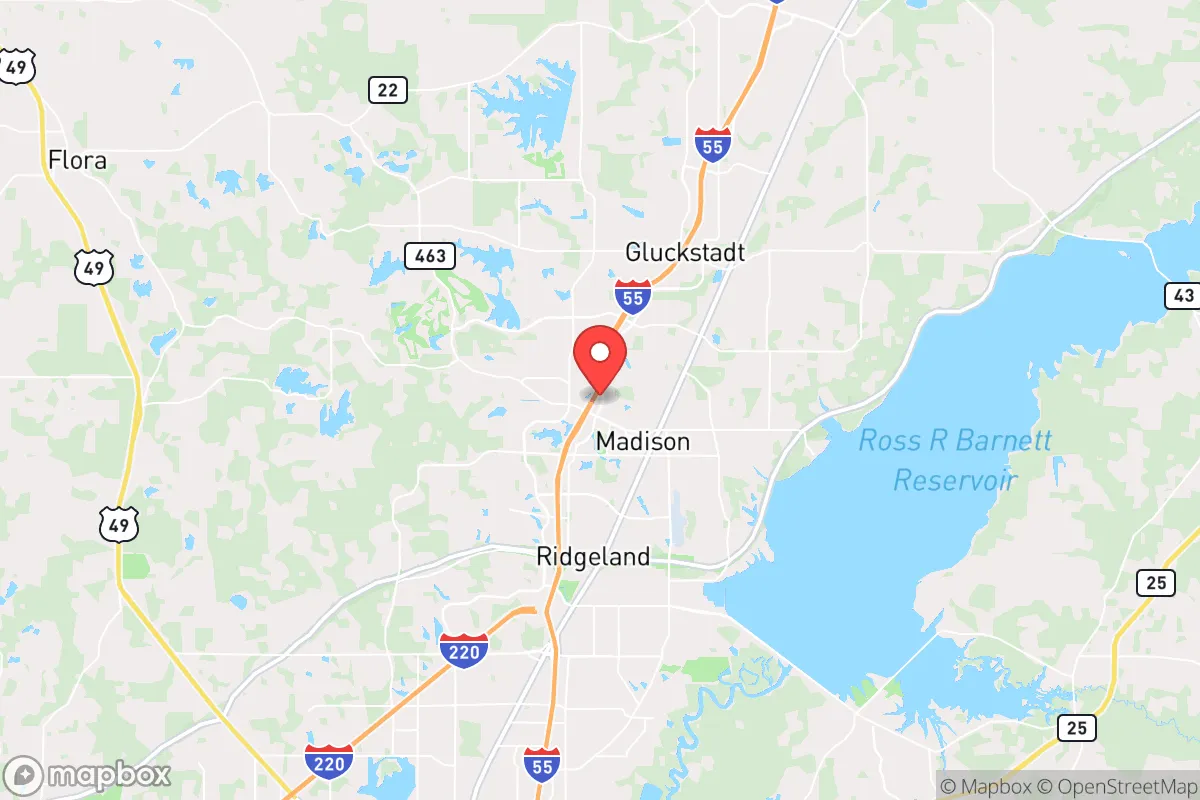
Key Distances
Regional Safe Places
Below is our recommended "safe zones" in Mississippi and the surrounding area based on our strategic heuristics. For most people, it's unrealistic to live in a “safe zone” full-time due to work, family or other personal reasons. They tend to be more rural. However, many of these areas are perfect for second homes and retreat properties that double as a vacation home or even a short-term rental.
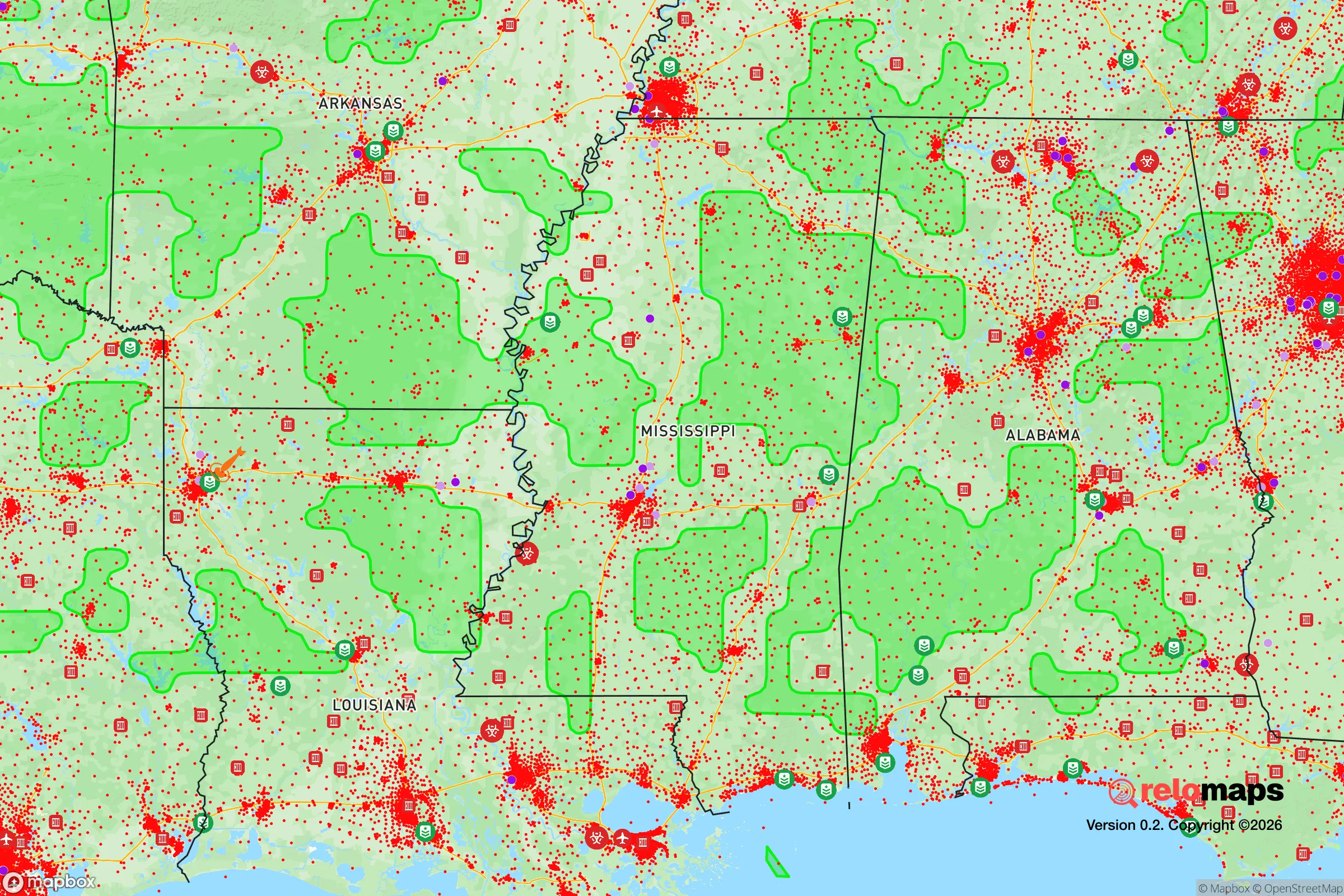
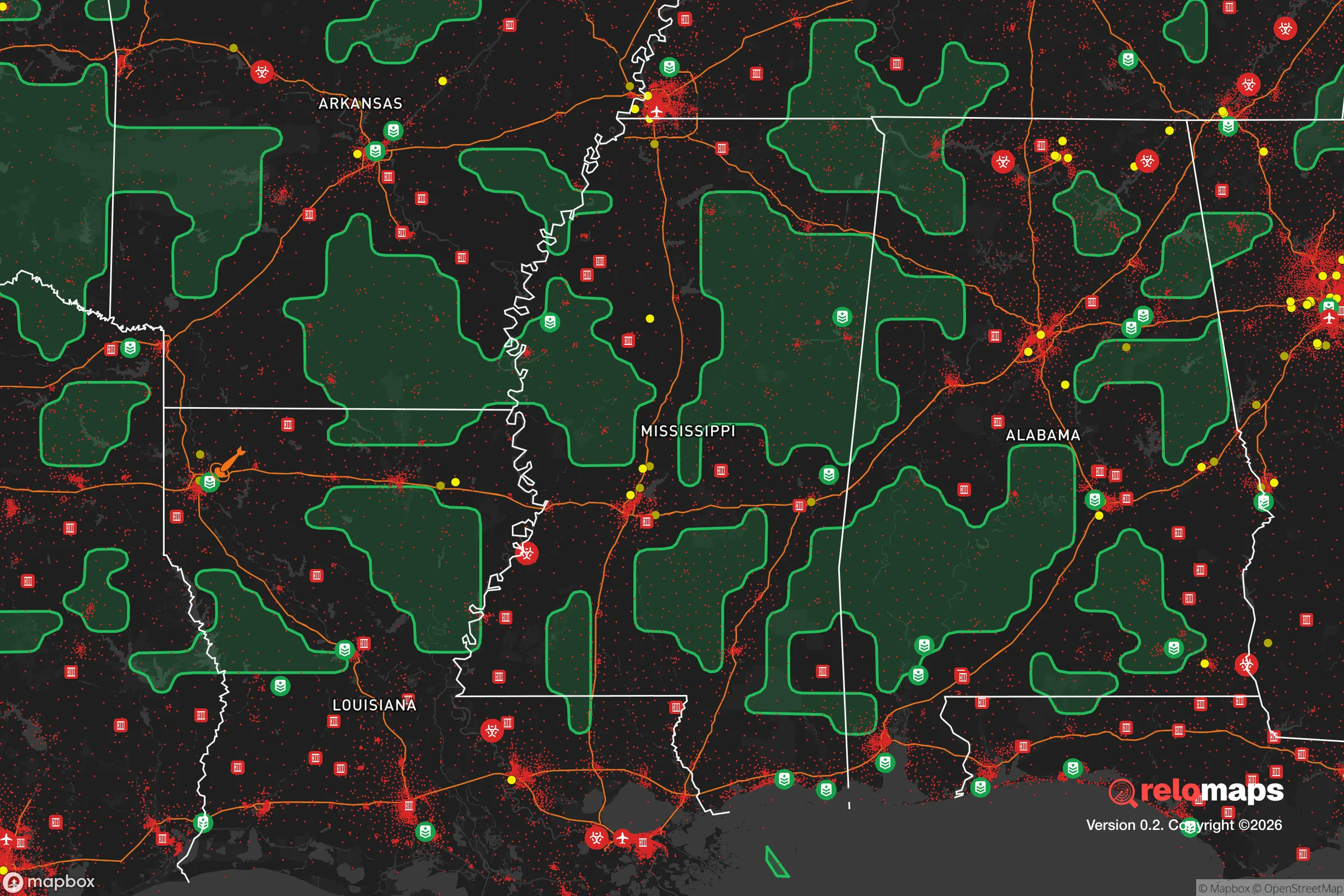


Important Note: For informational purposes only. This does not mean nothing bad ever happens in the green zones. Please use common sense. This is based on public data and modeled with AI. We tried to take a conservative approach but mistakes happen. We update this regularly as new information becomes available.
Solar Generator Recommendations
Backup power matters more here than in safer locations. We've picked three solar generators across budgets and capacity tiers — start with the budget unit if you only need a few essentials, or step up if you want to run a fridge and HVAC for days at a time.

Jackery Portable Power Station Explorer 300
Budget OptionPower on the Go: Weighing only 11 lbs, it's convenient to set up and store with book-sized foldable solar panels

BLUETTI Portable Power Station AC180
Designed for both indoor and outdoor scenarios, AC180 is highly capable as it has a robost capacity and continuous output power.

EF ECOFLOW DELTA Pro Ultra Power Station
Upgraded PickEcoFlow DELTA Pro Ultra is a whole-home energy system designed to grow with your family. Integrated with the Smart Home Panel 2, it scales to meet your evolving energy needs — keeping your home powered, intelligent, and secure through every stage of life.
We earn a commission, at no additional cost to you.
Strategic Assessment Analysis
Madison, Mississippi, offers a strategic relocation option for those prioritizing resilience, offering a blend of suburban stability and rural proximity that is increasingly rare in the modern American landscape. Its position within the Jackson metro area provides access to regional infrastructure, but its physical and cultural distance from the city center—roughly 15 miles north of downtown Jackson—creates a meaningful buffer against the cascading failures that often accompany urban crises. For a conservative-leaning individual or family focused on preparedness, Madison’s combination of strong local governance, a robust tax base, and a geography that avoids major floodplains and industrial hazards makes it a defensible base of operations, not just a comfortable suburb.
Geographic position and natural advantages for long-term stability
Madison sits on the high ground of the Jackson Prairie region, a geological formation that provides well-drained soils and minimal flood risk compared to the Mississippi Delta or the Pearl River floodplain to the east. This elevation is a quiet but critical asset: during the catastrophic 2019 Easter tornado outbreak, which devastated parts of the Jackson metro, Madison County structures largely held, and recovery was swift. The area’s natural topography—rolling hills interspersed with hardwood forests—offers natural concealment and defensible perimeters for those with acreage, especially in the northern and eastern parts of the county. The Ross Barnett Reservoir, a 33,000-acre body of water just east of Madison, provides a reliable freshwater source and a potential food supply via fishing, though its recreational popularity means it would be a contested resource during a prolonged grid-down scenario. The city’s location along the I-55 corridor, while convenient for commerce, is a double-edged sword: it offers rapid evacuation north toward Memphis or south toward the Gulf Coast, but it also funnels traffic and potential threats from Jackson. For a prepper, the key is that Madison is not a choke point—it has multiple secondary roads (like Highway 463 and Gluckstadt Road) that allow bypassing the interstate entirely, a tactical advantage for movement during unrest.
Risks, exposures, and proximity to fallout-relevant landmarks
The most significant risk for Madison residents is its proximity to Jackson, a city that has experienced chronic infrastructure decay, a 2023 water crisis that left thousands without potable water for weeks, and a violent crime rate that consistently ranks among the highest in the nation. Jackson’s Jackson-Hinds Comprehensive Health Center and the University of Mississippi Medical Center are critical regional assets, but they also represent potential mass casualty event magnets—a major incident at either facility could overwhelm local resources and trigger a refugee flow north into Madison. The city is also within 30 miles of the Entergy Gerald Andrus natural gas-fired power plant in Jackson County, a potential target for sabotage or grid failure, though its location south of the city means prevailing winds would carry fallout away from Madison. More concerning is the proximity to the Vicksburg Chemical Plant and the Port of Vicksburg, roughly 40 miles west, which handles hazardous materials; a catastrophic release there could contaminate the Big Black River watershed that feeds into Madison County. On the positive side, Madison is far from any nuclear power plant (the nearest is Grand Gulf in Port Gibson, 60 miles southwest) and has no major military installations or ammunition depots within a 50-mile radius, reducing the risk of targeted strikes or collateral damage from civil unrest. The city’s primary exposure is not a single catastrophic event but the slow bleed of urban decay from Jackson, which could manifest as increased property crime, strained emergency services, and a gradual erosion of the social fabric if the metro area’s decline accelerates.
Practical resilience for a relocator: food, water, energy, and defensibility
For a relocator serious about self-sufficiency, Madison offers a surprisingly workable foundation. The city’s water supply comes from the Sparta Aquifer, a deep groundwater source that is less vulnerable to surface contamination than the Pearl River, which supplies Jackson. However, the municipal system is aging, and a prolonged power outage would still disrupt pumping; a well on private property, common on lots of two acres or more in the county, is a wise investment. The local soil is loamy and fertile, supporting gardens and small-scale agriculture—many residents already keep chickens or maintain vegetable plots, and the Madison County Farmers Market is a hub for local food networks that could be bartered or shared during disruptions. Energy resilience is improving: while Entergy Mississippi dominates the grid, solar adoption is growing, and the area’s average of 215 sunny days per year makes photovoltaic systems viable. For defensibility, Madison’s residential neighborhoods are generally low-density, with cul-de-sacs and tree-lined streets that create natural chokepoints; the city’s police department is well-funded and responsive, but for a prepper, the real value is in the community itself. Madison has a high rate of homeownership, a strong church presence, and a culture of mutual aid among conservative families—neighbors know each other, and during the 2020 civil unrest in Jackson, Madison residents organized informal watch groups without incident. The downside is that the city is not remote; it is a bedroom community, and during a full-scale collapse, the 50,000-plus residents would face the same resource competition as any suburb. The key is to secure property with acreage in the northern part of the county, near the Ross Barnett Reservoir or the Natchez Trace Parkway, where density drops and natural barriers increase.
The overall strategic picture for Madison is one of calculated viability for the conservative prepper. It is not a bug-out location in the wilderness sense—it is a suburban stronghold that offers a high baseline quality of life while retaining the capacity for rapid adaptation. The city’s greatest strength is its insulation from the worst of Jackson’s dysfunction, combined with a local government that has resisted the progressive policy trends that have destabilized other Southern cities. The greatest vulnerability is the same proximity to Jackson that makes it economically attractive: if the capital city experiences a mass casualty event or a complete governmental collapse, Madison would become a pressure valve for displaced populations. For a single individual or family willing to invest in a well, solar panels, and a defensible property, Madison provides a rare balance of comfort and readiness. It is a place where you can raise children in a safe environment while still being able to lock down and ride out a crisis. The calculus is simple: if you want to be near enough to Jackson to benefit from its resources but far enough to avoid its collapse, Madison is one of the best options in the region. Just do not mistake its suburban charm for true isolation—prepare accordingly, and you will be fine.

* Values derived from national, state, county, city and local statistics and may differ in a specific area. Last updated: 2026-05-03T12:47:59.000Z
Narrative content on this page is AI-generated and may contain mistakes. Verify any details that matter before acting on them.
ReloMaps may earn a commission from affiliate links at no extra cost to you.

