

Photo: Wikipedia
Political ClimatePolitical Climate in Madison, MS
District shown is the primary district for this city’s centroid. Cities may span multiple districts.
Local Political AnalysisPolitical Analysis of Madison, MS
Madison, Mississippi, is about as solidly conservative as they come, with a Cook PVI of R+14 that tells you everything you need to know about the local political lean. This isn't a purple suburb that's slowly turning blue; it's a place where Republican candidates routinely win by double digits, and the local culture reflects that. If you're looking at the political trajectory, it's been remarkably stable—Madison has stayed the course while other parts of the country have shifted left, and that's a big reason why families keep moving here from places like California and Illinois.
How it compares
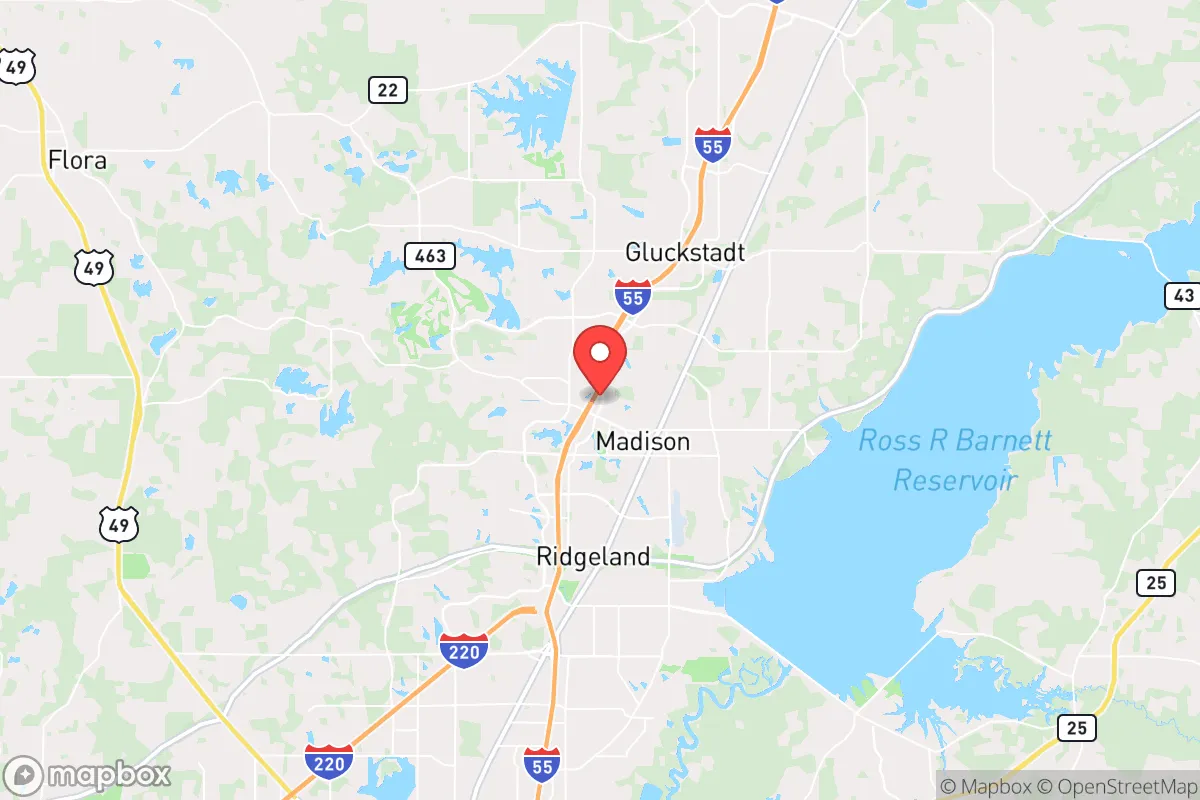
Drive 15 minutes south into Jackson, and you're in a completely different world politically—a deep-blue city where progressive policies dominate and crime rates have skyrocketed. That contrast is stark and intentional for many Madison residents. Surrounding towns like Ridgeland and Flowood lean conservative too, but Madison is the anchor of that corridor. The difference isn't subtle: Madison's county-level voting patterns show consistently 70%+ Republican turnout in recent cycles, while Hinds County (Jackson) flips that number. This isn't just about party preference—it's about a fundamental disagreement on how much government should be involved in your daily life.
What this means for residents
For the people who live here, the conservative climate translates into real, tangible differences. Property taxes are among the lowest in the metro area, and there's no city income tax eating into your paycheck. The school system—Madison County Schools—is consistently ranked among the best in the state, and the local government generally stays out of the way when it comes to business regulations and personal choices. You won't see the kind of overreach you hear about in blue states: no mask mandates that drag on for years, no heavy-handed business closures, and no push to defund the police. The Madison Police Department is well-funded and respected, and the crime rate reflects that—violent crime is about 80% lower here than the national average.
That said, there are some warning signs worth watching. The city has grown fast—population jumped from about 25,000 in 2010 to over 30,000 by 2025—and with that growth comes pressure from developers and outside interests. There's been chatter about adding more "amenities" that sound nice but often come with higher taxes and more government control. Some newer residents from blue states have tried to bring their politics with them, pushing for things like diversity equity and inclusion programs in the schools or stricter environmental regulations on new construction. So far, those efforts have been mostly beaten back, but it's something to keep an eye on.
Culturally, Madison is still a place where the Second Amendment is respected, church attendance is high, and neighbors know each other's names. The annual Madison Christmas Parade and the local farmers market are community staples, not political battlegrounds. If you're looking for a place where you can raise a family without worrying about government overreach or progressive experiments, Madison is about as close as it gets in Mississippi. Just don't expect it to stay that way automatically—it takes active involvement from residents who value freedom to keep the local politics on the right track.

State Political ClimatePolitical Climate in Mississippi
State Political AnalysisPolitical Environment in the State
Mississippi is one of the most reliably conservative states in the nation, with a Republican lean that has only deepened over the past two decades. The state has not voted for a Democratic presidential candidate since 1976, and in 2024, Donald Trump carried it by roughly 17 points. The dominant coalition is a mix of rural white evangelicals, suburban families, and a growing number of conservative-leaning retirees and remote workers moving in from higher-tax states. Over the last 10-20 years, the trajectory has been a steady march rightward, with Democrats now largely confined to the Delta region and a handful of majority-Black urban precincts in Jackson and the Gulf Coast.
Urban vs. rural divide
The political map of Mississippi is starkly divided. The state's largest metro, the Jackson area (Hinds, Madison, and Rankin counties), is a microcosm of the national urban-rural split. Hinds County, which includes most of Jackson proper, is heavily Democratic and reliably votes 70-80% for Democratic candidates. But just a 15-minute drive north, Madison County is one of the most Republican suburban counties in the state, routinely voting 65-70% GOP. The Gulf Coast metros of Biloxi and Gulfport lean Republican but are more competitive, with a mix of military families, casino workers, and retirees. The DeSoto County suburbs of Memphis (like Southaven and Olive Branch) are deep red, driven by families fleeing Tennessee's higher taxes and crime. Meanwhile, the Delta region—places like Greenville, Clarksdale, and Cleveland—remains a Democratic stronghold due to its majority-Black population and persistent poverty. The rural Pine Belt and northeastern hill country (Tupelo, Starkville, Oxford) are solidly Republican, though the college towns of Oxford and Starkville show a slight purple tint from university faculty and students.
Policy environment
Mississippi's policy environment is aggressively pro-business and limited-government. The state has no personal income tax on wages (phased out by 2026), a flat 4% corporate income tax, and one of the lowest property tax burdens in the country. There is no state-level sales tax on groceries. Education policy is a mixed bag: the state has a robust school choice program through the Mississippi Educational Scholarship Account (ESA) for special-needs students, and a new universal school choice bill (HB 1430) passed in 2025, allowing any family to use state funds for private or homeschool expenses. However, public school performance remains near the bottom nationally, and teacher pay is below the regional average. Healthcare is a flashpoint: Mississippi has not expanded Medicaid under the Affordable Care Act, leaving roughly 200,000 working poor in a coverage gap. The state has some of the strictest abortion laws in the country, with a near-total ban in effect since the Dobbs decision. Election laws are straightforward: voter ID is required, early voting is limited to in-person absentee with an excuse, and there is no no-excuse mail voting. The state has not adopted ranked-choice voting or automatic voter registration.
Trajectory & freedom
Mississippi is trending more free in several key areas, particularly fiscal and educational freedom. The elimination of the income tax (phased out by 2026) is a landmark shift, making the state one of only nine with no wage tax. The 2025 universal school choice law (HB 1430) is a major expansion of parental rights, allowing families to redirect state education dollars to private schools, homeschool co-ops, or microschools. On gun rights, Mississippi is a constitutional carry state (permitless carry for adults 18+ since 2016) and has a strong Stand Your Ground law. The state also passed a medical freedom bill in 2023 (SB 2098) that prohibits employers from mandating COVID-19 vaccines as a condition of employment. On the other hand, property rights remain a concern: the state still allows civil asset forfeiture without a criminal conviction, though a 2024 reform bill (HB 1249) raised the evidentiary standard slightly. Medical marijuana was legalized in 2022 via Initiative 65, but the legislature quickly replaced it with a more restrictive program (SB 2095) that limits dispensaries and qualifying conditions. Overall, the trajectory is toward more personal liberty, but with a cautious, incremental pace.
Civil unrest & political movements
Mississippi has seen relatively little civil unrest compared to other Southern states. The most visible flashpoints in recent years have been around Confederate monument debates in Jackson and Oxford. In 2020, the state legislature voted to remove the Confederate battle emblem from the state flag, a move that was broadly supported by business leaders but deeply unpopular in rural areas. There have been no major sanctuary city movements; in fact, the state passed a law (SB 2710) in 2024 requiring local law enforcement to cooperate with federal immigration authorities. Election integrity controversies have been minimal, though the state did pass a 2021 law (HB 1510) that tightened absentee ballot procedures and banned ballot harvesting. Organized activist movements are small: the left is concentrated in Jackson and the Delta, with groups like the Mississippi Poor People's Campaign and the NAACP chapters pushing for Medicaid expansion and criminal justice reform. On the right, the Mississippi Freedom Caucus (a state-level version of the House Freedom Caucus) has been a vocal force in the legislature, pushing for further tax cuts, school choice, and anti-abortion measures. A new resident would notice that political activism is generally low-key and localized—there are no large-scale protests or counter-protests like you'd see in Portland or Atlanta.
Projection
Over the next 5-10 years, Mississippi is likely to become even more conservative, driven by two demographic trends: the continued exodus of Black residents from the Delta to other states (especially Georgia and Texas), and the steady in-migration of conservative-leaning retirees and remote workers from California, Illinois, and New York. The state's population is projected to grow modestly, with the Gulf Coast and DeSoto County absorbing most of the new arrivals. The political implications are clear: the Democratic base in the Delta will continue to shrink, while the Republican suburbs of Madison, DeSoto, and Lamar counties will expand. The state legislature will likely push for further tax cuts (possibly eliminating the corporate income tax entirely) and additional school choice expansions. The biggest wildcard is healthcare: if the state continues to refuse Medicaid expansion, rural hospitals will keep closing, and the coverage gap will grow. That could eventually create pressure for a change, but it's unlikely to shift the partisan balance. A new resident moving in now should expect a state that is deeply conservative, fiscally restrained, and culturally traditional, with a growing emphasis on educational freedom and limited government.
Bottom line for a new resident: Mississippi offers a low-tax, high-freedom environment for those who value limited government and traditional values. The trade-offs are a weak public school system, limited healthcare access in rural areas, and a political culture that moves slowly on reform. If you're looking for a place where your tax dollars stay local, your kids can be educated outside the public system, and your Second Amendment rights are secure, Mississippi is a strong bet. Just don't expect the amenities or diversity of a fast-growing Sun Belt metro—this is a state that values stability over speed.
* Values derived from national, state, county, city and local statistics and may differ in a specific area. Last updated: 2026-05-03T12:47:59.000Z
Narrative content on this page is AI-generated and may contain mistakes. Verify any details that matter before acting on them.
ReloMaps may earn a commission from affiliate links at no extra cost to you.

