 Popular
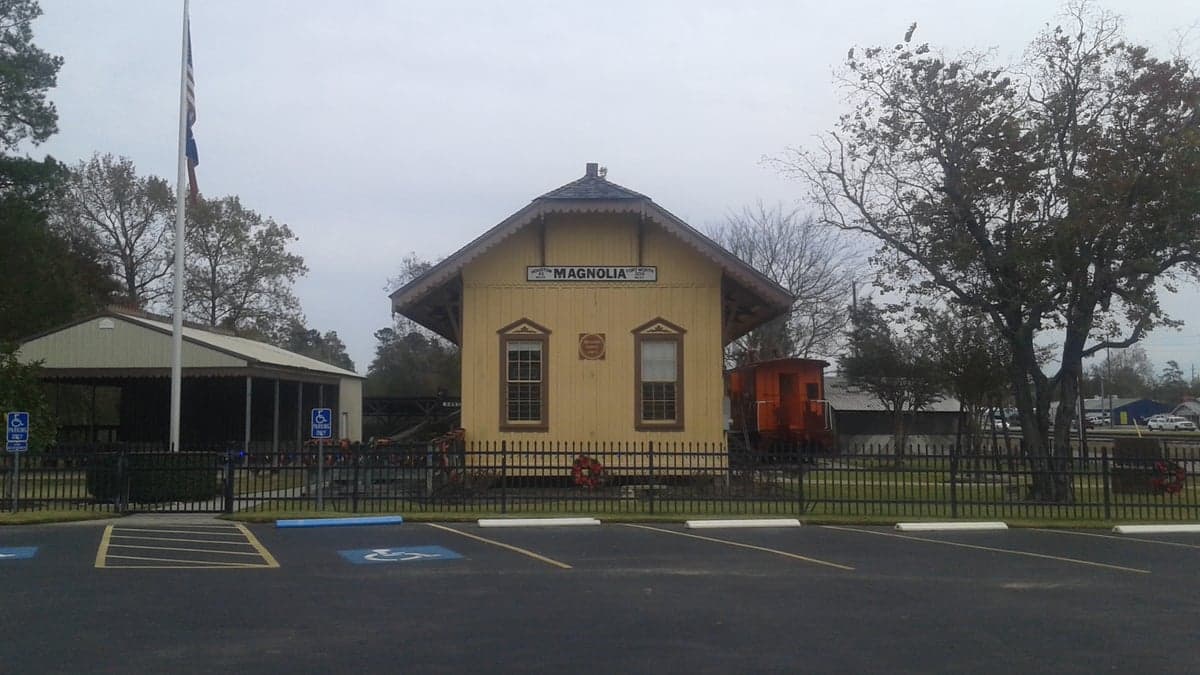
Photo: Wikipedia
Demographics of Magnolia, TX
Affluence Level in Magnolia, TX
An upper-middle-class area. Household wealth, education levels, and homeownership run ahead of national benchmarks.
People of Magnolia, TX
The people of Magnolia, Texas today form a small, predominantly white community of 3,230 residents, with a notable Hispanic minority of 21.1% and a Black population of 8.8%. The city retains a distinctly rural-suburban character, with a low foreign-born share of just 2.9% and a college-educated rate of 27.4%, reflecting its roots as a working-class railroad and timber town. Despite its small size, Magnolia functions as a commercial and civic hub for a much larger unincorporated area, giving it an outsized role in Montgomery County’s rapidly growing northern corridor.
How the city was settled and grew
Magnolia was founded in the 1840s as a stop on the Houston & Great Northern Railroad, drawing its first wave of settlers from the American South, primarily Anglo-American farmers and timber workers. The town’s name came from the abundant magnolia trees in the area, and the railroad allowed cotton and lumber to be shipped to Houston, 45 miles south. The original settlement clustered around what is now Old Town Magnolia, the historic core along FM 1488 and Magnolia Boulevard, where the first general stores, churches, and a school were built. A second wave arrived after the Civil War, when freedmen established small farming communities on the outskirts, including the Shady Grove area to the east, which became a predominantly Black settlement. By 1900, Magnolia’s population hovered around 500, with the economy tied to timber and cotton, and the town remained overwhelmingly white and native-born through the early 20th century.
Modern era (post-1965)
The post-1965 period brought little direct immigration to Magnolia itself, as the city’s foreign-born share remains low at 2.9%. Instead, the major demographic shift came from domestic in-migration, as Houston’s suburban sprawl pushed northward along the I-45 corridor. From the 1980s onward, white families seeking larger lots and lower taxes moved into new subdivisions like Lakewood Forest and Highland Ranch, which sit just outside the city limits but use Magnolia’s address and school district. These subdivisions drew primarily from Houston’s Anglo middle class, reinforcing the area’s white majority. Meanwhile, the Hispanic population grew from near-zero in 1970 to 21.1% by 2020, driven by construction and service-sector workers settling in mobile home parks and older neighborhoods like Magnolia West and the Nichols Sawmill area. The Black population, at 8.8%, is concentrated in the historic Shady Grove area and newer subdivisions like Shadowbend, reflecting both continuity and new migration from the Houston metro. East/Southeast Asian residents (0.6%) and Indian-subcontinent residents (0.0%) remain negligible, consistent with the city’s lack of high-skilled employment hubs.
The future
Magnolia’s population is projected to grow modestly, likely reaching 4,000–4,500 by 2040, as Montgomery County’s northern corridor continues to develop. The city’s demographic trajectory points toward modestly increasing diversity, driven by Hispanic and Black in-migration from Houston and the surrounding region, while the white share is expected to decline gradually from its current 64.4%. New master-planned communities like Woodtrace and Walden are attracting a mix of white and Hispanic families, dispersing growth across the area rather than concentrating it in any single neighborhood. The foreign-born share may rise slightly as Hispanic families bring relatives from Mexico and Central America, but Magnolia is unlikely to become a major immigrant destination. The city’s cultural identity is evolving from a historically Anglo, rural enclave into a more diverse exurban bedroom community, though it remains politically conservative and family-oriented. For someone moving in now, Magnolia offers a low-density, relatively affordable alternative to Houston’s inner suburbs, with a population that is becoming more varied but still predominantly white and native-born.
In short, Magnolia is becoming a more diverse exurban hub, but its growth is driven by domestic migration rather than international immigration, and its character remains rooted in its Southern, small-town origins. New residents will find a community that is slowly changing but still anchored by its historic Anglo majority and conservative values.

* Values derived from national, state, county, city and local statistics and may differ in a specific area. Last updated: 2026-07-30T02:01:00.000Z
Narrative content on this page is AI-generated and may contain mistakes. Verify any details that matter before acting on them.
ReloMaps may earn a commission from affiliate links at no extra cost to you.

