 Popular
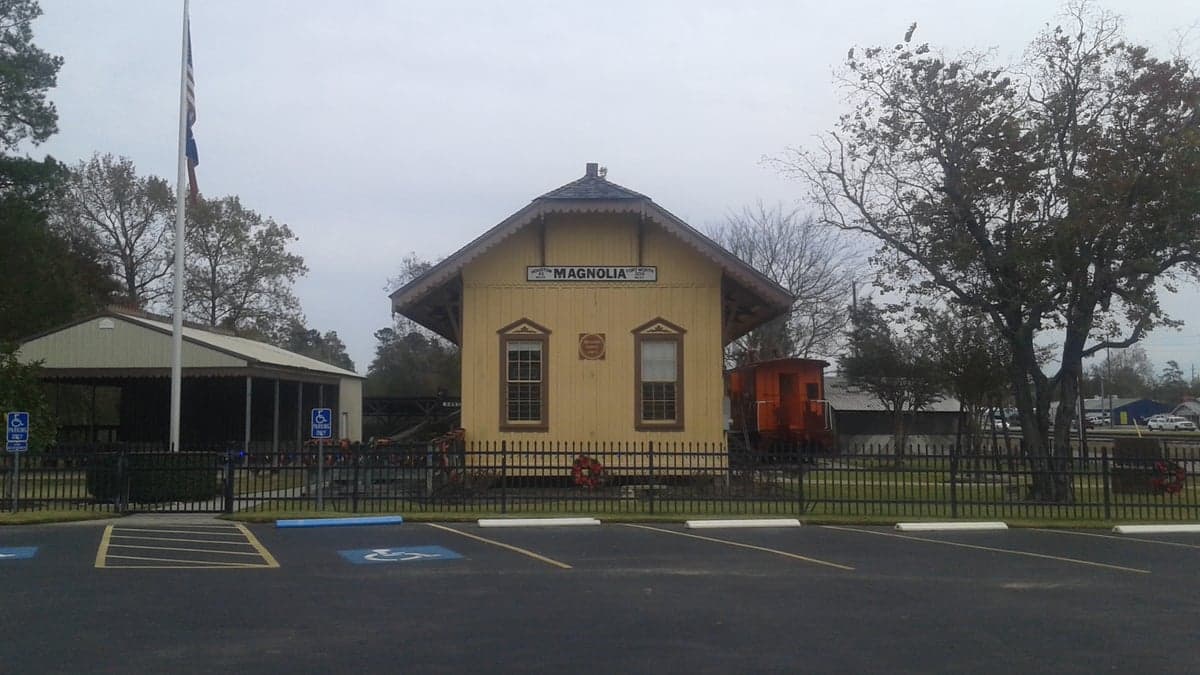
Photo: Wikipedia
Personal Sovereignty in Magnolia, TX
Strong independent fundamentals that actively favor personal liberty and low regulation.
What does Personal Sovereignty tell us?
Personal Sovereignty measures your capacity for self-reliance and independence with minimal government friction. Higher scores mean fewer barriers between you and the way you want to live... but it assumes you have the space you need and good neighbors.
What does this tell us?
Personal Sovereignty measures your capacity for self-reliance and independence with minimal government friction. Higher scores mean fewer barriers between you and the way you want to live... but it assumes you have the space you need and good neighbors.
State Policy
Energy independence: Net exporter (220% of energy produced in-state)
Personal Liberty
Homesteading

Personal Liberty Analysis
Magnolia, Texas, offers a personal sovereignty environment that is among the strongest in the greater Houston region, anchored by Texas’s broad preemption of local regulations and a deeply ingrained culture of self-reliance. The town’s unincorporated status within Montgomery County means residents answer to county-level governance rather than a municipal code, resulting in fewer zoning restrictions, no city property taxes, and a general posture of "unless it's explicitly prohibited, it's allowed." For a relocation audience prioritizing autonomy, this translates into a legal and practical framework where individual choice—on property use, self-defense, and lifestyle—is the default, not the exception.
Tax burden and regulatory posture: How Texas’s no-income-tax model and local rules shape freedom
Texas’s absence of a state income tax is the headline benefit, but the regulatory posture in Magnolia is equally significant. Montgomery County imposes no city-level property tax on unincorporated Magnolia, though residents pay county taxes (roughly 0.42% of assessed value) and a school district tax (typically 1.0–1.2% for Magnolia ISD). The combined effective property tax rate lands around 1.6–1.8%, which is moderate for Texas but still a real cost—on a $350,000 home, that’s roughly $5,600–$6,300 annually. Sales tax is 8.25% (state 6.25% + county 2%), with no local option to raise it further. The key regulatory advantage is the lack of municipal zoning in unincorporated areas: you can keep livestock, park an RV, or run a home-based business without needing a city variance. Montgomery County does enforce subdivision-level deed restrictions (HOA covenants) in many newer developments, so buyers should verify whether a property is deed-restricted before purchasing. The county’s building code is limited to basic structural and septic standards, with no energy-efficiency mandates or aesthetic review boards. This light-touch approach means fewer bureaucratic hurdles for renovations, accessory structures, or land use changes compared to incorporated cities like The Woodlands or Conroe.
Self-defense and gun law specifics: Castle Doctrine, permitless carry, and local enforcement culture
Texas law provides some of the strongest self-defense protections in the U.S., and Magnolia’s enforcement culture aligns with that. Permitless carry (constitutional carry) has been state law since 2021, allowing any law-abiding adult 21 or older to carry a handgun openly or concealed without a license. The Castle Doctrine applies to homes, vehicles, and workplaces, with no duty to retreat—a person may use deadly force if they reasonably believe it’s necessary to prevent imminent death, great bodily harm, or certain violent felonies. Montgomery County’s district attorney and sheriff’s office have publicly stated they will not prosecute lawful self-defense shootings, and the county’s grand jury historically declines to indict in clear-cut Castle Doctrine cases. There are no local ordinances restricting magazine capacity, firearm types, or storage requirements—state law preempts all such local regulation. For those who want a license anyway (for reciprocity when traveling), the Texas License to Carry (LTC) requires a 4–6 hour class and a background check, but is not mandatory. Gun ranges and firearms retailers are plentiful in the area, including the 1836 Gun Range and Shoot Point Blank in nearby Tomball. The practical effect: a resident can legally defend their home or person with a firearm, carry it daily without a permit, and face minimal local government interference in that choice.
Self-reliance and homesteading viability: Lot sizes, zoning, and off-grid feasibility
Magnolia’s unincorporated status makes it one of the most homesteading-friendly areas within commuting distance of Houston. Minimum lot sizes in the county’s rural areas are typically 1 acre for a single-family home on septic, though many subdivisions require 2–5 acres. Properties of 5–20 acres are common and affordable, with raw land prices ranging from $15,000–$30,000 per acre as of 2025. There is no county-wide ban on keeping chickens, goats, or horses, though HOA-restricted subdivisions may prohibit livestock. Off-grid feasibility is high: rainwater collection is legal and encouraged (Texas law allows up to 100,000 gallons of storage without a permit), and solar panels are permitted without special county approval. Composting toilets and graywater systems are allowed under state health code as long as they meet basic septic standards, making it possible to live without municipal water or sewer. The county does not require a building permit for structures under 200 square feet (like sheds or tiny houses), but any dwelling intended for habitation must pass a septic inspection and meet the International Residential Code (IRC) for structural safety. Internet access is available via fixed wireless (e.g., Rise Broadband) or Starlink, but fiber is limited to subdivisions near FM 1488. For a family wanting to grow food, raise animals, and reduce reliance on utilities, Magnolia offers a regulatory environment that largely stays out of the way.
Personal liberties: Parental rights, medical autonomy, speech, and property rights
Texas law strongly protects parental rights in education and healthcare. Parents have the legal right to direct their child’s education, including homeschooling without state oversight—no curriculum approval, no testing requirements, and no teacher certification needed. Magnolia ISD, the primary public school district, has a conservative school board that has resisted state-level mandates on critical race theory and gender identity instruction, and parents can opt their children out of any sex education or health survey. Medical autonomy is robust: Texas does not require COVID-19 vaccines for school attendance, and there is no state-level vaccine mandate for adults. Informed consent laws require parental notification for any medical procedure on a minor, and the state has banned gender-affirming care for minors. For adults, alternative medicine (naturopathy, herbalism) is legal but unlicensed; you can refuse any medical treatment. Free speech is protected under the Texas Religious Freedom Restoration Act, which applies to both government and private entities in certain contexts. Property rights are strong: there is no county-wide rent control, no short-term rental ban (though HOAs may restrict them), and no tree preservation ordinances. Eminent domain is limited to public utilities and roads, with compensation required. The overall legal climate is one where individual choice—on education, healthcare, and property use—is presumed unless a specific law says otherwise.
Compared to other Texas exurbs like Georgetown or New Braunfels, Magnolia offers a notably lighter regulatory touch due to its unincorporated status and Montgomery County’s pro-property-rights stance. The absence of city zoning, combined with Texas’s preemption of local gun laws and parental rights statutes, creates an environment where personal sovereignty is less a matter of fighting for exceptions and more a baseline expectation. For a single individual or family who values self-reliance, low taxes, and minimal government interference in daily life, Magnolia ranks among the top options in the Houston metro area—provided the buyer is comfortable with the trade-offs of rural living, such as longer emergency response times and limited public transit. The area’s autonomy is not absolute, but it is structurally embedded in the legal framework, making it a practical choice for those who prioritize freedom over convenience.

* Values derived from national, state, county, city and local statistics and may differ in a specific area. Last updated: 2026-07-30T02:01:00.000Z
Narrative content on this page is AI-generated and may contain mistakes. Verify any details that matter before acting on them.
ReloMaps may earn a commission from affiliate links at no extra cost to you.

