
Photo: Wikipedia
Demographics of Marfa, TX
Affluence Level in Marfa, TX
A middle-class area roughly in line with national averages across income, home values, education, and employment.
People of Marfa, TX
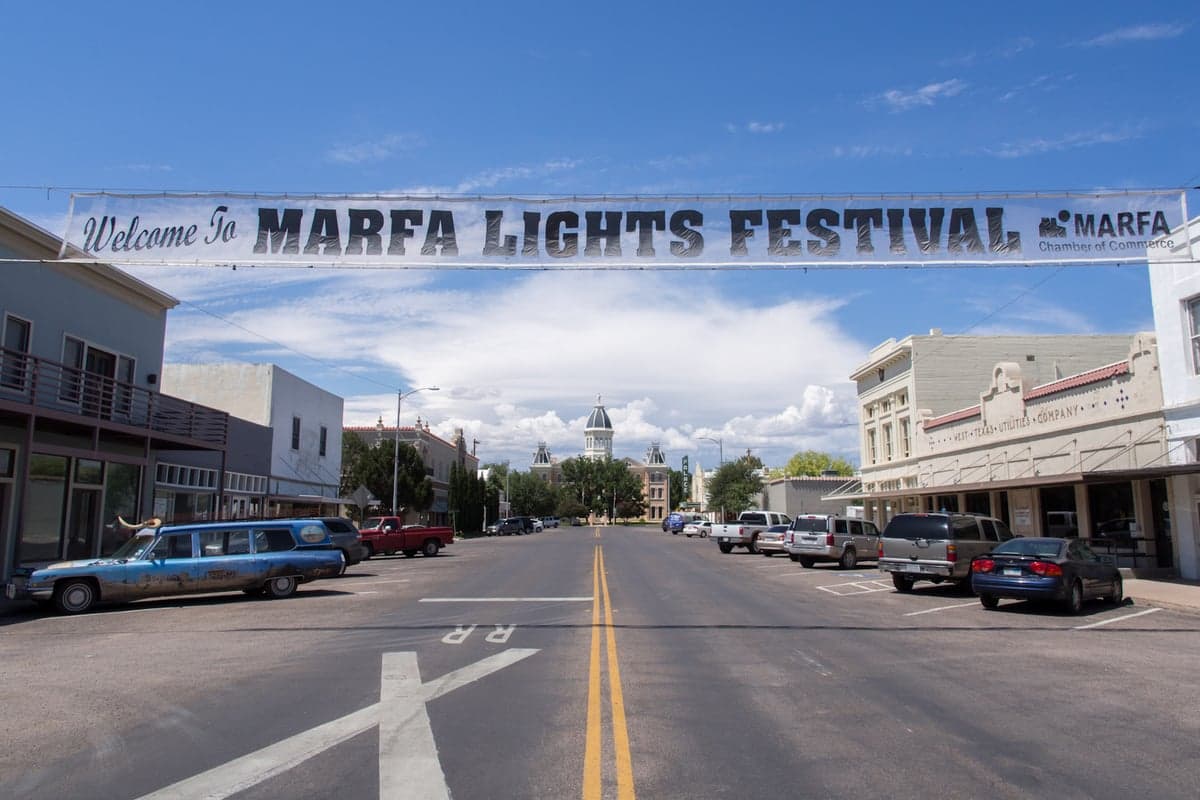
Marfa, Texas, is a small, culturally distinct city of 2,179 residents where a narrow Hispanic majority (50.8%) coexists with a large white population (44.6%), creating a demographic balance rare in rural Texas. The city’s identity is shaped by a dual character: a historic, working-class Hispanic community rooted in ranching and rail, and a newer, predominantly white influx of artists, retirees, and remote workers drawn by the town’s minimalist art scene and desert solitude. With a foreign-born share of 11.4% and a college-educated rate of 29.8%, Marfa’s population is more educated and slightly more international than typical for a town its size in Presidio County. The city is not growing rapidly but is undergoing a quiet transformation, with distinct neighborhoods reflecting the layers of its human history.
How the city was settled and grew
Marfa was founded in 1883 as a water stop and railroad division point for the Galveston, Harrisburg & San Antonio Railway, which drew the first permanent residents: Anglo railroad workers and Mexican laborers who built the tracks and supporting infrastructure. The original Hispanic population settled in what is now known as Barrio El Pueblo, the historic Mexican-American neighborhood south of the railroad tracks, where adobe homes and a strong Catholic parish (St. Mary’s) anchored the community. Anglo ranchers and merchants clustered in the Northside, near the courthouse square and along Highland Avenue, establishing the town’s commercial and civic core. By the 1910s, Marfa became the county seat, and the U.S. Army’s Camp Marfa (later Marfa Army Airfield) brought a temporary influx of soldiers during World War II, though most left after the base closed in 1945. The population peaked at around 3,000 in the 1950s, then declined as rail employment shrank and younger generations moved to larger cities.
Modern era (post-1965)
The Immigration and Nationality Act of 1965 had a muted direct effect on Marfa, as the city’s Hispanic population was already long-established, but it did facilitate a modest wave of family reunification from northern Mexico, reinforcing the existing community in Barrio El Pueblo and the adjacent Southside area near U.S. 90. The more transformative shift began in the 1970s, when minimalist artist Donald Judd moved to Marfa and established the Chinati Foundation, drawing a steady stream of artists, writers, and cultural tourists. These newcomers—overwhelmingly white, college-educated, and often from coastal cities—settled in the Eastside around the Chinati campus and in renovated historic homes near the Courthouse Square, creating a distinct enclave of galleries, boutique hotels, and second homes. The 2000s and 2010s saw an acceleration of this trend, with remote workers and retirees buying property, driving up home prices, and shifting the demographic balance. The Hispanic share of the population, which was likely above 60% in 1990, has declined to 50.8% as of the latest data, while the white share has risen to 44.6%. The Black, Asian, and Indian populations remain at 0.0%, reflecting Marfa’s persistent lack of diversity beyond its Hispanic-white axis.
The future
Marfa’s population is heading toward a more bifurcated future, with the Hispanic community increasingly concentrated in Barrio El Pueblo and the Southside, while the white, artist-driven population dominates the Eastside and Courthouse Square area. The foreign-born share of 11.4% is likely to remain stable or decline slightly, as immigration from Mexico slows and the children of earlier immigrants assimilate into the broader Hispanic population. The college-educated share of 29.8% is expected to grow, driven by continued in-migration of remote workers and retirees, but this will also exacerbate housing affordability pressures that could push out longer-term Hispanic residents. The city is not homogenizing; rather, it is tribalizing into two distinct enclaves with limited social overlap—a pattern seen in other small Western towns with a strong arts tourism economy. The next 10-20 years will likely see a slow population increase to around 2,500, with the white share edging toward 50% and the Hispanic share settling near 45%, while other racial groups remain negligible.
For someone moving to Marfa now, the city offers a choice between two worlds: the historic, family-oriented Hispanic community in the south, or the arts-and-remote-work enclave in the east. The town’s small size and limited housing stock mean that newcomers will quickly become visible, and the cultural divide between these neighborhoods is real but not hostile. Marfa is becoming a place where the old ranching and railroad heritage coexists with a new creative economy, but the two populations largely live parallel lives—a dynamic that newcomers should understand before deciding where to put down roots.

* Values derived from national, state, county, city and local statistics and may differ in a specific area. Last updated: 2026-05-16T21:52:13.000Z
Narrative content on this page is AI-generated and may contain mistakes. Verify any details that matter before acting on them.
ReloMaps may earn a commission from affiliate links at no extra cost to you.

