Political ClimatePolitical Climate in Mccomb, MS
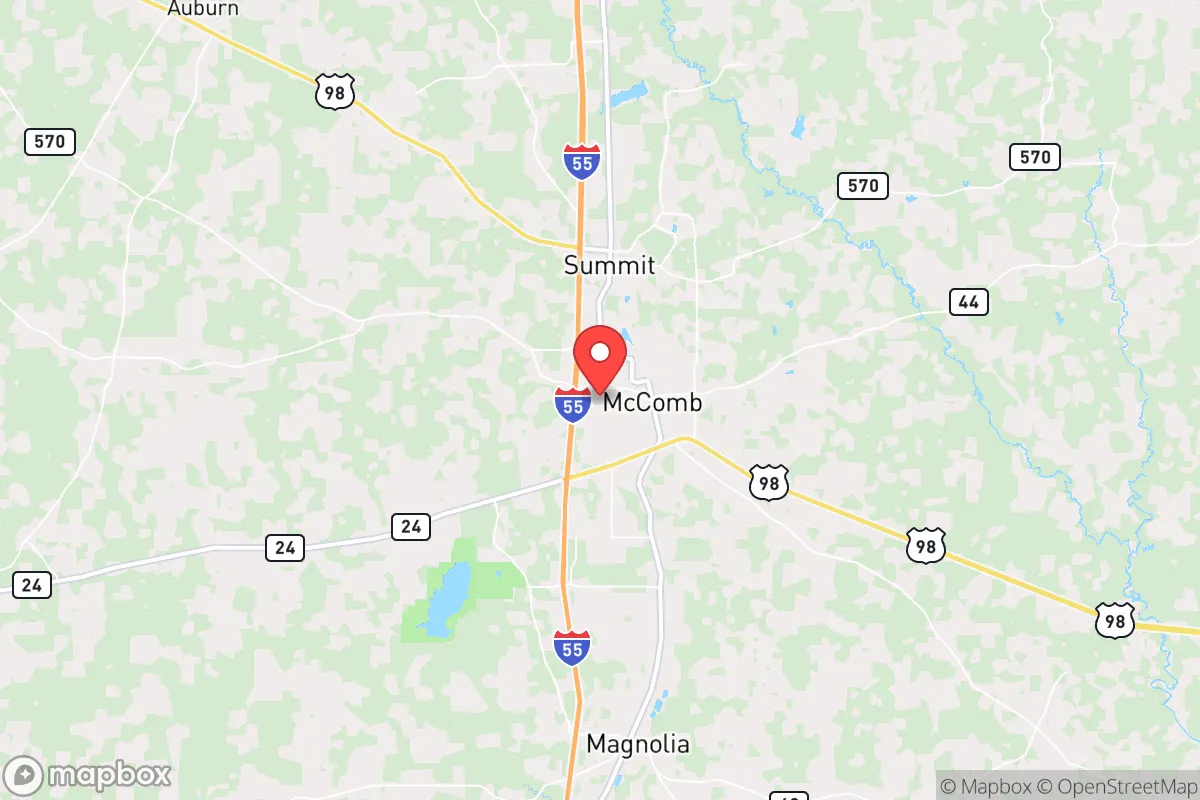
District shown is the primary district for this city’s centroid. Cities may span multiple districts.
Local Political AnalysisPolitical Analysis of Mccomb, MS
McComb, Mississippi, sits solidly in the red, with a Cook PVI of R+14 that reflects a deep-rooted conservative tradition in this part of Pike County. For as long as most folks around here can remember, the political lean has been reliably Republican, and while the national winds have shifted a bit, McComb has held its ground. You don't see the kind of wild swings you get in some places; the local elections and the way people vote for president and governor tell you this is a community that values stability, personal responsibility, and keeping government out of your business. The trajectory is steady, but there's a quiet concern among long-time residents that outside influences and a growing push from more progressive areas could start to chip away at that foundation if we're not careful.
How it compares
Drive an hour north to Jackson, and you'll feel like you're in a different world politically. Jackson's liberal lean is a stark contrast to McComb's conservative backbone. Even closer, places like Brookhaven or even the smaller towns in Amite County tend to be more reliably conservative, but McComb has its own character—it's a bit more of a working-class town with a strong sense of community, not a bedroom community for the capital. The real contrast is with the coastal areas like Biloxi or Gulfport, where tourism and a more transient population have nudged things a little more toward the center. Here in McComb, the political climate is less about flashy issues and more about the day-to-day: keeping taxes low, protecting the Second Amendment, and making sure local schools and roads are managed without a lot of bureaucratic nonsense. We don't have the same kind of political theater you see in bigger cities, and that's how most of us like it.
What this means for residents
For the people living here, the political climate means a government that generally stays out of your personal life. You're not going to see the kind of overreach you hear about in places like California or New York—no heavy-handed mandates on how you run your small business, no constant pressure to conform to the latest progressive social experiments. Property taxes are manageable, and there's a strong sense that your vote actually counts for something. The downside, if you can call it that, is that the community can be resistant to change, even when change might be necessary. But for most folks, that's a feature, not a bug. The real concern now is watching how the state and federal levels handle things like education and healthcare. There's a growing worry that if the progressive wing gains more traction in state government, we could see policies that undermine local control—things like curriculum mandates or restrictions on how we handle our own public safety. That's the kind of government overreach that gets people here riled up.
Culturally, McComb still holds onto a lot of the old Southern values: church on Sunday, helping your neighbor, and a healthy skepticism of anyone who thinks they know better than you how to live your life. There's a strong sense of personal freedom here, and that extends to everything from how you raise your kids to how you choose to protect your home. The biggest policy distinction is the local approach to law enforcement and community safety—there's a real emphasis on supporting the police and keeping a visible presence, not defunding or reimagining anything. If you're looking for a place where the government respects your rights and doesn't try to micromanage your day-to-day, McComb is still that kind of town. But keep an eye on the state legislature; if the tide turns too far left, the character of this place could start to change faster than most of us would like.

State Political ClimatePolitical Climate in Mississippi
State Political AnalysisPolitical Environment in the State
Mississippi is one of the most reliably conservative states in the nation, with a Republican trifecta that has held the governorship, both legislative chambers, and all statewide offices for over a decade. The state voted +17 points for Donald Trump in 2024, a margin that has widened from +12 in 2016, reflecting a steady rightward drift even as the national map shifts. The dominant coalition is a blend of rural white evangelicals, suburban families in the Jackson metro exurbs, and Gulf Coast retirees, with the Democratic stronghold shrinking to a handful of majority-Black counties along the Delta and in urban Jackson. Over the past 20 years, Mississippi has gone from a competitive state that occasionally elected Democrats like Governor Ronnie Musgrove (2000-2004) to a deep red lock where Republicans now hold supermajorities in both the House and Senate.
Urban vs. rural divide
The political map of Mississippi is a stark study in geographic polarization. The state’s largest metro, the Jackson area, is a Democratic island: Hinds County (Jackson proper) voted 80% for Joe Biden in 2020, while the surrounding suburban counties of Madison and Rankin voted 60-65% Republican. Madison, in particular, has become a conservative stronghold of affluent families and commuters, with its school system and low taxes drawing Republicans from across the state. The Gulf Coast, anchored by Biloxi and Gulfport, leans Republican but with a libertarian streak—voters there are pro-gun, pro-business, and skeptical of federal hurricane aid strings. The Delta region, including Greenville and Clarksdale, is heavily Democratic and majority-Black, but its population is declining, reducing its electoral weight. The northeastern hill country around Tupelo and Oxford is a mixed bag: Tupelo is reliably red, while Oxford (home to Ole Miss) has a liberal college-town enclave that votes Democratic in local races. The Pine Belt around Hattiesburg is solidly Republican, driven by military families from Camp Shelby and the University of Southern Mississippi’s conservative student body.
Policy environment
Mississippi’s policy environment is among the most conservative in the country, with a low-tax, low-regulation posture that appeals to freedom-minded residents. The state has a flat income tax of 4.0% (phasing down to 3.99% by 2026) and no estate or inheritance tax. Sales tax is 7% on most goods, but groceries are exempt. Property taxes are among the lowest in the nation, with a median effective rate of 0.65%. The regulatory climate is business-friendly: Mississippi is a right-to-work state, has no state-level minimum wage above the federal $7.25, and has a tort reform cap on non-economic damages. Education policy is a battleground: the state has a school choice program (the Mississippi Educational Choice Scholarship) for students with disabilities, but a broader voucher push failed in 2024. Homeschooling is lightly regulated—no notification, no testing requirements—making it a haven for families seeking educational freedom. Healthcare is a sore spot: Mississippi did not expand Medicaid under the ACA, leaving a coverage gap for about 100,000 low-income adults. Abortion is effectively banned after the 2022 trigger law took effect, with no exceptions for rape or incest. Election laws are strict: voter ID is required, early voting is limited to in-person absentee with an excuse, and no-excuse mail voting is not permitted.
Trajectory & freedom
Mississippi has been on a trajectory of expanding personal freedom in several key areas, though with notable exceptions. On gun rights, the state passed constitutional carry in 2016, allowing permitless concealed carry for anyone 18 or older who can legally possess a firearm. In 2023, the legislature passed a law prohibiting local governments from enforcing federal gun regulations that conflict with state law—a direct nullification move. On parental rights, the 2023 "Parents’ Bill of Rights" (HB 1310) requires schools to notify parents of any medical or mental health services offered to their child and prohibits instruction on sexual orientation or gender identity in K-3. Medical freedom took a hit in 2021 when the state banned transgender medical procedures for minors, but this is seen by conservatives as protecting children from irreversible harm. Property rights are strong: Mississippi is a "Dillon’s Rule" state, meaning local governments have only powers explicitly granted by the state, which limits zoning overreach. However, the state’s heavy reliance on federal funding (about 40% of the budget) creates a vulnerability to federal strings, particularly in infrastructure and healthcare. The biggest freedom concern is the state’s high incarceration rate (second in the nation), driven by mandatory minimums and a tough-on-crime posture that some conservatives argue infringes on personal liberty.
Civil unrest & political movements
Mississippi has a history of civil rights activism, but contemporary political movements are quieter than in many states. The most visible flashpoint in recent years was the 2020-2021 debate over the state flag, which led to the removal of the Confederate battle emblem and adoption of a new design. This was driven by a coalition of business leaders, sports figures, and some Republican legislators, but it sparked backlash in rural areas. The "Moms for Liberty" movement has a strong presence in suburban counties like DeSoto (Memphis suburbs) and Rankin, organizing against critical race theory and LGBTQ curriculum in schools. Immigration politics are muted because Mississippi has a small foreign-born population (about 2.5%), but there is a vocal anti-sanctuary movement: in 2024, the legislature passed a bill requiring local law enforcement to cooperate with ICE. Election integrity concerns flared after 2020, leading to a 2023 law that tightened absentee ballot procedures and banned private funding of elections. There have been no major protests or riots in recent years, though the Jackson water crisis in 2022 sparked local activism around infrastructure and government incompetence. The state has a small but active secessionist fringe, but it has no mainstream political traction.
Projection
Over the next 5-10 years, Mississippi is likely to become even more conservative, driven by two demographic trends: the continued exodus of Black residents from the Delta to other states, and the in-migration of conservative retirees and remote workers to the Gulf Coast and the "Golden Triangle" (Columbus, Starkville, West Point). The Jackson metro will continue to suburbanize, with Madison and Rankin counties growing while Hinds County shrinks, further diluting Democratic votes. The state’s Republican supermajority is unlikely to be challenged, as the Democratic Party has no bench and no clear path to competitiveness. The biggest wildcard is federal funding: if the federal government cuts Medicaid or infrastructure dollars, Mississippi’s budget will face severe strain, potentially forcing tax increases or service cuts that could erode the state’s low-tax appeal. On cultural issues, expect more parental rights legislation, possibly a school voucher program, and continued resistance to federal mandates on climate, transgender issues, and voting. The state’s freedom trajectory is positive for conservatives, but the high incarceration rate and reliance on federal money are structural risks.
For a new resident, the bottom line is this: Mississippi offers a low-cost, low-regulation environment with strong protections for gun rights, parental control, and religious liberty. You will find a state that is culturally and politically aligned with traditional values, but you should be prepared for limited healthcare access, poor infrastructure in rural areas, and a political class that is more focused on cultural battles than on economic diversification. If you value freedom from government overreach and are willing to trade some amenities for that liberty, Mississippi is a solid bet. Just don’t expect the politics to change anytime soon—this is as red as it gets.
* Values derived from national, state, county, city and local statistics and may differ in a specific area. Last updated: 2026-04-21T17:22:45.000Z
Narrative content on this page is AI-generated and may contain mistakes. Verify any details that matter before acting on them.
ReloMaps may earn a commission from affiliate links at no extra cost to you.

