
Photo by Pete Alexopoulos on Unsplash
Demographics of McGregor, TX
Affluence Level in McGregor, TX
A low-income area with significant economic hardship. Household wealth and educational attainment are well below national averages.
People of McGregor, TX
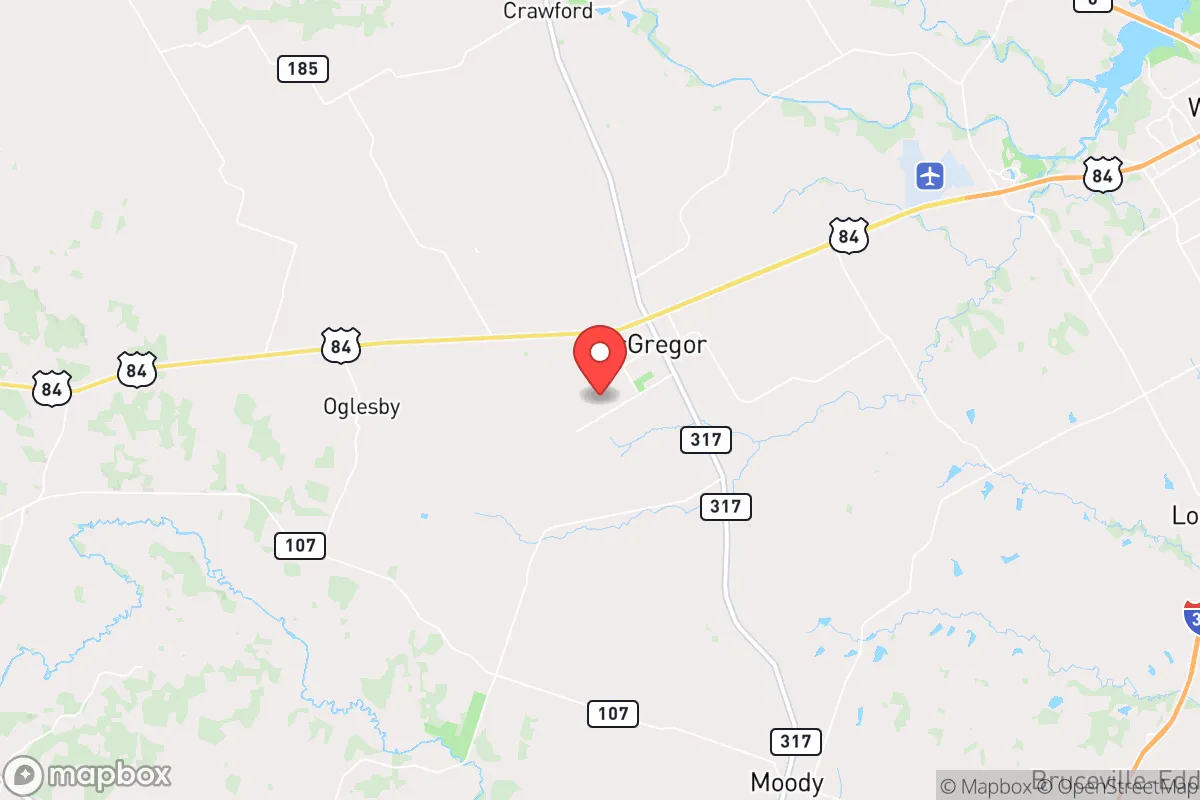
The people of McGregor, Texas today form a small, predominantly working-class community of 5,608 residents, characterized by a near-even split between non-Hispanic white (51.5%) and Hispanic (39.5%) populations, with a small Black minority (4.3%). The city’s foreign-born share stands at 14.7%, notably higher than the Texas average, driven largely by Hispanic immigration. Distinctively, McGregor has virtually no East/Southeast Asian or Indian subcontinent populations (0.0% each), and only 13.3% of adults hold a college degree, reflecting a blue-collar, agricultural, and industrial economic base. The city’s identity is rooted in its railroad and cotton history, with a present-day character that is quietly bicultural, conservative, and family-oriented.
How the city was settled and grew
McGregor was founded in 1882 as a railroad town on the Gulf, Colorado and Santa Fe Railway, drawing its first wave of settlers—primarily Anglo-American farmers and merchants—from the post-Reconstruction South and Midwest. The original plat centered on the railroad depot, with early residential development concentrated in what is now Old Town McGregor, the historic core around Main Street and 2nd Street. Cotton ginning and grain milling drove the economy, and by 1900 the population had reached roughly 1,500. A second wave arrived between 1910 and 1930, when German and Czech immigrant families, drawn by cheap land and railroad access, settled on the outskirts, particularly in the North McGregor area near the cotton compress and along what is now Highway 84. These groups established small farms and built the city’s first Catholic and Lutheran churches. The city’s growth plateaued after the 1930s, with the population hovering around 3,000 through mid-century as cotton declined and younger residents left for larger cities.
Modern era (post-1965)
After the 1965 Immigration and Nationality Act, McGregor saw a gradual but significant influx of Hispanic families, primarily from South Texas and northern Mexico, who came for agricultural labor and later for industrial jobs at the nearby McGregor Industrial Park (established in the 1970s). These new residents concentrated in the Southside neighborhood, south of the railroad tracks, and in the East McGregor area along Farm-to-Market Road 2671. By 1990, the Hispanic share had risen to roughly 20%, and by 2020 it had nearly doubled to 39.5%. The white population, meanwhile, declined from over 80% in 1970 to 51.5% today, as younger Anglo families moved to Waco or larger metros for college and white-collar work. The Black population, historically small (around 5% since the 1920s), has remained stable, with most Black families living in the West McGregor neighborhood near the old segregated school site. No significant East/Southeast Asian or Indian subcontinent communities have ever formed in McGregor, reflecting its limited economic draw for those groups.
The future
McGregor’s population is trending toward a Hispanic majority, likely within the next 10–15 years, as the white population continues to age and shrink while Hispanic families remain younger and have higher birth rates. The foreign-born share (14.7%) is expected to plateau or decline slightly as second- and third-generation Hispanic residents assimilate and become native-born. The city is not tribalizing into distinct enclaves—neighborhoods remain mixed, with the Southside and East McGregor areas becoming predominantly Hispanic but not exclusively so. The biggest demographic wildcard is the potential for growth from the SpaceX McGregor Test Facility, which has brought a small number of engineers and technicians (mostly white and Asian) since 2003, but these workers typically commute from Waco or Woodway and do not settle in McGregor itself. Over the next 20 years, McGregor will likely become a majority-Hispanic, working-class bedroom community for Waco, with a stable population around 6,000–7,000, low educational attainment, and a conservative political culture that reflects its rural and religious roots.
For someone moving in now, McGregor offers a quiet, affordable, and increasingly Hispanic community where family ties and church life remain central. The city is becoming more bicultural but not more diverse in the broader sense—it remains a place where the white and Hispanic populations are slowly merging into a single working-class identity, with little presence of other ethnic groups. New residents should expect a tight-knit, conservative social environment with limited amenities but strong local schools and a low cost of living.

* Values derived from national, state, county, city and local statistics and may differ in a specific area. Last updated: 2026-05-31T21:02:02.000Z
Narrative content on this page is AI-generated and may contain mistakes. Verify any details that matter before acting on them.
ReloMaps may earn a commission from affiliate links at no extra cost to you.

