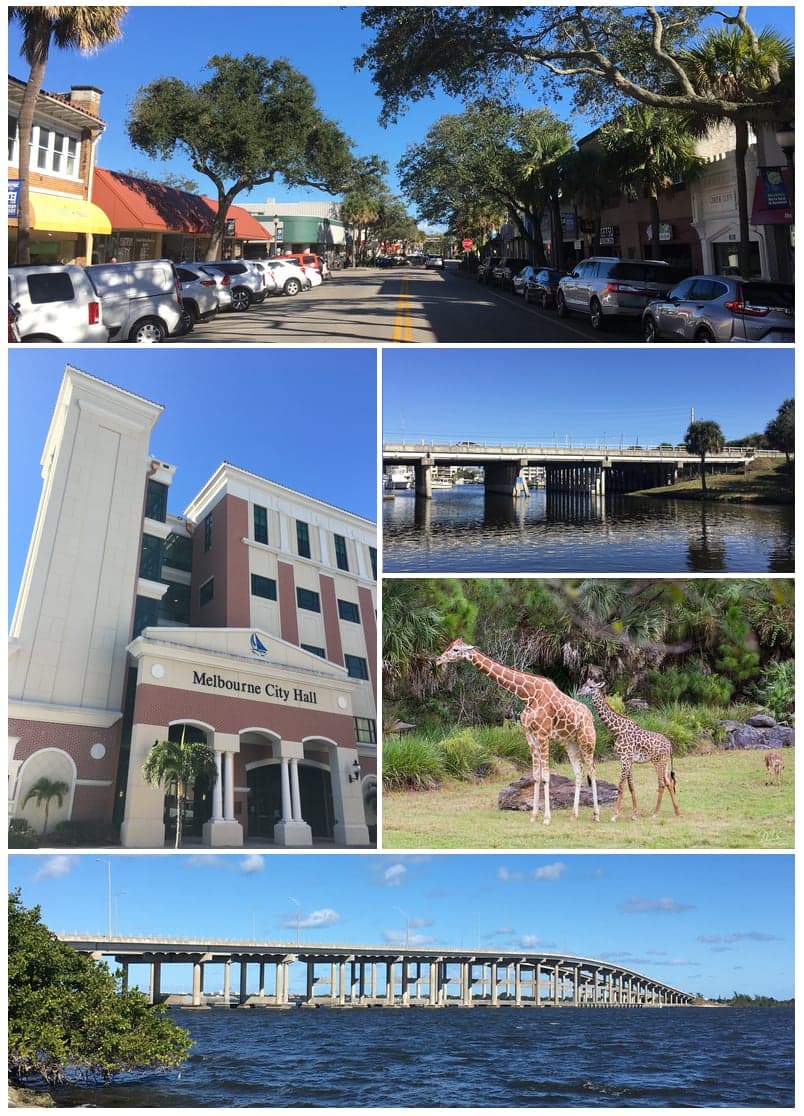
Photo: Wikipedia
Demographics of Melbourne, FL
Affluence Level in Melbourne, FL
A middle-class area roughly in line with national averages across income, home values, education, and employment.
People of Melbourne, FL
The people of Melbourne, Florida today number roughly 85,718, forming a predominantly white (70.2%) and college-educated (33.3%) population with a notably low foreign-born share of just 4.9%. The city’s character is shaped by its dual identity as a coastal retirement destination and a hub for aerospace and defense engineering, anchored by the nearby Kennedy Space Center and Patrick Space Force Base. Distinctive markers include a sizable Hispanic minority (11.8%) and a Black population (9.6%), alongside smaller East/Southeast Asian (2.6%) and Indian-subcontinent (0.6%) communities. The overall density is moderate, with a suburban feel that attracts both families and single professionals seeking a stable, mid-sized Florida city with strong ties to the space industry.
How the city was settled and grew
Melbourne was founded in the late 19th century, a product of the Florida land boom rather than colonial-era settlement. The first permanent residents arrived after the Civil War, drawn by the promise of citrus farming and the arrival of the railroad in the 1880s. The original plat was laid out by English settler Richard W. Goode in 1879, and the town was named after Melbourne, Australia, in honor of a local postmaster’s admiration for the city. Early growth was slow and overwhelmingly white, with a small Black population concentrated in the Georgetown neighborhood, a historic African American community established in the 1880s just south of downtown. By the early 20th century, Melbourne’s economy relied on citrus, fishing, and tourism, but the population remained under 2,000 until World War II. The 1940s brought the first major wave of in-migration: the construction of Naval Air Station Melbourne (now Melbourne Orlando International Airport) and the nearby Patrick Air Force Base drew thousands of military personnel and civilian contractors, many of whom settled in the Eau Gallie district, an older coastal area that became a hub for service members and their families.
Modern era (post-1965)
The post-1965 era transformed Melbourne from a sleepy coastal town into a mid-sized city driven by the space race and defense spending. The Apollo program and later the Space Shuttle program at Kennedy Space Center, 40 miles north, triggered a sustained influx of engineers, technicians, and scientists. This wave was overwhelmingly domestic, with white professionals from the Midwest and Northeast relocating for high-paying jobs at contractors like Harris Corporation (now L3Harris) and Rockwell Collins. The Viera area, a master-planned community developed from the 1990s onward, absorbed many of these newcomers, offering large single-family homes and top-rated schools. Meanwhile, the Lake Washington area and West Melbourne saw growth from families seeking more affordable housing. The Hispanic population grew modestly during this period, rising to 11.8% by 2020, with many settling in the Palm Bay Road corridor and parts of central Melbourne, drawn by service-sector jobs and existing family networks. The Black population, historically concentrated in Georgetown and the Dixie Manor area, remained stable at around 9.6%, with limited suburban dispersion. The East/Southeast Asian community (2.6%) is largely composed of engineers and medical professionals, with a visible cluster near the Florida Institute of Technology campus in the Downtown Melbourne district. The Indian-subcontinent population (0.6%) is small but growing, primarily professionals in tech and healthcare, with no single dominant neighborhood.
The future
Melbourne’s population is trending toward moderate diversification, but the pace is slow. The foreign-born share (4.9%) is well below the national average of 13.7%, and the city remains overwhelmingly native-born. The Hispanic share is projected to grow gradually, likely reaching 15-17% by 2040, driven by natural increase and continued migration from Puerto Rico and Latin America, with new arrivals settling in the Palm Bay Road corridor and southern Melbourne. The Black population is expected to remain stable or decline slightly as younger residents move to more affordable areas inland. The East/Southeast Asian and Indian-subcontinent communities are likely to grow modestly, tied to the expansion of tech and aerospace employers, but will remain small enclaves rather than forming large ethnic neighborhoods. The city is not tribalizing into distinct ethnic enclaves; instead, it is slowly homogenizing into a predominantly white, college-educated, middle-to-upper-middle-class suburb, with pockets of diversity in older neighborhoods like Georgetown and along commercial corridors. The biggest demographic shift may be age-related: as Baby Boomer retirees age out, the city will need to attract younger families to maintain its tax base and workforce.
For someone moving in now, Melbourne is becoming a stable, moderately diverse, and professionally oriented city where the population is shaped more by domestic migration for aerospace and tech jobs than by international immigration. The low foreign-born share and high college attainment rate mean a relatively homogeneous social environment, with diversity concentrated in specific neighborhoods and along certain corridors. The city’s future is one of slow, managed growth, with a population that will remain majority-white and native-born for the foreseeable future, but with a gradually expanding Hispanic and Asian presence that adds texture without fundamentally altering the city’s character.

* Values derived from national, state, county, city and local statistics and may differ in a specific area. Last updated: 2026-05-03T05:02:29.000Z
Narrative content on this page is AI-generated and may contain mistakes. Verify any details that matter before acting on them.
ReloMaps may earn a commission from affiliate links at no extra cost to you.

