
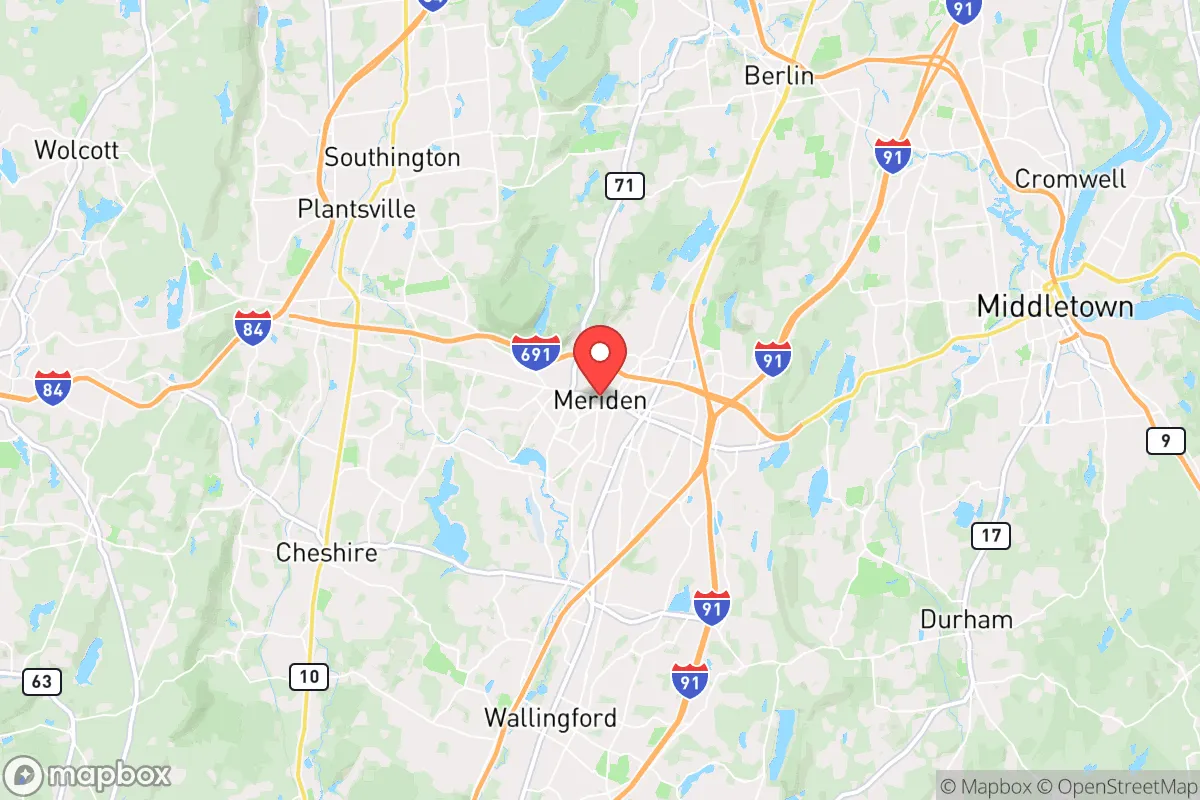
Photo: Wikipedia
Personal Sovereignty in Meriden, CT
Viable for self-reliance. Generally workable, though some barriers may limit total independence.
What does Personal Sovereignty tell us?
Personal Sovereignty measures your capacity for self-reliance and independence with minimal government friction. Higher scores mean fewer barriers between you and the way you want to live... but it assumes you have the space you need and good neighbors.
What does this tell us?
Personal Sovereignty measures your capacity for self-reliance and independence with minimal government friction. Higher scores mean fewer barriers between you and the way you want to live... but it assumes you have the space you need and good neighbors.
State Policy
Energy independence: Importer (5% of energy produced in-state)
Personal Liberty
Homesteading

Personal Liberty Analysis
For the individual or family prioritizing personal sovereignty, Meriden, Connecticut presents a challenging environment where state-level authority consistently overrides local autonomy. As a mid-sized city in a state with some of the nation's most restrictive gun laws, highest tax burdens, and aggressive environmental regulations, Meriden offers limited room for the self-reliant, prepper-minded resident. While the city itself is not the most restrictive in Connecticut, the overarching legal and fiscal framework from Hartford creates a landscape where personal freedom is heavily mediated by government mandates, making it a location that demands careful strategic consideration for those who value maximum independence.
Tax burden and regulatory posture: What the state takes and controls
Connecticut's tax burden is among the highest in the nation, and Meriden residents feel this acutely. The state imposes a progressive income tax with rates reaching 6.99%, a sales tax of 6.35%, and some of the highest property taxes in the country. Meriden's mill rate hovers around 40 mills, meaning a home assessed at $200,000 carries an annual property tax bill of roughly $8,000. This is a significant fixed cost that directly reduces the capital available for self-reliance investments like land, supplies, or alternative energy systems. Beyond taxes, the regulatory posture is dense. Connecticut has a state-level building code, strict environmental regulations on wetlands and water usage, and a permitting process for even minor home improvements that can take months. For the prepper, this means any project—from installing a backup generator to building a root cellar—requires navigating a bureaucratic maze. The state's aggressive pursuit of "green" energy mandates also means that homeowners face pressure to adopt expensive, government-approved technologies, with limited tolerance for off-grid solutions that don't meet state standards.
Self-defense and gun law specifics: Navigating a restrictive landscape
For those who view the Second Amendment as a cornerstone of personal sovereignty, Connecticut is a hostile jurisdiction. The state requires a permit to purchase any firearm, a permit to carry a handgun (which is "may-issue" in practice, though nominally "shall-issue"), and maintains a state-level assault weapons ban that covers many common semi-automatic rifles. Magazine capacity is capped at 10 rounds. Meriden itself has a local police department that processes permits, and while the city is not as anti-gun as some urban centers like Hartford or New Haven, the process is still burdensome. The state also has a "red flag" law that allows for the temporary seizure of firearms based on a complaint, with no criminal charge required. For the survivalist, this creates a chilling effect: your ability to defend yourself and your family is contingent on government permission, and that permission can be revoked based on a third-party allegation. Self-defense outside the home is also limited; Connecticut does not have a "stand your ground" law, imposing a duty to retreat in public spaces. This legal framework fundamentally undermines the concept of personal sovereignty for anyone who believes in the right to armed self-defense.
Self-reliance and homesteading viability: Lot sizes, zoning, and off-grid feasibility
Meriden is a dense, older city with a mix of single-family homes, multi-family units, and industrial areas. The typical residential lot is small—often less than a quarter-acre—making serious homesteading or large-scale gardening difficult. Zoning regulations are strict, with limits on keeping livestock (chickens are allowed with a permit, but larger animals are generally prohibited) and restrictions on structures like sheds, greenhouses, or workshops. Off-grid living is effectively illegal. Connecticut law requires all habitable dwellings to be connected to the electrical grid and municipal water and sewer systems where available. Solar panels are permitted but must be grid-tied and meet state utility interconnection standards. Rainwater collection is allowed but regulated, and composting toilets are not a legal substitute for a septic system. For the prepper seeking true self-reliance—growing food, generating power, and managing waste independently—Meriden's urban zoning and state building codes present near-insurmountable barriers. The city is simply not designed for the kind of autonomous living that a survivalist mindset demands.
Personal liberties: Parental rights, medical autonomy, speech, and property
On parental rights, Connecticut has moved aggressively in recent years to centralize authority with the state. The state mandates comprehensive sex education in public schools, with no opt-out for parents on certain topics. Vaccine mandates for school attendance are strict, with limited medical and no philosophical exemptions. During the COVID-19 pandemic, the state imposed some of the longest-lasting school mask mandates and business restrictions in the Northeast, and the legal framework for future public health emergencies remains broad. Medical autonomy is similarly constrained. Connecticut has a state-run health insurance exchange and mandates that all residents carry health insurance. The state has also passed laws that limit the ability of parents to refuse medical treatment for their children on religious grounds. Free speech is protected under the First Amendment, but the state has enacted laws that restrict certain types of speech online, including "disinformation" related to elections, which raises concerns for those who value absolute free expression. Property rights are heavily circumscribed by zoning, environmental regulations, and the state's aggressive use of eminent domain for economic development projects. For the conservative-leaning individual, the cumulative effect is a state that consistently prioritizes government authority over individual and family decision-making.
In the broader context of personal sovereignty, Meriden and Connecticut rank among the most restrictive states in the nation. Compared to states like New Hampshire, Texas, or Idaho, where tax burdens are lower, gun laws are more permissive, and zoning allows for greater self-reliance, Connecticut represents a fundamentally different philosophy of governance. For the survivalist or prepper who values maximum autonomy, Meriden is a location to approach with extreme caution. The high cost of living, dense regulatory environment, and erosion of personal liberties make it a poor fit for those seeking to build a life of self-reliance. While the city itself has its charms, the state-level constraints are so pervasive that they effectively dictate the terms of daily life. For the strategic relocator, the calculus is clear: if personal sovereignty is your priority, look elsewhere.

* Values derived from national, state, county, city and local statistics and may differ in a specific area. Last updated: 2026-04-19T06:54:05.000Z
Narrative content on this page is AI-generated and may contain mistakes. Verify any details that matter before acting on them.
ReloMaps may earn a commission from affiliate links at no extra cost to you.

