Photo: Wikipedia
Demographics of Meridian, TX
Affluence Level in Meridian, TX
A middle-class area roughly in line with national averages across income, home values, education, and employment.
People of Meridian, TX
Meridian, Texas, is a small, predominantly White community of 1,546 residents where a strong rural identity and conservative values shape daily life. The city’s population is 77.1% White and 17.5% Hispanic, with a very small Black (3.8%) and East/Southeast Asian (0.8%) presence, and no Indian-subcontinent residents. With only 10.9% of adults holding a college degree, the workforce is heavily oriented toward agriculture, local trades, and commuting to larger hubs like Waco. The city retains a tight-knit, slow-paced character, where generational families live alongside a modest but growing Hispanic population.
How the city was settled and grew
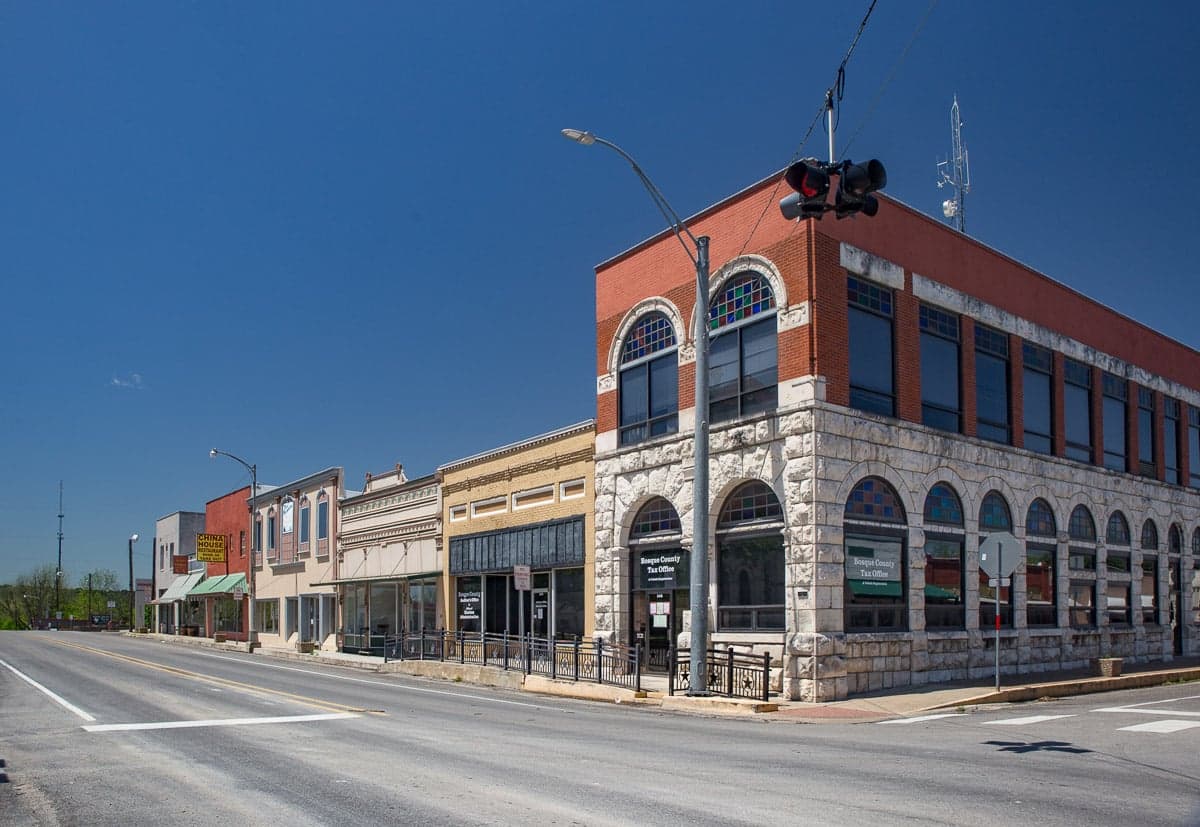
Meridian was founded in 1854 as the seat of Bosque County, carved out of the Peters Colony land grant that attracted Anglo-American settlers from the U.S. South. The original population was almost entirely White, drawn by fertile blackland soil for cotton farming and the promise of cheap land. The earliest settlers clustered around the town square and along what is now Main Street, building wood-frame homes and a courthouse that anchored the community. By the late 1800s, a small number of German and Czech immigrants arrived, settling in the North Meridian area near the railroad depot, where they established farms and small businesses. The city’s growth remained slow through the early 20th century, as the rural economy shifted from cotton to livestock and hay. The South Bosque neighborhood, along the Bosque River, became home to later waves of White tenant farmers and sharecroppers who worked the surrounding ranches. No significant Black or Hispanic enclaves formed during this period; Meridian remained overwhelmingly White and Protestant, with the population peaking near 1,800 in the 1920s before declining as mechanization reduced farm labor needs.
Modern era (post-1965)
After the 1965 Hart-Cellar Act, Meridian saw almost no international immigration. The foreign-born share today is just 4.9%, and those residents are overwhelmingly Hispanic, not from Asia or the Indian subcontinent. The major demographic shift since the 1970s has been domestic: a slow out-migration of younger White residents seeking jobs in Dallas-Fort Worth or Waco, balanced by an influx of Hispanic families drawn to agricultural work and lower housing costs. These Hispanic newcomers have concentrated in the East Meridian area, near the highway and older mobile home parks, where rental housing is more affordable. The Westside Addition, a small subdivision built in the 1980s, absorbed some White families returning from urban areas, but it remains predominantly Anglo. The Black population, at 3.8%, is largely descended from a handful of families who moved to Meridian in the 1990s for work at the nearby Bosque County Detention Center and live scattered across the city, with no distinct Black neighborhood. The East/Southeast Asian community (0.8%) is negligible, consisting of a few individuals employed in regional healthcare or academia, with no visible enclave. The Hispanic share has grown from roughly 8% in 1990 to 17.5% today, but this growth has plateaued in recent years as agricultural mechanization reduces demand for seasonal labor.
The future
Meridian’s population is likely to remain stable or decline slightly over the next decade, as the aging White cohort (median age ~45) shrinks and Hispanic growth slows. The city is not tribalizing into distinct ethnic enclaves; instead, it is slowly homogenizing as younger White residents leave and Hispanic families assimilate into the broader community, often adopting English as a primary language. The Downtown Meridian area, centered on the courthouse square, is seeing a modest revival as retirees and remote workers from Dallas-Fort Worth buy historic homes, but this inflow is too small to reverse population loss. The Bosque River Estates subdivision, developed in the 2000s, has attracted a few White families seeking rural acreage, but it remains sparsely populated. No significant immigrant community is expected to emerge, as the city lacks the industrial or service-sector jobs that draw foreign-born populations. The college-educated share (10.9%) is unlikely to rise sharply, given the limited local professional job market.
Meridian is becoming a quieter, older, and slightly more Hispanic version of its historical self, with little demographic dynamism. For a conservative-leaning mover seeking a stable, low-cost, rural community with minimal ethnic diversity and a strong sense of local history, Meridian offers a predictable and unchanging social environment. The city’s future is one of slow decline or steady stasis, not transformation.

* Values derived from national, state, county, city and local statistics and may differ in a specific area. Last updated: 2026-05-12T01:21:39.000Z
Narrative content on this page is AI-generated and may contain mistakes. Verify any details that matter before acting on them.
ReloMaps may earn a commission from affiliate links at no extra cost to you.

