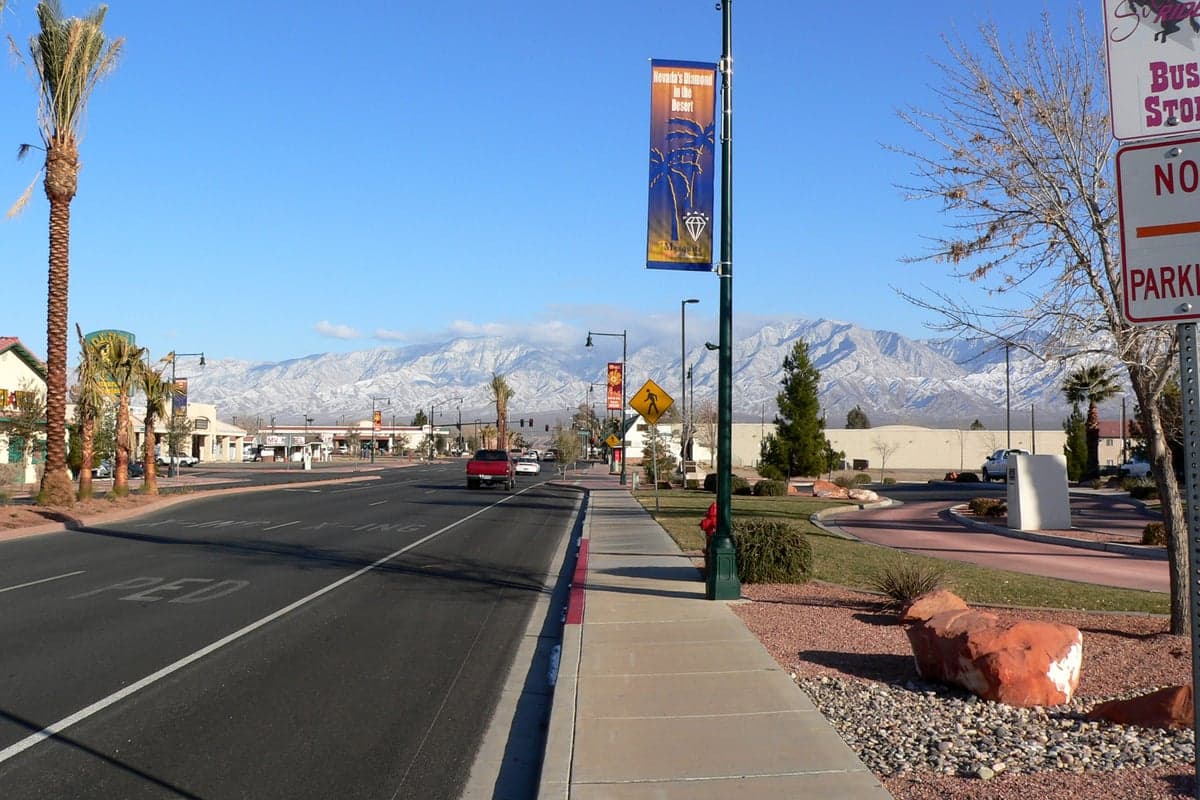
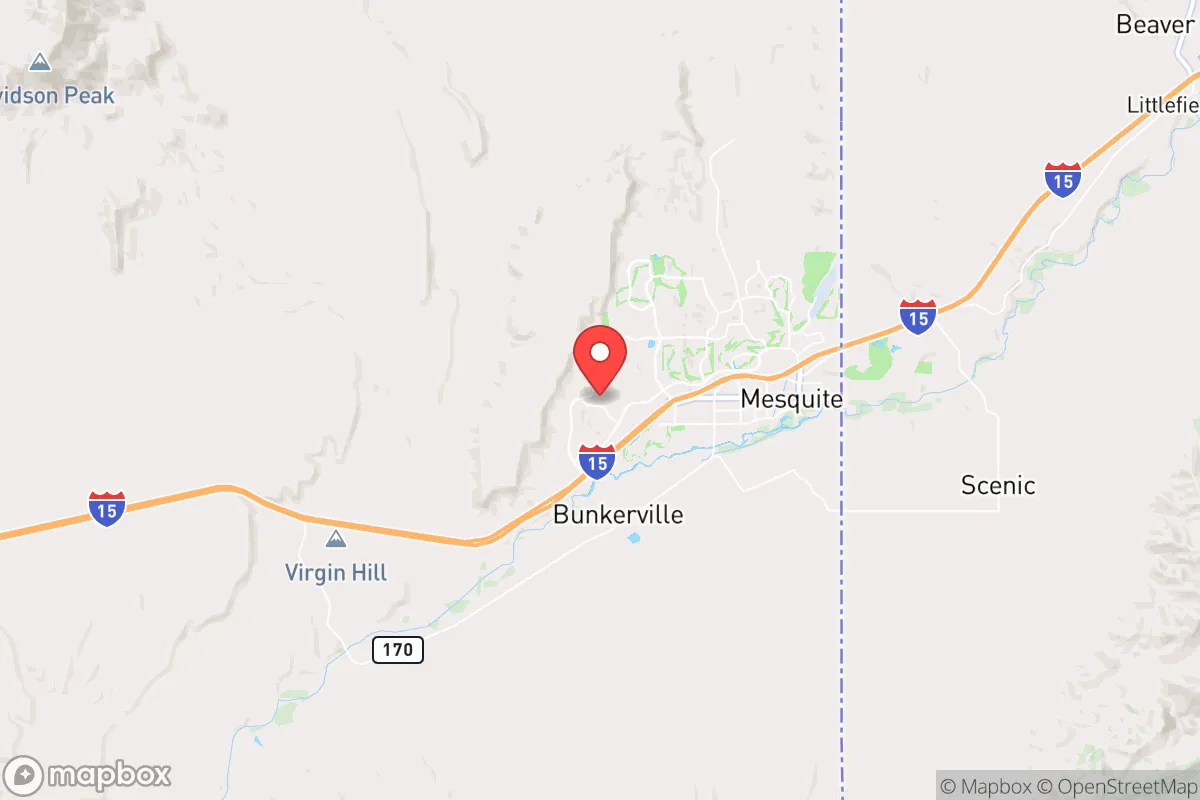

Photo: Wikipedia
Demographics of Mesquite, NV
Affluence Level in Mesquite, NV
A middle-class area roughly in line with national averages across income, home values, education, and employment.
People of Mesquite, NV
Mesquite, Nevada, is a retirement and recreation hub of 21,314 residents, characterized by a predominantly white population (70.8%) with a significant Hispanic minority (23.8%) and a small but growing East/Southeast Asian community (1.8%). The city’s identity is shaped by its dual role as a golf-centric retirement destination and a service-industry town serving Interstate 15 travelers, creating a population that is older, less diverse than the national average, and politically conservative. Foreign-born residents make up 7.5% of the population, and the college-educated share stands at 23.9%, reflecting a workforce oriented toward hospitality, healthcare, and retail rather than white-collar industries.
How the city was settled and grew
Mesquite’s human history begins with the Southern Paiute people, who inhabited the Virgin River valley for centuries before Mormon settlers arrived in the late 19th century. The first permanent Anglo settlement occurred in 1880 when Mormon pioneers from St. George, Utah, established a farming community along the river. These early settlers were predominantly of English and Scandinavian descent, drawn by the promise of irrigated agriculture in a desert landscape. The original settlement clustered around what is now Mesquite Boulevard and the historic downtown area, where families built modest homes and farmsteads. For decades, the population remained small and homogeneous—a tight-knit Mormon farming community of a few hundred people. The arrival of the railroad in the early 1900s brought a modest influx of laborers, but Mesquite remained a rural outpost until the late 20th century. The Historic District along Mesquite Boulevard still contains some of the original pioneer homes, now preserved as a reminder of the city’s agrarian roots.
Modern era (post-1965)
The modern transformation of Mesquite began in the 1980s and accelerated through the 1990s, driven by the development of casino-resorts and golf courses. The opening of the Peppermill Mesquite (now the Virgin River Hotel & Casino) in 1990 and the Oasis Resort in 1991 marked a pivot from agriculture to tourism. This shift attracted a wave of in-migrants: retirees from California, Utah, and the Pacific Northwest seeking affordable desert living, and service workers—many of them Hispanic—to staff the casinos, hotels, and restaurants. The Hispanic population grew from negligible in 1980 to 23.8% today, concentrated in the Sun City Mesquite neighborhoods (where many retirees settled) and the more affordable Falcon Ridge area, which absorbed a mix of working-class families and Hispanic service workers. The East/Southeast Asian community (1.8%) is small but visible, with families primarily working in hospitality and settling in the Bunker Estates subdivision. The Black population remains tiny at 0.8%, and the Indian subcontinent community is negligible at 0.1%. The post-1965 immigration reforms had little direct effect on Mesquite, as the city’s growth has been overwhelmingly domestic—driven by retirees and interstate migration rather than foreign-born influx.
The future
Mesquite’s population is projected to grow slowly, reaching roughly 25,000 by 2040, driven by continued retirement migration and limited job growth. The city is not homogenizing into a single identity; rather, it is tribalizing into distinct enclaves. Sun City Mesquite remains overwhelmingly white and older, a gated retirement community where residents are largely native-born and politically conservative. Falcon Ridge and the Virgin River corridor are becoming more Hispanic, as second-generation families settle and service-sector jobs anchor them in place. The East/Southeast Asian community is likely to plateau, given the limited economic opportunities for professional-class immigrants. The Hispanic population is growing through natural increase and continued migration from California and the Southwest, but it is assimilating linguistically and culturally—English proficiency is high among younger generations. The white population is aging in place, with younger white families often leaving for larger job markets in St. George or Las Vegas. Over the next decade, Mesquite will become slightly more Hispanic and slightly older, but it will remain a predominantly white, conservative retirement town with a working-class Hispanic service sector.
For someone moving in now, Mesquite offers a stable, low-crime environment with a clear demographic divide: retirees in gated golf communities and working families in more affordable neighborhoods. The city is not a melting pot but a collection of distinct enclaves, each with its own character. New residents should expect a conservative, churchgoing culture, limited ethnic diversity outside the Hispanic community, and a pace of life defined by golf, gaming, and the desert landscape.

* Values derived from national, state, county, city and local statistics and may differ in a specific area. Last updated: 2026-04-23T04:12:10.000Z
Narrative content on this page is AI-generated and may contain mistakes. Verify any details that matter before acting on them.
ReloMaps may earn a commission from affiliate links at no extra cost to you.

