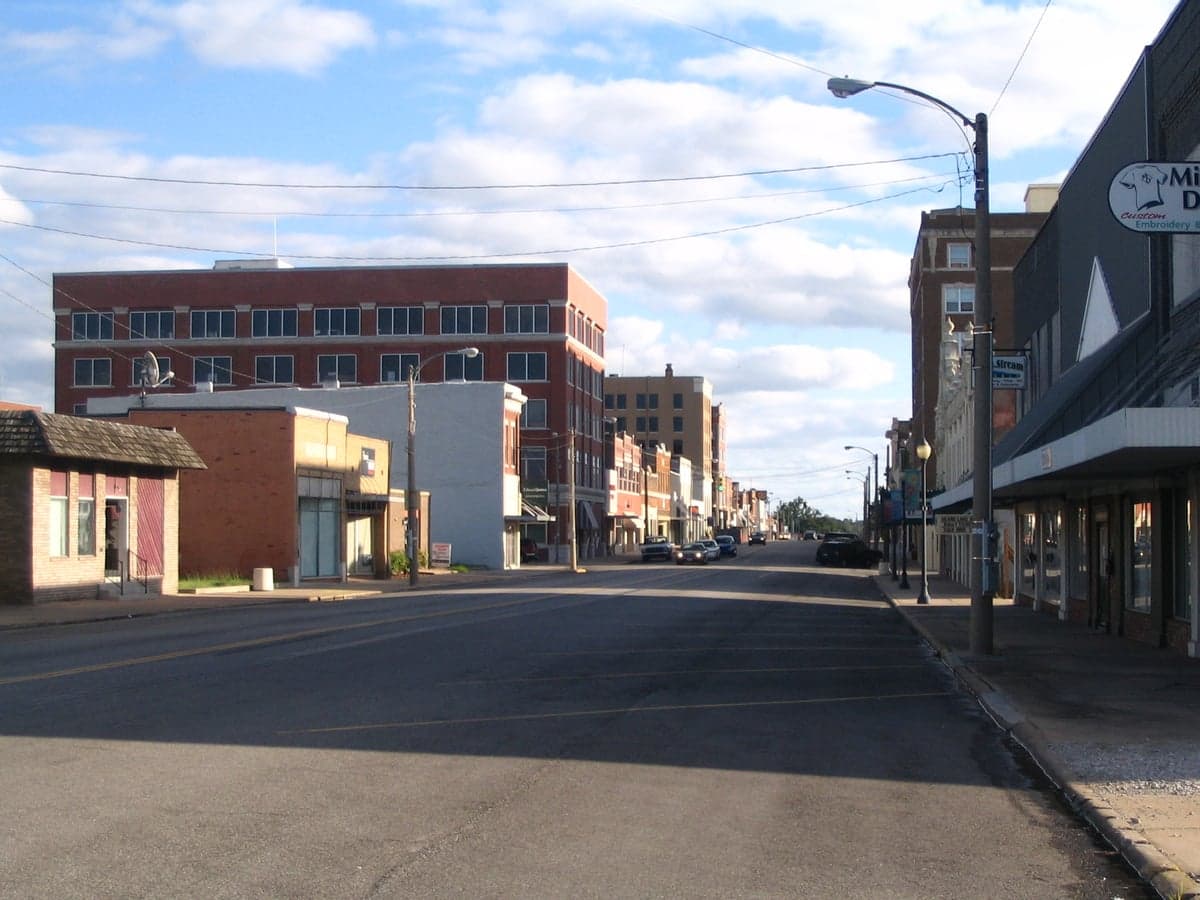
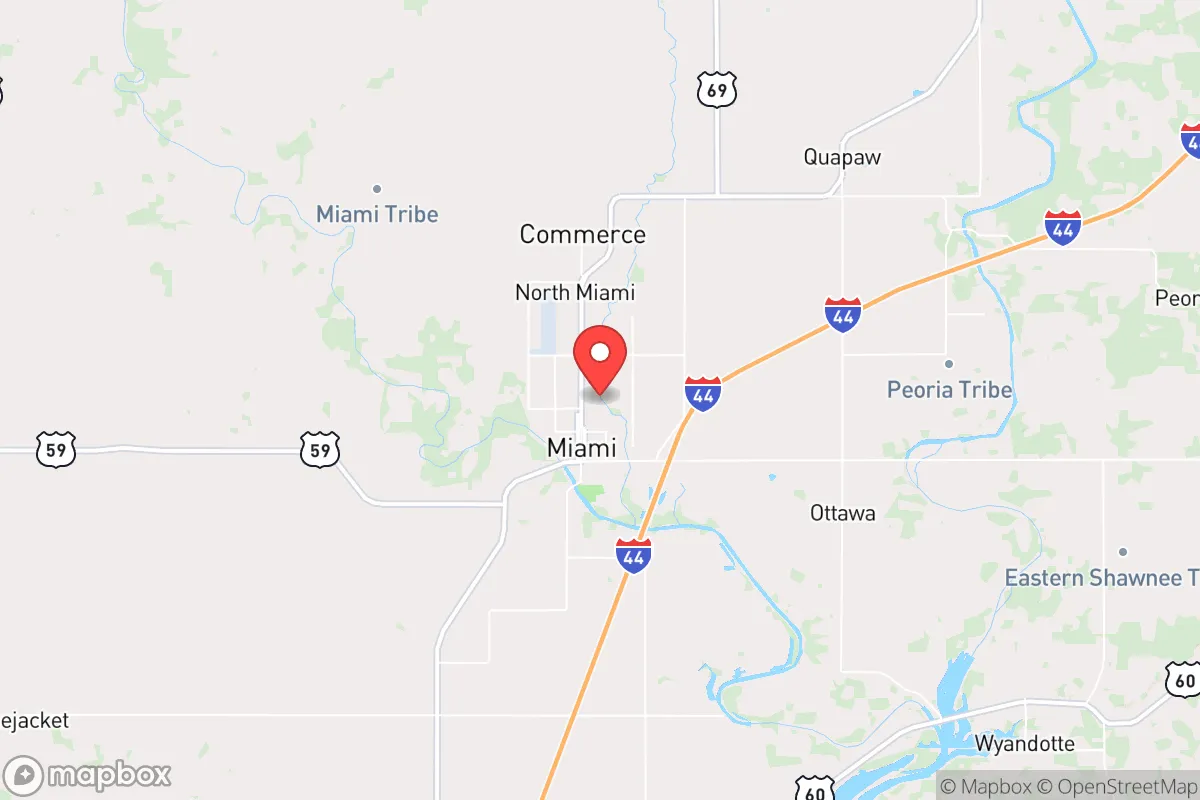
Photo: Wikipedia
Demographics of Miami, OK
Affluence Level in Miami, OK
A below-average socioeconomic profile. Incomes, home values, and educational attainment trail the U.S., with higher poverty and unemployment.
People of Miami, OK
The people of Miami, Oklahoma, today number roughly 12,960, forming a community that is predominantly white (61.7%) with a notable Native American presence—a legacy of the city’s location within the historic boundaries of the Quapaw and Ottawa tribes. The population is older and less diverse than the national average, with a foreign-born share of just 2.0% and a college attainment rate of 16.4%. Distinctive markers include a strong sense of local identity tied to the city’s Route 66 heritage and a conservative, family-oriented culture that shapes daily life.
How the city was settled and grew
Miami was founded in 1891 on land originally part of the Quapaw Reservation, following the Dawes Act of 1887, which allotted tribal lands to individual Native Americans and opened the remainder to white settlement. The city’s name derives from the Miami tribe, though the area was historically inhabited by the Quapaw, Ottawa, and Seneca-Cayuga peoples. The original population consisted of Native American families who received allotments, followed by white homesteaders and merchants drawn by the promise of farmland and the arrival of the railroad in 1895. The discovery of lead and zinc in the nearby Tri-State Mining District in the early 1900s triggered a boom, attracting a wave of miners and laborers from the Ozarks, the Midwest, and Southern Europe—primarily Italian and Irish immigrants. These groups settled in working-class neighborhoods like North Miami, near the mines, and East Central Miami, where modest frame houses still line the streets. By 1920, the population had surged to over 8,000, making Miami a bustling mining hub. The decline of mining after World War II led to a gradual shift toward manufacturing and services, with the population stabilizing around 13,000 by 1960.
Modern era (post-1965)
After the 1965 Hart-Cellar Act, Miami saw only a modest increase in foreign-born residents, with the current 2.0% share far below the national average of 13.7%. The city’s Hispanic population grew from negligible levels to 5.7% today, concentrated in the Southwest Miami area near the industrial parks and along Steve Owens Boulevard, where a handful of Mexican restaurants and tiendas serve the community. The Black population remains small at 2.0%, with families primarily living in the Downtown Historic District and the Coleman Addition neighborhood, a mid-century subdivision built for workers at the B.F. Goodrich tire plant. East/Southeast Asian residents (0.7%) and Indian-subcontinent residents (0.1%) are present in very small numbers, mostly professionals employed at the Miami Regional Hospital or Northeastern Oklahoma A&M College. The most significant demographic shift has been domestic: a steady outflow of young adults seeking jobs in Tulsa or Joplin, Missouri, and a modest inflow of retirees from rural Oklahoma and Kansas, drawn by low housing costs and the nearby Grand Lake recreation area. These retirees have settled in newer subdivisions like Willow Springs and Oak Ridge Estates on the city’s western edge.
The future
The population of Miami is projected to remain flat or decline slightly over the next decade, as the city’s aging demographic (median age 39.5) and limited job growth in high-skilled sectors constrain in-migration. The Hispanic share is likely to grow slowly, potentially reaching 8-10% by 2035, driven by natural increase and continued employment in agriculture and light manufacturing. The Native American population, which is not separately tracked in the supplied data but is a visible presence, may stabilize as tribal enterprises like the Buffalo Run Casino provide economic anchors. The city is not tribalizing into distinct enclaves; rather, it is homogenizing as older white residents age in place and younger families move to larger metro areas. The foreign-born share is unlikely to rise significantly, given the lack of refugee resettlement programs or major immigrant-employing industries. For someone moving in now, Miami offers a stable, low-cost, and culturally conservative environment, but with limited demographic dynamism and a population that skews older and less diverse than the state average.
In summary, Miami, Oklahoma, is becoming a quieter, older, and slightly more Hispanic community, shaped by its mining-era roots and modern reliance on tribal gaming and regional healthcare. For a conservative-leaning individual or family, the city provides affordable housing, a safe small-town atmosphere, and proximity to outdoor recreation, but with few opportunities for professional growth or exposure to significant cultural diversity.

* Values derived from national, state, county, city and local statistics and may differ in a specific area. Last updated: 2026-04-25T13:52:20.000Z
Narrative content on this page is AI-generated and may contain mistakes. Verify any details that matter before acting on them.
ReloMaps may earn a commission from affiliate links at no extra cost to you.

