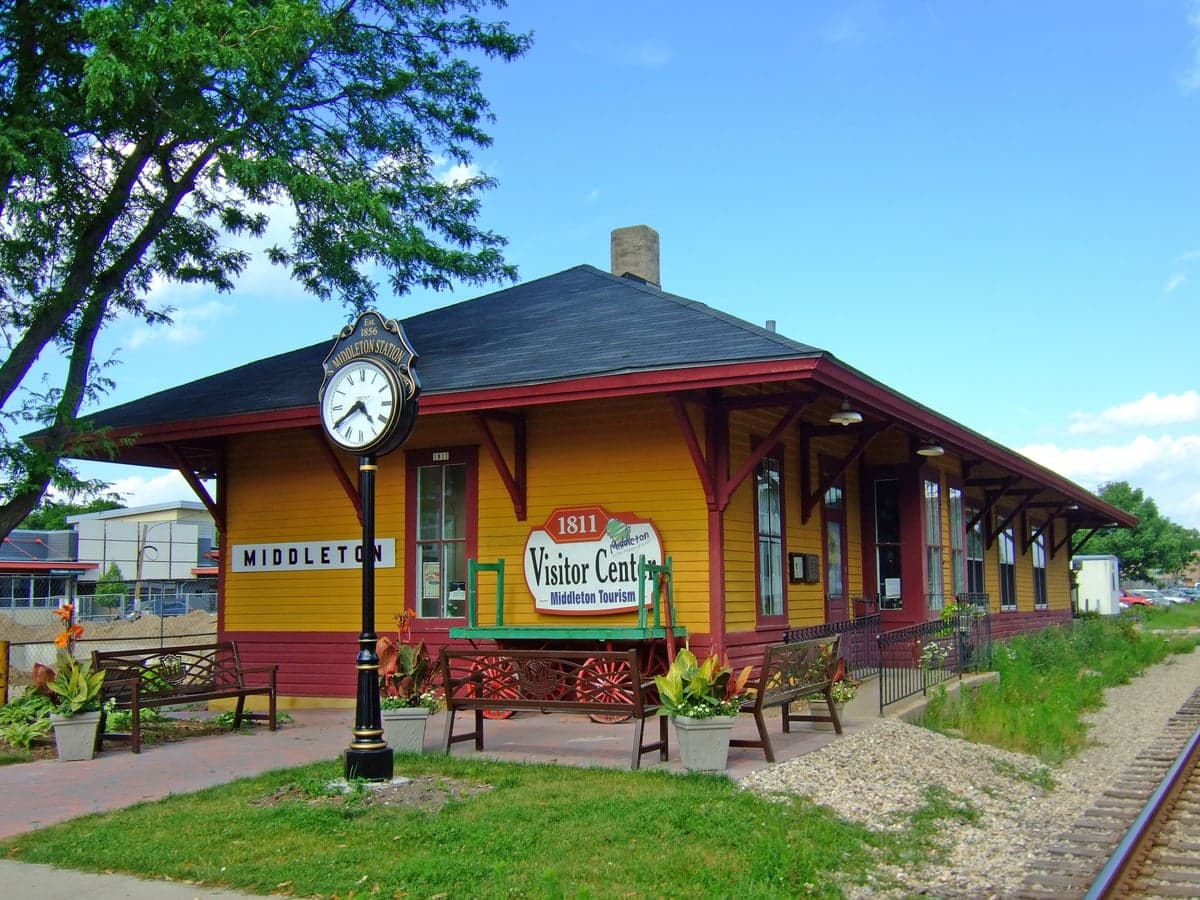
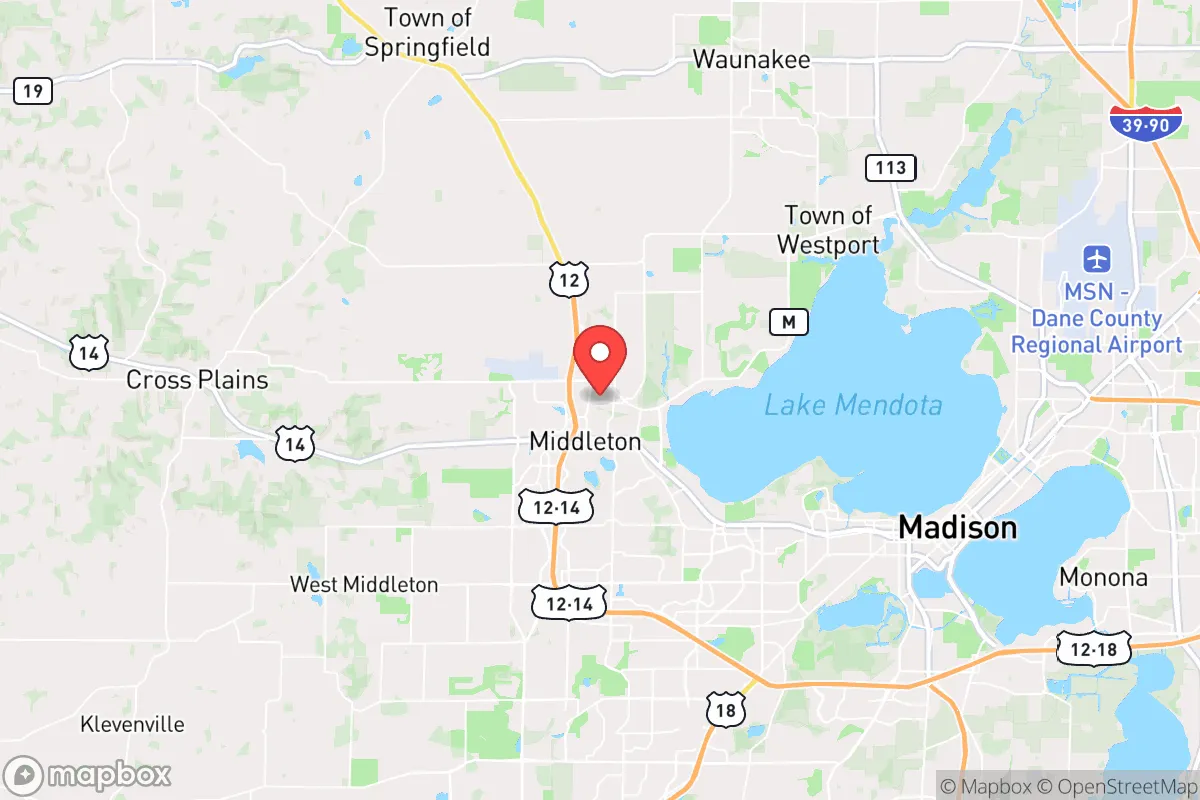
Photo: Wikipedia
Demographics of Middleton, WI
Affluence Level in Middleton, WI
A middle-class area roughly in line with national averages across income, home values, education, and employment.
People of Middleton, WI
The people of Middleton, Wisconsin, today form a highly educated, predominantly white-collar community of 22,235 residents, distinguished by a 62.1% college-educated rate—nearly double the national average. The city carries a notably stable, family-oriented character, with a population that is 76.9% white and a modest 4.4% foreign-born share, reflecting its roots as a quiet suburban anchor for nearby Madison. Distinctive markers include a strong sense of local identity centered on the downtown Hubbard Avenue corridor and a demographic profile that leans older and more settled than the typical college town.
How the city was settled and grew
Middleton’s original population was drawn by the promise of fertile farmland and the arrival of the Milwaukee & St. Paul Railroad in the 1850s. The first wave of settlers were primarily Yankee and German farmers, who established the village around what is now the Hubbard Avenue commercial district. By the late 19th century, Norwegian and Irish immigrants joined the mix, settling in the South Park neighborhood and along the railroad corridor, where they worked in the local grain mills and creameries. The city incorporated in 1905, and through the mid-20th century, its population remained small and overwhelmingly white, with growth driven by the expansion of the University of Wisconsin–Madison and the rise of local manufacturing, such as the Ray-O-Vac battery plant. The Middleton Hills neighborhood, developed in the 1940s and 1950s, became a classic post-war enclave for returning veterans and their families, cementing the city’s reputation as a stable, middle-class suburb.
Modern era (post-1965)
The post-1965 era brought gradual diversification, though Middleton remained far more homogeneous than nearby Madison. The 1970s and 1980s saw an influx of professionals drawn by the growth of the Epic Systems campus in nearby Verona and the expansion of the University of Wisconsin Hospital and Clinics. These new residents—largely white and college-educated—settled in the Greentree and Westfield subdivisions, which offered larger lots and newer homes. The Hispanic population, now 9.6%, began to grow in the 1990s, with many families finding housing in the Lakeview Heights area and along the Parmenter Street corridor, often working in construction, landscaping, and service industries. The East/Southeast Asian community, at 4.8%, and the Indian-subcontinent community, at 1.7%, arrived primarily after 2000, drawn by tech and healthcare jobs; they tend to concentrate in the Highland Ridge and newer developments near the Greenway Station shopping center. The Black population, at 2.6%, remains small and is scattered across the city, with no single dominant neighborhood. Overall, the foreign-born share of 4.4% is low for a college-educated suburb, indicating that most growth has come from domestic in-migration rather than international immigration.
The future
Middleton’s population is likely to continue its slow, steady growth, but the character of that growth is shifting. The city is not homogenizing into a single melting pot; rather, it is tribalizing into distinct enclaves by income and ethnicity. The white, college-educated professional class will remain dominant in the Greentree and Westfield neighborhoods, while Hispanic families are consolidating in Lakeview Heights and the Parmenter Street area. The East/Southeast Asian and Indian communities are plateauing, as the tech job market in the region matures and housing costs rise. The next 10–20 years will likely see a modest increase in the Hispanic share, possibly reaching 12–14%, while the white share may decline to around 70%. The foreign-born share is unlikely to exceed 6%, as Middleton lacks the large immigrant-employing industries found in Milwaukee or Chicago. The city will remain a stable, safe, and highly educated suburb, but with a growing socioeconomic divide between its established professional neighborhoods and its newer, more diverse working-class areas.
For someone moving in now, Middleton is becoming a place of clear neighborhood identities rather than a uniform suburb. The city offers excellent schools and low crime, but the social landscape is increasingly segmented by income and ethnicity. New residents should expect to find their social circle largely defined by which neighborhood they choose, rather than a single, cohesive community identity.

* Values derived from national, state, county, city and local statistics and may differ in a specific area. Last updated: 2026-04-21T10:16:22.000Z
Narrative content on this page is AI-generated and may contain mistakes. Verify any details that matter before acting on them.
ReloMaps may earn a commission from affiliate links at no extra cost to you.

