
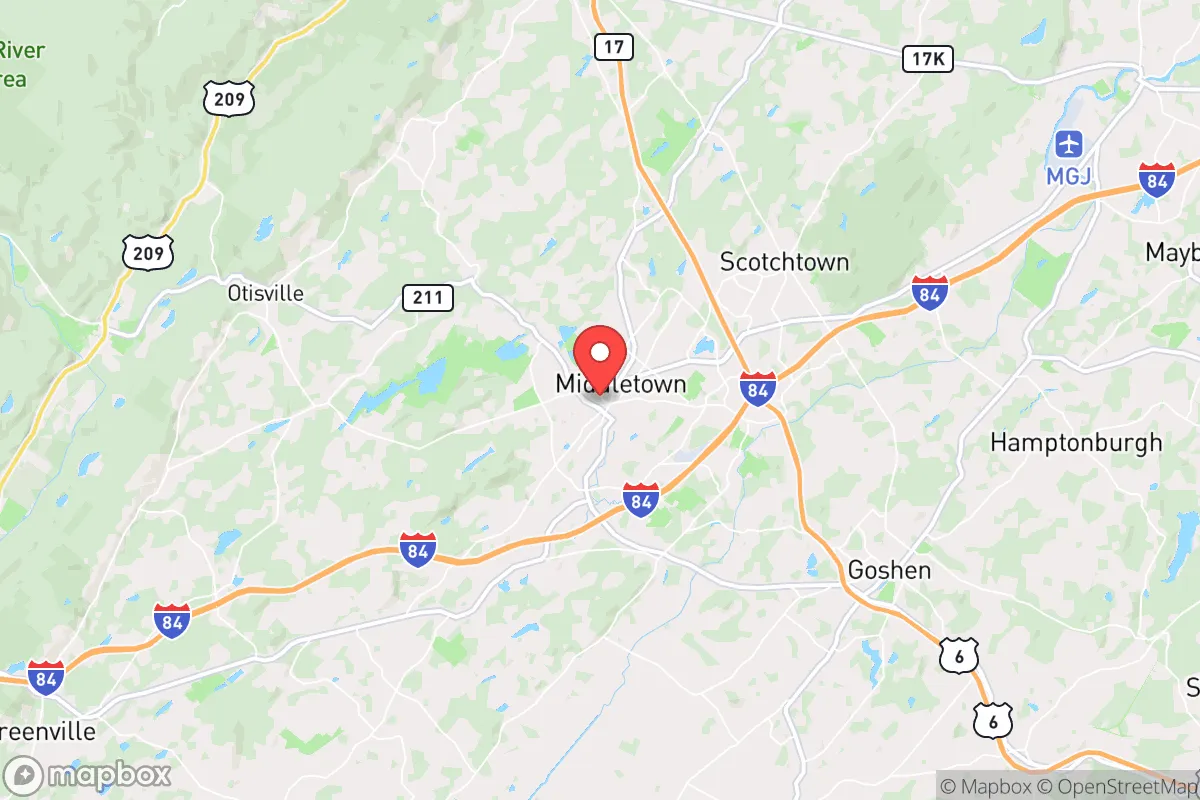
Photo: Wikipedia
Personal Sovereignty in Middletown, NY
Moderate friction. Expect trade-offs in some aspect of personal liberty and independence.
What does Personal Sovereignty tell us?
Personal Sovereignty measures your capacity for self-reliance and independence with minimal government friction. Higher scores mean fewer barriers between you and the way you want to live... but it assumes you have the space you need and good neighbors.
What does this tell us?
Personal Sovereignty measures your capacity for self-reliance and independence with minimal government friction. Higher scores mean fewer barriers between you and the way you want to live... but it assumes you have the space you need and good neighbors.
State Policy
Energy independence: Importer (12% of energy produced in-state)
Personal Liberty
Homesteading

Personal Liberty Analysis
Middletown, New York, sits in a state where personal sovereignty faces constant pressure from Albany’s regulatory machine, making it a mixed bag for those who prioritize autonomy. While the city itself offers a relatively low-cost entry point compared to downstate areas, the overarching legal and tax environment in New York State imposes significant constraints on individual freedom. For a survivalist or prepper mindset, this means navigating a landscape where self-reliance is possible but requires deliberate workarounds, particularly in areas like taxation, self-defense, and property use. The key question is whether Middletown’s specific local conditions—its zoning, community culture, and proximity to less restrictive regions—can offset the state-level drag on personal sovereignty.
Tax burden and regulatory posture in Orange County
New York State’s tax burden is among the highest in the nation, and Orange County is no exception. Property taxes in Middletown average around 2.5% of assessed home value, which can eat into any prepper’s budget for gear, land, or supplies. The state income tax tops out at 10.9% for high earners, but even middle-income households face a combined state and local rate near 7%. Sales tax in Orange County is 8.125%, adding friction to every purchase of bulk goods or hardware. Regulatory posture is equally aggressive: New York’s building codes, environmental review processes, and permitting requirements for anything from a backyard shed to a rainwater catchment system are notoriously cumbersome. For someone seeking to minimize government entanglement, this means every step—from installing solar panels to raising chickens—requires navigating layers of bureaucracy. The state’s climate leadership and community protection act (CLCPA) also imposes strict emissions targets, which could eventually affect fuel storage or generator use. In short, the tax and regulatory climate in Middletown is a net negative for personal sovereignty, forcing residents to either comply or find creative loopholes.
Self-defense and gun law specifics in New York
New York’s gun laws are among the most restrictive in the country, and Middletown residents must operate within a framework that heavily limits self-defense options. The state’s SAFE Act, passed in 2013, bans so-called "assault weapons" and limits magazine capacity to ten rounds. In 2022, the Concealed Carry Improvement Act (CCIA) further tightened rules, requiring a "proper cause" showing for a concealed carry permit—a standard that effectively gives local licensing officers discretion to deny permits. Orange County’s pistol permit process is notoriously slow, often taking 6 to 12 months for approval, and requires character references, a background check, and a firearms safety course. Open carry is illegal. For a prepper, this means building a defensive arsenal is legally constrained: no AR-15s with standard features, no high-capacity magazines, and no carrying a sidearm without a permit that can be revoked at any time. The state also maintains a registry of pistol permit holders, which raises privacy concerns for those wary of government overreach. Self-defense in the home is legally protected under the "castle doctrine," but there is no "stand your ground" law—you have a duty to retreat if safely possible. For those prioritizing armed autonomy, Middletown’s legal environment is a significant obstacle, though some residents circumvent restrictions by storing certain firearms out of state or relying on less regulated options like bolt-action rifles and shotguns.
Self-reliance and homesteading viability in Middletown
Middletown’s zoning and lot sizes offer some room for self-reliance, but the state’s regulatory reach limits full homesteading. The city itself is dense, with typical residential lots around 0.1 to 0.25 acres, making large-scale gardening or livestock impractical within city limits. However, the surrounding Town of Wallkill and rural areas of Orange County feature 1- to 5-acre parcels that are more viable for food production, small livestock (chickens, goats), and even limited hunting on private land. Zoning in these areas generally permits backyard chickens and small gardens, but pigs, cows, or horses require agricultural zoning, which is harder to obtain. Off-grid feasibility is low: New York requires connection to the electrical grid for new construction, and solar panel installation must comply with state net metering rules that limit system size. Rainwater collection is legal but must not interfere with groundwater recharge, and well permits are subject to environmental review. Composting toilets are allowed only if a septic system is deemed infeasible. For a prepper seeking true independence, these constraints mean that full off-grid living is effectively illegal in most of Orange County. The best strategy is to buy a rural property with existing agricultural zoning, ideally in a town like Wawayanda or Greenville, where enforcement is laxer. Even then, the state’s Department of Environmental Conservation (DEC) has broad authority to inspect and regulate land use, so privacy is not guaranteed.
Personal liberties: parental rights, medical autonomy, speech, and property
Parental rights in New York have been under pressure, with the state mandating COVID-19 vaccines for school attendance (though this has been relaxed) and requiring comprehensive sex education in public schools. Middletown’s school district, like many in the state, follows the New York State Education Department’s curriculum, which includes topics some conservative parents find intrusive. Opt-out options exist for specific lessons but are not guaranteed. Medical autonomy is similarly constrained: New York has strict vaccine mandates for healthcare workers and schoolchildren, and the state’s public health law allows for quarantine and isolation orders without judicial review. For those who prioritize medical freedom, this means living in a state where the government can compel treatment during declared emergencies. Free speech is legally protected, but New York’s hate crime laws and social media regulations (e.g., the SAFE Act’s online monitoring provisions) create a chilling effect for those expressing dissenting views on sensitive topics. Property rights are the strongest of these liberties: while zoning and environmental regulations are burdensome, eminent domain is rarely used for private development, and property taxes, though high, are predictable. Overall, personal liberties in Middletown are significantly weaker than in states like Texas or Florida, but stronger than in New York City or Westchester County. The key trade-off is that the lower cost of land and housing in Orange County allows for a degree of physical separation from government oversight that is harder to achieve downstate.
In the broader context of personal sovereignty, Middletown offers a middle ground that may appeal to those willing to accept state-level constraints in exchange for affordable land and proximity to less restrictive regions like Pennsylvania (a two-hour drive). The tax burden and gun laws are clear negatives, but the ability to buy a few acres, raise some livestock, and keep a low profile can partially offset them. For a survivalist or prepper, the most viable path is to treat Middletown as a base of operations—a place to build skills and stockpile supplies—while maintaining a secondary location in a more permissive state for high-value assets like firearms or off-grid infrastructure. Compared to upstate areas like the Adirondacks, Orange County has better access to markets and medical care, but worse regulatory freedom. Ultimately, personal sovereignty in Middletown is a compromise: you can live a self-reliant life, but you’ll do so under the watchful eye of Albany, and you’ll need to be strategic about which battles you choose to fight.

* Values derived from national, state, county, city and local statistics and may differ in a specific area. Last updated: 2026-05-01T10:46:22.000Z
Narrative content on this page is AI-generated and may contain mistakes. Verify any details that matter before acting on them.
ReloMaps may earn a commission from affiliate links at no extra cost to you.

