Photo: Wikipedia
Political ClimatePolitical Climate in Middletown, NY
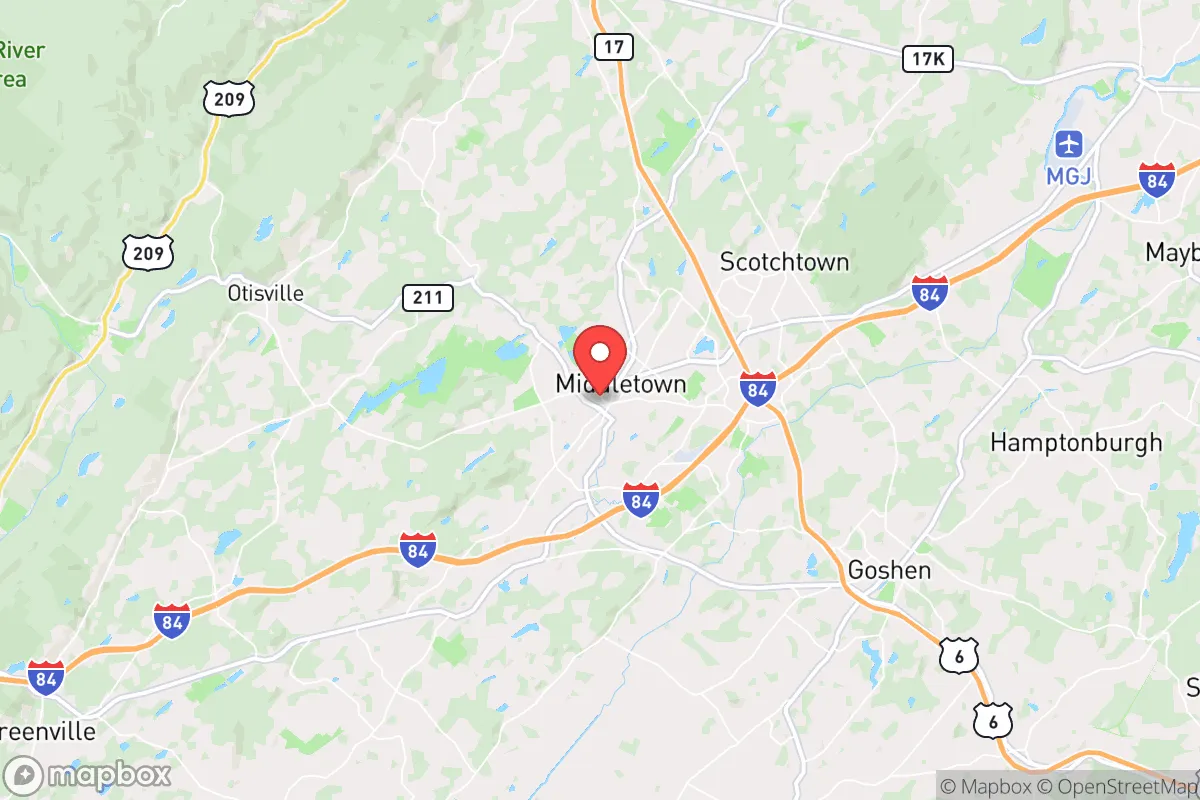
District shown is the primary district for this city’s centroid. Cities may span multiple districts.
Local Political AnalysisPolitical Analysis of Middletown, NY
Middletown, New York, sits in a politically tricky spot, and if you’ve lived here as long as I have, you’ve watched it shift from a reliably moderate, live-and-let-live community to something that feels a lot more progressive—and frankly, a lot more intrusive. The Cook PVI rating of D+2 tells you the official story, but the real picture is that the city itself has been trending left for a while now, while the surrounding towns in Orange County—like Goshen, Warwick, and Wallkill—still lean pretty conservative. That split creates a constant tug-of-war, and lately, the city council and county government have been pulling harder in a direction that raises some serious eyebrows about personal freedoms.
How it compares
Drive ten minutes outside Middletown, and you’re in a different world. Towns like Chester and Montgomery still vote reliably red, with local boards that push back on state mandates and keep taxes lower. Inside the city limits, though, you’ll see a council that’s been cozying up to Albany’s progressive agenda—think stricter zoning rules that make it harder to build a simple garage or add a fence without a pile of permits, and a police oversight board that’s more about checking boxes than keeping the streets safe. Compared to Newburgh, which is even further left, Middletown is still a bit more grounded, but the gap is closing fast. The real contrast is with the county legislature, where Republicans hold a slim majority and often block the city’s more ambitious proposals—like the recent push for rent control that would have tied up property owners in red tape. That tension is the daily reality here: the city wants to regulate, and the county wants to let people breathe.
What this means for residents
For folks who just want to live their lives without a government official peeking over their shoulder, the trend is concerning. Property taxes have crept up as the city adds more social programs and administrative layers—up about 8% over the last two years, according to local budget reports. You’ll also notice more noise around “equity” initiatives in the school district, which sound nice on paper but often mean new committees and training sessions that pull focus from actual teaching. The biggest red flag for me is the push for a local housing authority with broad powers to inspect rentals and set rent caps—something that could easily turn into a tool for overreach, especially for small landlords who are already struggling with state-level tenant laws. If you value your right to do what you want with your own property, Middletown’s path is worth watching closely.
One thing that still sets Middletown apart from places like Beacon or Kingston is a stubborn streak of independence. You’ll still find plenty of folks at the diner who remember when the city was a farming hub and don’t take kindly to being told how to run their lives. The local gun club has a strong membership, and the annual Orange County Fair draws crowds that aren’t shy about flying the Gadsden flag. But the long-term trajectory is clear: as more people move up from the city for cheaper housing, the voting patterns shift, and with them, the policies. If you’re thinking of relocating here, just know that the political climate is a mixed bag—and the side that likes to regulate is gaining ground.

State Political ClimatePolitical Climate in New York
State Political AnalysisPolitical Environment in the State
New York State has been a reliably blue stronghold for decades, but don't let the statewide numbers fool you—this is a tale of two states. The Democratic coalition is driven by New York City and its immediate suburbs, while the rest of the state votes increasingly red. Over the last 10-20 years, the partisan lean has hardened: Democrats consolidated power in the five boroughs and downstate, while upstate and rural counties have swung hard to the right. In 2024, President Biden won the state by roughly 12 points, but that margin was entirely carried by New York City; outside the city, Donald Trump won by a similar margin. The trajectory is clear: the state is becoming more polarized, with the urban core pulling policy further left while the hinterlands feel increasingly alienated.
Urban vs. rural divide
The political map of New York is a study in extremes. New York City—Manhattan, Brooklyn, Queens, the Bronx, and Staten Island—is the engine of Democratic dominance. Manhattan alone delivers margins of 80-85% for Democrats, while the outer boroughs like Queens and Brooklyn are reliably blue but with growing pockets of conservative resistance, especially among immigrant communities. The immediate suburbs—Nassau County on Long Island and Westchester County north of the city—have trended purple in recent cycles. Nassau County, once a Republican stronghold, flipped to Biden in 2020 and 2024, but local races remain competitive. Upstate New York is a different world. Counties like Otsego, Chenango, and Allegany routinely vote 60-70% Republican. Erie County (Buffalo) and Monroe County (Rochester) are blue islands surrounded by red seas, driven by union-heavy manufacturing and university towns. The Hudson Valley is a battleground: Dutchess County and Orange County are swing areas, while Ulster County leans left. The divide isn't just geographic—it's cultural. Rural voters see Albany as an out-of-touch urban machine, while city voters view upstate as backward. This tension defines every major policy fight.
Policy environment
New York's policy environment is aggressively progressive, and it shows in the tax code. The state has the highest combined state and local tax burden in the nation, with a top income tax rate of 10.9% and property taxes that can exceed 2% of home value annually. The regulatory posture is heavy: rent control in NYC, strict environmental regulations (the Climate Leadership and Community Protection Act mandates 70% renewable energy by 2030), and a $15 minimum wage that's indexed to inflation. Education policy is dominated by the teachers' unions, with school choice virtually nonexistent—charter schools are capped and underfunded. Healthcare is a mixed bag: the state expanded Medicaid under Obamacare and runs its own exchange, but wait times for specialists in rural areas are long. Election laws are among the most liberal in the country: no-excuse absentee voting, early voting, automatic voter registration, and same-day registration. The state also passed the New York Health Act (single-payer) through the Assembly multiple times, though it's stalled in the Senate. For a conservative, the policy environment feels like a one-party state where the legislature and governor (Kathy Hochul, a Democrat) push through progressive priorities with little opposition.
Trajectory & freedom
New York is becoming less free by almost any measure, and the trend has accelerated since 2020. The SAFE Act of 2013 was the first major gun control law after Sandy Hook, banning "assault weapons" and limiting magazine capacity to 10 rounds. In 2022, the state passed the Concealed Carry Improvement Act (CCIA) after the Bruen decision, which made it a crime to carry a firearm in "sensitive locations" like Times Square, subways, and even private businesses unless the owner posts a sign allowing it. Parental rights took a hit with the Gender Expression Non-Discrimination Act (GENDA) and the state's refusal to require parental notification for school-based mental health services. Medical autonomy is restricted: the state has strict vaccine mandates for healthcare workers and schoolchildren, and during COVID, New York had some of the longest lockdowns and most aggressive mandates in the country. Property rights are under pressure from rent control expansion and the Good Cause Eviction Law (passed in 2024), which limits landlords' ability to evict tenants or raise rents without cause. On the positive side, the state has no right-to-work law, but it also has no income tax on Social Security benefits. The overall trajectory is toward more government control over daily life, especially in housing, health, and education.
Civil unrest & political movements
New York has been a flashpoint for political activism on both sides. The Black Lives Matter protests in summer 2020 were massive, especially in NYC, where tens of thousands marched daily for weeks. The state responded with police reform laws, including the repeal of 50-a (which had shielded police disciplinary records). On the right, the Second Amendment movement is strong upstate, with groups like the New York State Rifle and Pistol Association fighting the CCIA in court. Immigration politics are a major fault line: New York is a sanctuary state, with laws prohibiting local law enforcement from cooperating with ICE unless a judge signs a warrant. The influx of migrants from the southern border in 2022-2024 overwhelmed NYC's shelter system, leading to backlash in working-class neighborhoods in Queens and Staten Island. Election integrity is a hot topic: the state's mail-in voting expansion and lack of voter ID laws have fueled distrust among conservatives, though no major fraud has been proven. Secession rhetoric is alive and well—there's a long-running movement for upstate counties to break away and form a new state (the "State of New York" proposal), though it's purely symbolic. A new resident would notice the constant political tension: protests in Albany, dueling rallies in Buffalo, and a general sense that the state is culturally at war with itself.
Projection
Over the next 5-10 years, New York will likely become more progressive in its urban core and more conservative in its rural areas, with the gap widening. Demographic trends favor Democrats: NYC continues to attract young, diverse, left-leaning migrants, while upstate counties are aging and losing population. The state's in-migration is overwhelmingly from abroad (immigrants) and from other blue states, while out-migration is to red states like Florida, Texas, and the Carolinas. This means the political balance in Albany will remain firmly Democratic, with supermajorities in both chambers. Expect more progressive policies: a single-payer healthcare system is possible, rent control will likely expand statewide, and gun laws will tighten further. The Climate Act will drive up energy costs as fossil fuels are phased out. For a conservative moving in now, the next decade will feel like living in a one-party state where your vote for governor or state legislature is essentially meaningless. The only check is the courts, but the state's judiciary is increasingly progressive after Hochul's appointments. The practical takeaway: if you value low taxes, gun rights, school choice, and limited government, New York is a tough place to live, and it's only getting tougher.
For a conservative considering relocation, New York offers a stark choice. The state's urban centers provide unmatched economic opportunity and cultural amenities, but at the cost of high taxes, heavy regulation, and a political climate that's hostile to traditional values. If you're a single professional in finance or tech, Manhattan might be worth the trade-off. But if you're a parent looking for good schools, safe neighborhoods, and freedom to raise your kids as you see fit, the suburbs and upstate areas are increasingly strained by Albany's policies. The bottom line: New York is a beautiful state with great people, but its government is moving in a direction that makes it hard to recommend for conservatives unless you're willing to fight every day for your rights. If you do move here, get involved in local politics—it's the only way to push back.
* Values derived from national, state, county, city and local statistics and may differ in a specific area. Last updated: 2026-05-01T10:46:22.000Z
Narrative content on this page is AI-generated and may contain mistakes. Verify any details that matter before acting on them.
ReloMaps may earn a commission from affiliate links at no extra cost to you.

