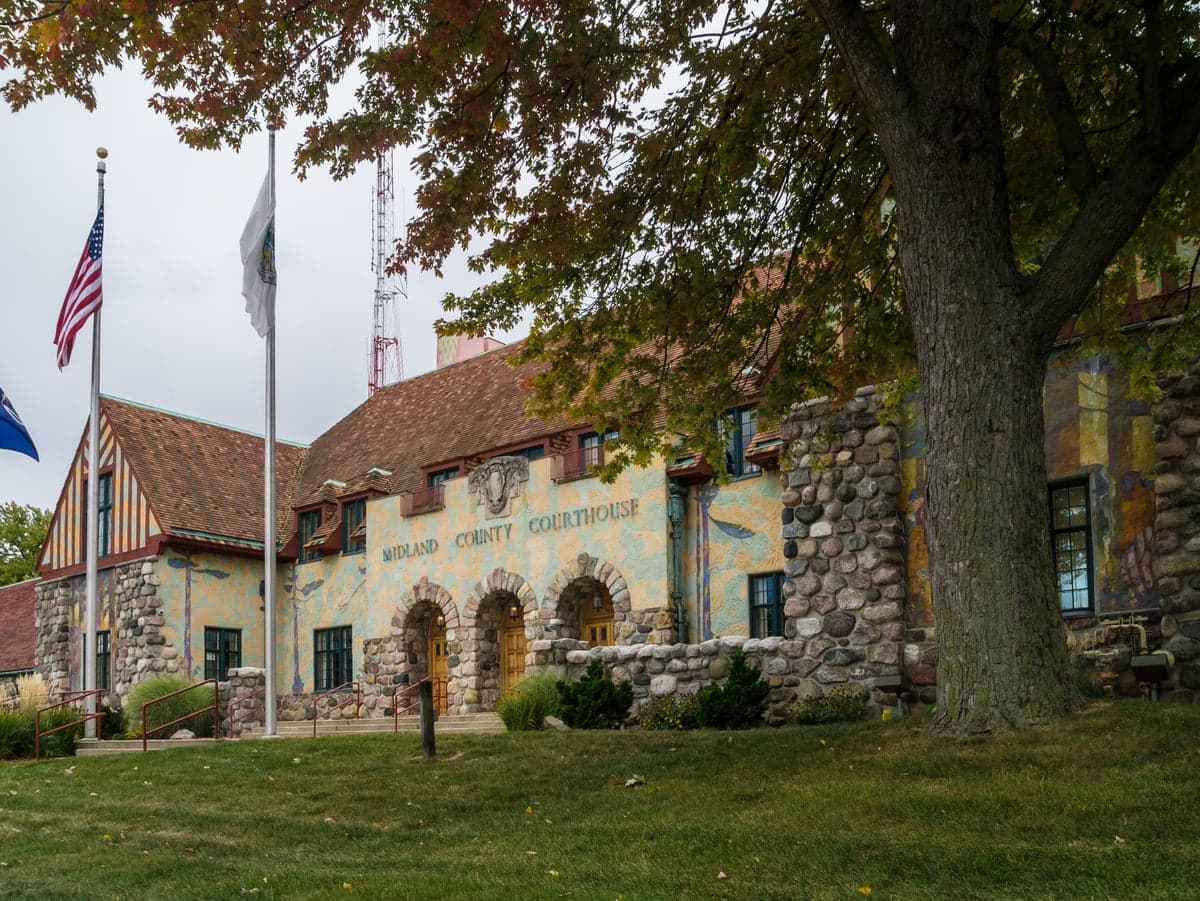
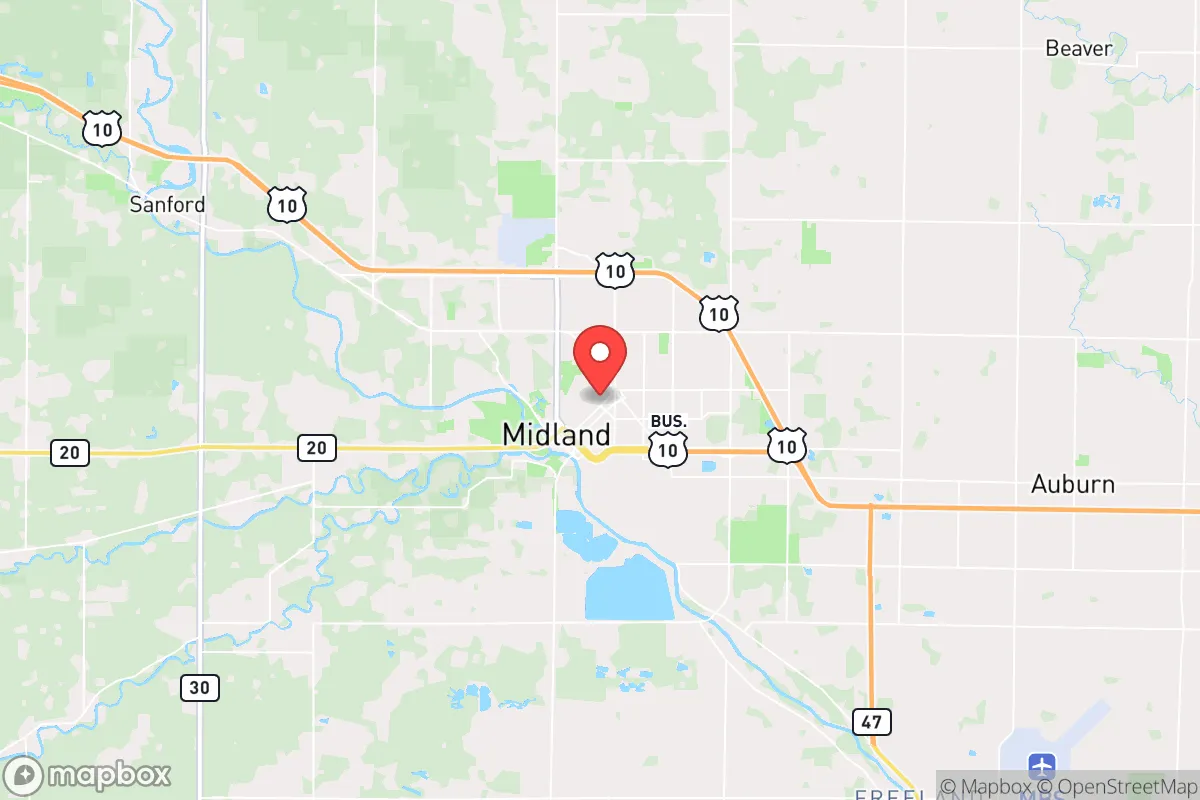

Photo: Wikipedia
Demographics of Midland, MI
Affluence Level in Midland, MI
A middle-class area roughly in line with national averages across income, home values, education, and employment.
People of Midland, MI
Midland, Michigan, is a city of 42,461 residents that blends a historically corporate, white-collar identity with a strong sense of community rooted in the chemical industry. The population is notably homogeneous — 86.5% white — and highly educated, with 45.5% holding a college degree, a figure that reflects the gravitational pull of The Dow Chemical Company. The city’s character is defined by a quiet, family-oriented stability, a low foreign-born rate of 1.7%, and a demographic profile that has changed only modestly over the past half-century.
How the city was settled and grew
Midland’s population history is inseparable from the rise of The Dow Chemical Company, founded in 1897 by Herbert H. Dow. The original settlers were a mix of Yankee entrepreneurs and German and Irish immigrants who arrived to work in the salt wells and lumber mills that preceded Dow’s chemical operations. The company’s explosive growth in the early 20th century drew a wave of skilled workers and engineers, many from the Midwest and Northeast, who settled in the Dow Gardens and West Midland neighborhoods — areas that remain among the city’s most affluent and stable. A second wave of European immigrants, primarily Polish and Italian, arrived between 1910 and 1930 to fill factory jobs, establishing roots in the East End near the plant and along the Saginaw River. By 1950, Midland was a company town in the truest sense, with Dow’s campus and housing policies shaping the city’s layout and social fabric.
Modern era (post-1965)
After the 1965 Immigration and Nationality Act, Midland saw only a trickle of new foreign-born residents, a pattern that persists today. The city’s 1.7% foreign-born share is far below the national average, and the population has remained overwhelmingly white. The modest growth of the Hispanic community (4.6%) and Black community (2.3%) has been concentrated in the South Side and near the Midland Mall corridor, where rental housing and service-sector jobs are more available. The East/Southeast Asian population (1.6%) and Indian-subcontinent population (1.7%) are small but visible, largely composed of professionals and researchers recruited by Dow and its spinoff, Dow Corning. These families tend to settle in the Northwood University area and the newer subdivisions off East Wackerly Road, where larger homes and good schools are the draw. The city’s overall racial and ethnic composition has shifted only incrementally since 1970, with white population share declining from roughly 97% to 86.5% — a change driven more by out-migration of younger whites to larger metros than by significant in-migration of minorities.
The future
Midland’s population is projected to remain stable or decline slightly over the next decade, as the city’s aging white population (median age ~40) is not being replaced by younger families at the same rate. The Indian and East/Southeast Asian communities are likely to grow slowly, as Dow and the healthcare sector continue to recruit specialized talent, but these groups are small enough that they will not dramatically alter the city’s demographic character. The Hispanic population may see modest growth through natural increase and some migration from Saginaw and Bay City, but Midland lacks the low-skilled job base to attract large numbers of new immigrants. The city is not tribalizing into distinct ethnic enclaves; rather, it is homogenizing further as younger, more diverse residents leave for larger cities and are replaced by retirees and remote workers drawn to the area’s low crime and good schools. The Downtown district, revitalized with new apartments and restaurants, is attracting some empty-nesters and young professionals, but the overall trend is toward a quieter, older, and whiter population base.
For a conservative-leaning mover, Midland offers a stable, safe, and highly educated community where the corporate culture of Dow still sets the tone. The city is not becoming more diverse in any meaningful sense, and its future is one of slow demographic drift rather than rapid change. New residents will find a place that values continuity, family, and a low-tax, low-crime lifestyle — but should expect a population that looks and thinks much like it did a generation ago.

* Values derived from national, state, county, city and local statistics and may differ in a specific area. Last updated: 2026-04-29T21:13:13.000Z
Narrative content on this page is AI-generated and may contain mistakes. Verify any details that matter before acting on them.
ReloMaps may earn a commission from affiliate links at no extra cost to you.

