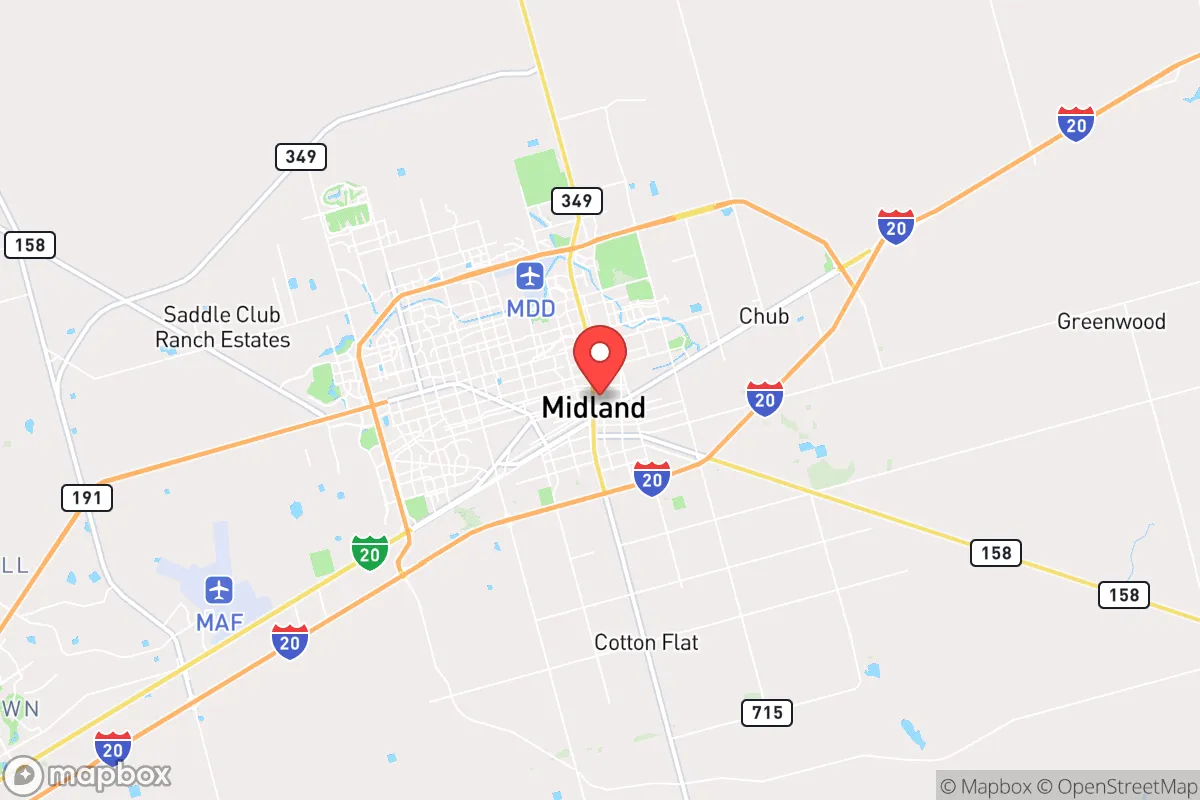
Strategic Assessment of Midland, TX
Workable tactical position. Some exposure to population density or targets, but generally defensible in a crisis.
What does the Strategic Assessment tell us?
Our Strategic Assessment grades tactical survivability of an area. Major population centers, military targets, fallout zones, natural disasters, and border exposure all drive risk — lower exposure means a more defensible position in a crisis.
This is heavily inspired by Joel Skousen's Strategic Relocation book. Highly recommended you checkout the book ($)What does this tell us?
Our Strategic Assessment grades tactical survivability of an area. Major population centers, military targets, fallout zones, natural disasters, and border exposure all drive risk — lower exposure means a more defensible position in a crisis.
This is heavily inspired by Joel Skousen's Strategic Relocation book. Highly recommended you checkout the book ($)Strategic Pillars

Key Distances
Regional Safe Places
Below is our recommended "safe zones" in Texas and the surrounding area based on our strategic heuristics. For most people, it's unrealistic to live in a “safe zone” full-time due to work, family or other personal reasons. They tend to be more rural. However, many of these areas are perfect for second homes and retreat properties that double as a vacation home or even a short-term rental.

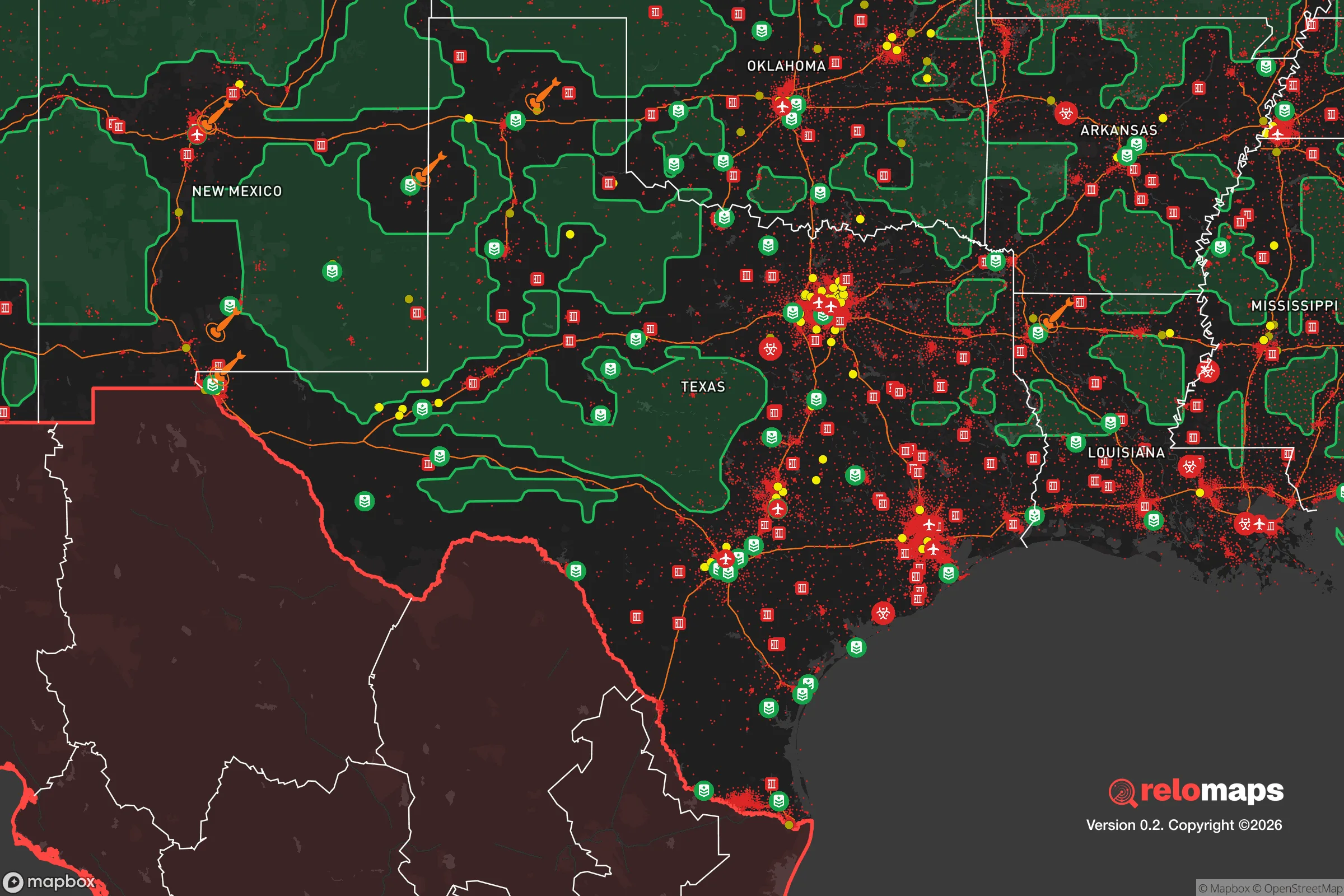


Important Note: For informational purposes only. This does not mean nothing bad ever happens in the green zones. Please use common sense. This is based on public data and modeled with AI. We tried to take a conservative approach but mistakes happen. We update this regularly as new information becomes available.
Solar Generator Recommendations
Backup power matters more here than in safer locations. We've picked three solar generators across budgets and capacity tiers — start with the budget unit if you only need a few essentials, or step up if you want to run a fridge and HVAC for days at a time.

Jackery Portable Power Station Explorer 300
Budget OptionPower on the Go: Weighing only 11 lbs, it's convenient to set up and store with book-sized foldable solar panels

BLUETTI Portable Power Station AC180
Designed for both indoor and outdoor scenarios, AC180 is highly capable as it has a robost capacity and continuous output power.

EF ECOFLOW DELTA Pro Ultra Power Station
Upgraded PickEcoFlow DELTA Pro Ultra is a whole-home energy system designed to grow with your family. Integrated with the Smart Home Panel 2, it scales to meet your evolving energy needs — keeping your home powered, intelligent, and secure through every stage of life.
We earn a commission, at no additional cost to you.
Strategic Assessment Analysis
Midland, Texas, sits at the heart of the Permian Basin, offering a strategic relocation option for those prioritizing energy independence, geographic isolation from major population centers, and a deeply conservative cultural foundation. Its primary resilience advantage is simple: the local economy and infrastructure are built around the one resource that keeps modern civilization running—oil and natural gas. For a prepper or survivalist, this means the area is less likely to experience the kind of cascading collapse seen in regions dependent on fragile supply chains. Midland is roughly 300 miles from Dallas, 300 miles from El Paso, and 320 miles from the Mexican border, placing it far enough from major cities to avoid the immediate fallout of civil unrest or a mass casualty event, yet close enough to the Permian’s energy assets to offer a unique form of strategic leverage.
Geographic position and natural advantages for long-term security
Midland’s location on the southern High Plains provides a flat, arid landscape that is both a blessing and a curse for survival planning. The area’s primary natural advantage is its position atop the Permian Basin, one of the most productive oil and gas fields in the world. This means that even in a grid-down scenario, the region has the raw materials and industrial knowledge to maintain local fuel production—something few other places in the country can claim. The climate is semi-arid, with average annual rainfall around 14 inches, which limits the risk of flooding but also means water is a critical concern. The Ogallala Aquifer lies to the east, but Midland itself relies on surface water from the Colorado River Municipal Water District and local groundwater. For a relocator, this means you need to plan for water storage and possibly drilling a private well if you’re outside city limits. The flat terrain offers excellent line-of-sight for security and long-range observation, but it also provides little natural cover. The lack of dense forests or mountains means you can’t easily hide, but you also can’t be easily ambushed. The area’s low population density—about 140,000 people in the city proper, with a county population under 200,000—means fewer targets for looters or organized chaos during a breakdown.
Risks, exposures, and proximity to fallout-relevant landmarks
Midland’s biggest exposure is its dependence on the oil and gas industry, which creates a single-point-of-failure economy. If the energy sector collapses due to a global crisis, the local economy would crater faster than a diversified region. However, for a prepper, this is a double-edged sword: the same industry that creates risk also provides the fuel, equipment, and skilled labor needed for self-sufficiency. The area is far from any major military installations that could become targets in a conflict—the closest is Fort Bliss in El Paso, over 300 miles away. There are no nuclear power plants within 200 miles, and the nearest major petrochemical complexes are in the Houston area, over 400 miles away. This makes Midland relatively safe from direct fallout or targeted strikes. The biggest man-made risk is actually the Permian Basin itself: a major pipeline rupture or well fire could create localized environmental hazards, but these are manageable with proper planning. The area is also prone to occasional severe weather, including dust storms, hail, and the rare tornado, but it sits outside the traditional Tornado Alley core. For a relocator concerned with civil unrest, Midland’s distance from large cities like Dallas, San Antonio, and Austin means you’re unlikely to see the kind of mass migration or looting that would hit closer suburbs. The local population is heavily armed and culturally conservative, which acts as a deterrent to organized chaos.
Practical resilience for a relocator: food, water, energy, and defensibility
For a survivalist, Midland offers a mixed bag of practical resilience factors. Energy is the strongest asset: you can source propane, diesel, and gasoline locally, and many residents already have generators and solar setups due to the area’s frequent power fluctuations during storms. The high number of sunny days (over 260 per year) makes solar a viable supplement, though you’ll need battery storage for the occasional dust storm that can cut solar output. Water is the weakest link: the area’s semi-arid climate means you cannot rely on surface water sources like creeks or rivers—the few that exist, like the Colorado River tributaries, are seasonal and often dry. You’ll need to invest in rainwater catchment (roof area is key) and deep well drilling if you’re on rural land. The city’s water supply is treated and reliable, but a grid-down scenario would require stored reserves. Food production is possible but challenging: the growing season is long (March to November), but the soil is sandy and alkaline, requiring raised beds and heavy amendment. Local farmers’ markets exist, but they’re small. For long-term food security, you’d need to plan for greenhouse growing and possibly livestock—chickens and goats are common in the surrounding county. Defensibility is moderate: the flat terrain makes it hard to conceal a retreat, but it also gives you clear sightlines. Rural properties outside the city offer space for perimeter security, and the local sheriff’s department is well-funded from oil taxes. The community is tight-knit and suspicious of outsiders, which is a double-edged sword—you’ll need to build trust to be part of the local network, but once you do, you’ll have a reliable mutual-aid group. The area’s strong gun culture means most households are armed, and the local gun stores and ranges are plentiful.
The overall strategic picture for Midland is one of high energy security offset by moderate water risk and geographic isolation from major threats. For a conservative relocator with a prepper mindset, this is a solid choice if you’re willing to invest in water infrastructure and accept a harsh, arid environment. You won’t have the lush forests or abundant water of the Pacific Northwest, but you also won’t have the population density, crime, or political instability of a coastal city. Midland’s economy is boom-and-bust, but that volatility is a feature, not a bug—it keeps out the kind of people who aren’t serious about self-reliance. The area’s distance from fallout-relevant targets, its energy independence, and its culturally aligned population make it a defensible, low-profile option for those looking to ride out the coming storms. Just bring your own water plan and a willingness to dig in for the long haul.

* Values derived from national, state, county, city and local statistics and may differ in a specific area. Last updated: 2026-04-18T19:25:16.000Z
Narrative content on this page is AI-generated and may contain mistakes. Verify any details that matter before acting on them.
ReloMaps may earn a commission from affiliate links at no extra cost to you.

