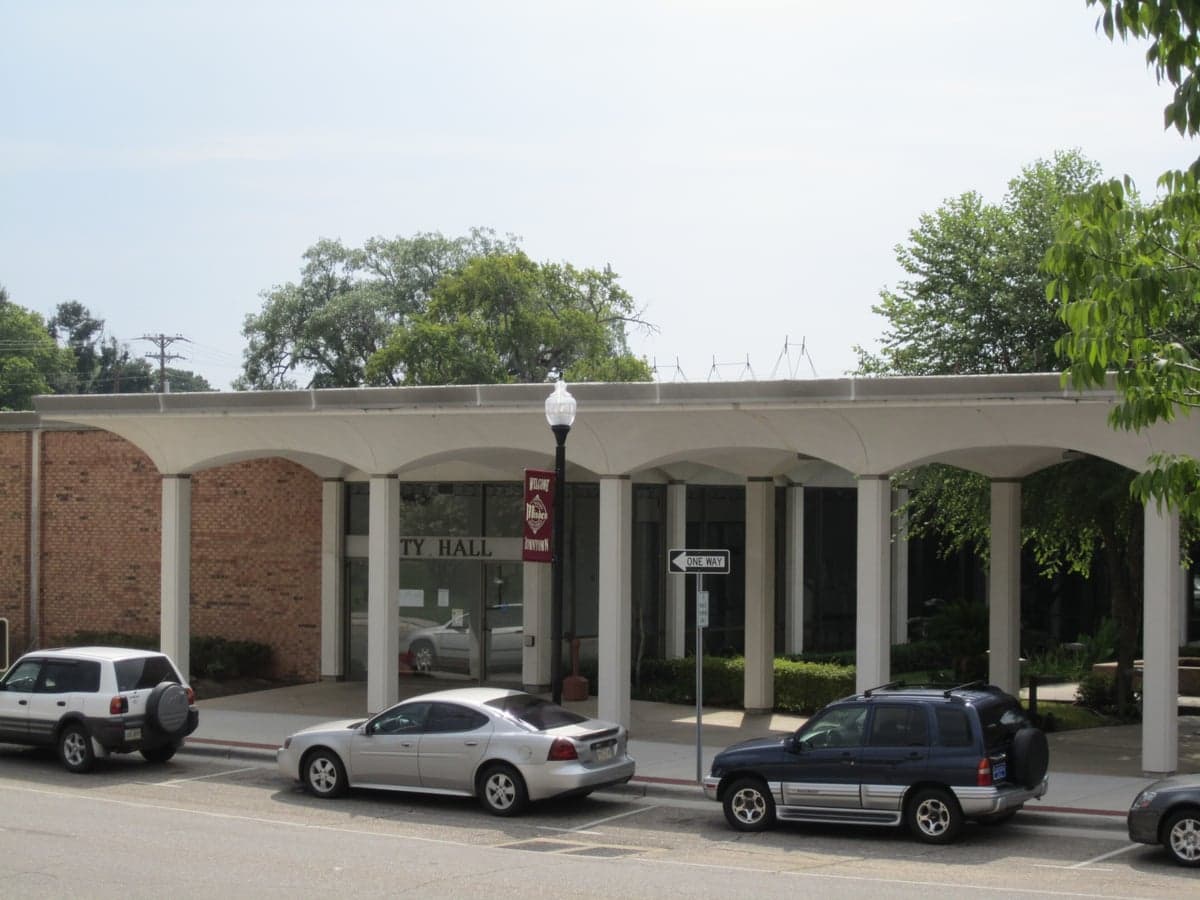
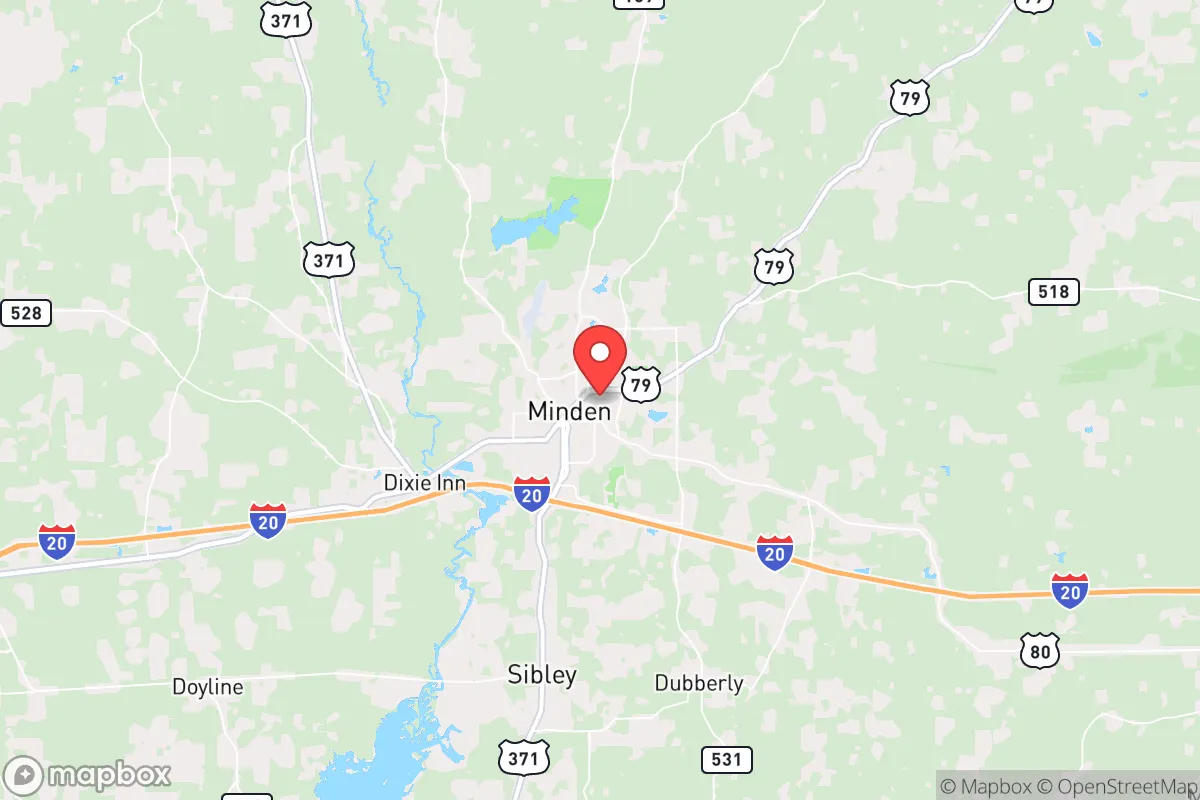
Photo: Wikipedia
Demographics of Minden, LA
Affluence Level in Minden, LA
A below-average socioeconomic profile. Incomes, home values, and educational attainment trail the U.S., with higher poverty and unemployment.
People of Minden, LA
Minden, Louisiana, is a small city of 11,604 residents where the population is almost evenly split between Black (50.4%) and White (44.1%) residents, a demographic balance shaped by distinct settlement waves and economic shifts. The city’s character is rooted in its role as a regional industrial and railroad hub, with a population density of roughly 1,100 people per square mile and a notably low foreign-born share of just 1.3%. Today, Minden is a community where historic racial boundaries persist in neighborhood patterns, but where a shared small-town identity and conservative values—reflected in its strong church presence and family-oriented lifestyle—unite many residents.
How the city was settled and grew
Minden’s founding in 1836 by German immigrant Charles Veeder set the stage for a population built on commerce and industry. The original settlers were Anglo-American farmers and merchants drawn by the fertile red clay soil and the promise of the Minden-Ruston stagecoach route. The arrival of the Vicksburg, Shreveport & Pacific Railroad in the 1850s transformed the town into a shipping point for cotton and timber, attracting a wave of white laborers and small-business owners who settled in what is now Germantown, a historic district near the railroad tracks where German and Scots-Irish families built modest frame houses. By the early 1900s, the lumber boom brought a second wave: Black workers from rural Webster Parish and neighboring counties, who established the College Heights neighborhood around the former Webster Parish Training School (later Minden High School’s Black campus). This area became the cultural and commercial heart of the Black community, with its own stores, churches, and a Masonic lodge. A third wave arrived during World War II, when the Louisiana Army Ammunition Plant (now the Minden Industrial Park) opened, drawing white and Black workers from across the South. Many of these workers settled in Eastside, a mixed-income area east of the railroad that grew rapidly with government-built housing for plant employees.
Modern era (post-1965)
The post-1965 era brought significant demographic change as the Civil Rights movement dismantled legal segregation and the ammunition plant’s workforce shifted. The 1970s and 1980s saw white flight from the city core to newly developed subdivisions like Northwood Estates and Southfield, both predominantly white neighborhoods with larger lots and newer homes. Meanwhile, Black families moved into previously white areas near downtown, such as the West End district, which transitioned from majority-white to majority-Black between 1970 and 1990. The Hispanic population, now 2.1%, began arriving in the 1990s, drawn by construction and poultry-processing jobs at the nearby Pilgrim’s Pride plant in neighboring Homer; these families concentrated in the Minden South area near Highway 79, where a small cluster of Mexican grocery stores and churches now serves the community. The Asian population (0.6%) and Indian population (0.1%) remain tiny, mostly professionals employed at the local hospital or at the Louisiana Tech University campus in Ruston, 20 miles east. The foreign-born share has never exceeded 2%, making Minden one of the least diverse cities in Louisiana by immigrant status. The college-educated share of 15.5% is well below the national average, reflecting the area’s reliance on blue-collar manufacturing and logistics jobs rather than knowledge-economy employment.
The future
Minden’s population is slowly aging and declining—down from 13,082 in 2010—as younger residents leave for larger metros like Shreveport or Dallas. The Black and White shares are likely to remain roughly equal for the next decade, as both groups experience similar out-migration rates. The Hispanic population is growing slowly, but from a very small base, and is unlikely to exceed 5% by 2035 unless a major employer relocates to the area. The East/Southeast Asian and Indian communities are expected to remain negligible, as the city lacks the professional job base or university presence to attract them. Neighborhoods are becoming more racially homogenous rather than integrating: Northwood Estates and Southfield remain over 90% white, while College Heights and West End are over 85% Black. The Germantown historic district is seeing some reinvestment from young white families drawn to its affordable Victorian homes, but this is a small trend. The overall trajectory is one of slow shrinkage and racial consolidation, with little new immigration to alter the city’s demographic character.
For someone moving to Minden now, the city offers a stable, racially balanced community with a strong sense of local identity and low cost of living, but limited economic opportunity and minimal ethnic diversity. The population is not homogenizing into a single melting-pot identity; rather, it is settling into distinct, historically rooted enclaves where race and neighborhood remain closely linked. New residents should expect a place where church, family, and local sports define social life, and where the demographic patterns of the 20th century continue to shape daily interactions.

* Values derived from national, state, county, city and local statistics and may differ in a specific area. Last updated: 2026-05-04T11:09:44.000Z
Narrative content on this page is AI-generated and may contain mistakes. Verify any details that matter before acting on them.
ReloMaps may earn a commission from affiliate links at no extra cost to you.

