
Photo: Wikipedia
Demographics of Alcorn County
Affluence Level in Alcorn County
A below-average socioeconomic profile. Incomes, home values, and educational attainment trail the U.S., with higher poverty and unemployment.
People of Alcorn County
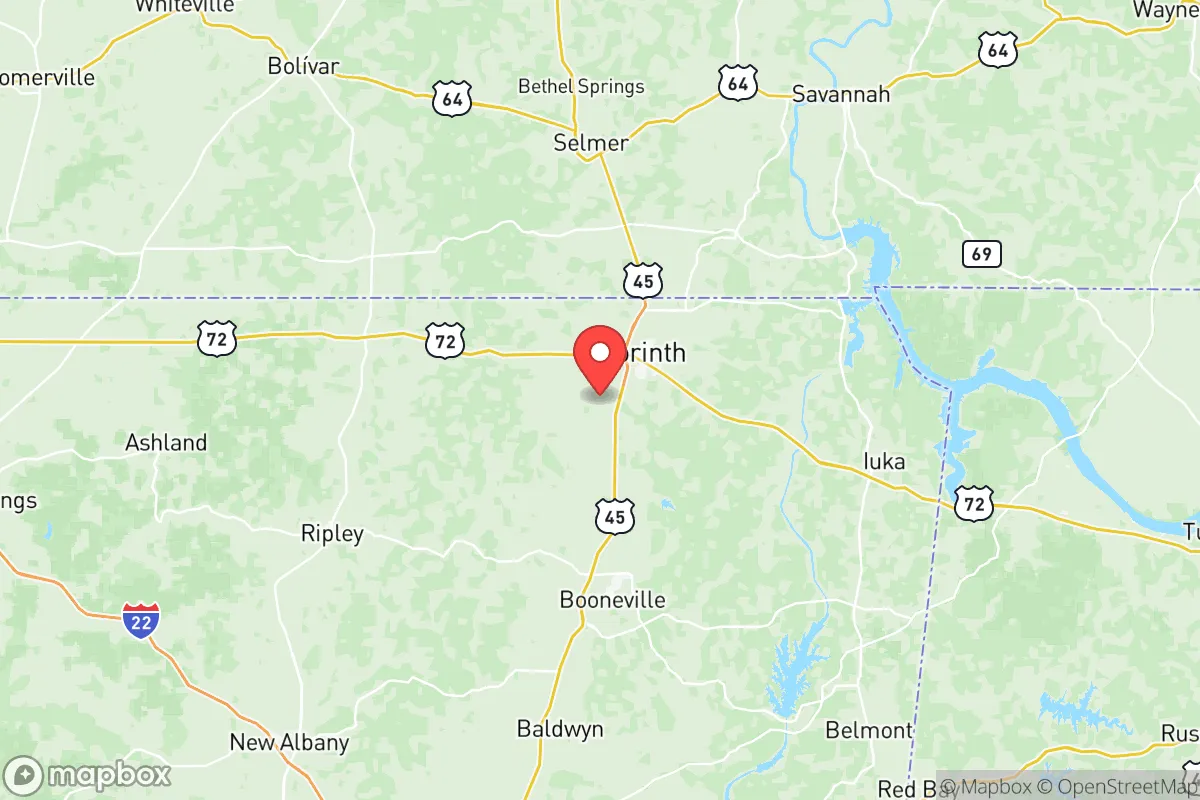
Alcorn County, Mississippi, is home to approximately 34,500 residents, a predominantly rural and small-town population that remains overwhelmingly native-born and white (80.3%), with a significant Black minority (10.6%) and a very small Hispanic community (3.7%). The county’s foreign-born population is just 0.5%, one of the lowest rates in the nation, reflecting a deeply rooted, multi-generational American populace. The county seat, Corinth, serves as the historic and economic hub, where the legacy of railroad and Civil War history blends with a quiet, family-oriented present. For those moving in, Alcorn County offers a stable, low-density community where change is gradual and traditional Southern identity remains strong.
Settlement & growth (pre-1960)
Before European settlement, the area now known as Alcorn County was part of the traditional homeland of the Chickasaw Nation, who controlled much of northeast Mississippi and west Tennessee. The Chickasaw were forcibly removed via the Treaty of Pontotoc Creek in 1832 and the subsequent Trail of Tears in the 1830s, opening the land to white settlement. The county itself was formed in 1870, carved from Tishomingo County and named for James L. Alcorn, a Reconstruction-era governor of Mississippi.
The first major wave of American settlers arrived in the 1830s and 1840s, primarily Scots-Irish and English yeoman farmers from the Upper South—Virginia, North Carolina, and Tennessee. These families were drawn by cheap, fertile land in the Black Prairie region and the promise of cotton-based agriculture. They established small farming communities like Kossuth, Rienzi, and Farmington, which remain unincorporated settlements today. Unlike the Delta region, Alcorn County had few large plantations; most farms were modest, family-run operations.
The county’s trajectory changed dramatically with the arrival of the Memphis and Charleston Railroad in the 1850s, which made Corinth a critical rail junction. During the Civil War, Corinth was a strategic prize, leading to the bloody Siege of Corinth in 1862. After the war, the railroad spurred modest industrial growth, including timber and cotton processing. African Americans, newly freed after the Civil War, remained in the area as sharecroppers and tenant farmers, forming the foundation of the county’s Black population, which today concentrates in Corinth and the rural community of Biggersville.
Through the early 20th century, Alcorn County remained overwhelmingly agricultural and rural. The Great Migration (1910–1970) saw many Black residents leave for industrial cities in the North, reducing the county’s Black share from roughly 30% in 1900 to its current 10.6%. White outmigration was less pronounced, but many young people left for Memphis or Birmingham. The county’s population peaked around 34,000 in 1940 and then stagnated for decades, as the local economy—based on cotton, timber, and small manufacturing—offered limited opportunity.
Modern era (post-1965)
The 1965 Hart-Cellar Act had virtually no impact on Alcorn County. With a foreign-born population of just 0.5%, the county has seen almost no international immigration. Unlike much of the South, which experienced a surge of Hispanic and Asian immigrants in the 1990s and 2000s, Alcorn County remained overwhelmingly native-born. The small Hispanic population (3.7%) is largely composed of families who moved from other U.S. states for work in poultry processing and light manufacturing, particularly at plants in Corinth and nearby communities like Glen.
Domestic migration has been the primary demographic force since 1970. The county has experienced a slow, steady influx of retirees and families from the Rust Belt—especially Illinois, Indiana, and Ohio—drawn by lower housing costs, a slower pace of life, and the region’s reputation for conservative values. These newcomers tend to settle in Corinth and the newer subdivisions around Jumpertown and Hinkle. At the same time, many native-born young adults continue to leave for college or jobs in Memphis (90 minutes north) or Tupelo (60 minutes south), contributing to an aging population.
Suburbanization has been modest. Corinth remains the dominant population center, with about 14,500 residents, while the rest of the county is rural or in small unincorporated communities. There has been no significant exurban boom; Alcorn County lacks a major interstate highway (the nearest is I-22, about 30 miles south) and has limited retail and healthcare infrastructure. The county’s racial composition has remained remarkably stable: the white share has hovered around 80% for decades, while the Black share has slowly declined due to outmigration. The Asian and Indian populations are effectively zero, and the county has no identifiable ethnic enclaves.
The future
Alcorn County is projected to remain one of Mississippi’s least diverse counties. The foreign-born share is unlikely to rise significantly, as the area lacks the job base or immigrant networks that drive international migration. The Hispanic population may grow slowly, driven by natural increase and continued domestic migration for manufacturing jobs, but will likely remain below 5% for the foreseeable future. The Black population is expected to hold steady or decline slightly, as younger Black residents continue to leave for larger cities.
The county’s overall population is aging and may begin a slow decline in the next decade, as deaths outpace births and outmigration continues. However, the county could see modest growth if remote work enables more urban refugees to relocate from high-cost areas. Communities like Corinth and Farmington may attract a small number of telecommuters and retirees, but the county lacks the amenities—airports, cultural institutions, major employers—to draw large numbers. The cultural identity of Alcorn County will likely remain deeply Southern, conservative, and church-oriented, with little pressure to change.
For someone moving in now, Alcorn County represents a choice for stability over dynamism. It is a place where the population is homogeneous, the pace is slow, and the future looks much like the past. New residents will find a welcoming, family-oriented community, but should expect limited diversity, modest economic opportunity, and a population that is gradually shrinking and aging.

* Values derived from national, state, county, city and local statistics and may differ in a specific area. Last updated: 2026-08-08T19:13:39.000Z
Narrative content on this page is AI-generated and may contain mistakes. Verify any details that matter before acting on them.
ReloMaps may earn a commission from affiliate links at no extra cost to you.

