
Photo: Wikipedia
Strategic Assessment of Alcorn County
Workable tactical position. Some exposure to population density or targets, but generally defensible in a crisis.
What does the Strategic Assessment tell us?
Our Strategic Assessment grades tactical survivability of an area. Major population centers, military targets, fallout zones, natural disasters, and border exposure all drive risk — lower exposure means a more defensible position in a crisis.
This is heavily inspired by Joel Skousen's Strategic Relocation book. Highly recommended you checkout the book ($)What does this tell us?
Our Strategic Assessment grades tactical survivability of an area. Major population centers, military targets, fallout zones, natural disasters, and border exposure all drive risk — lower exposure means a more defensible position in a crisis.
This is heavily inspired by Joel Skousen's Strategic Relocation book. Highly recommended you checkout the book ($)Strategic Pillars

Key Distances
Strategic Assessment Analysis
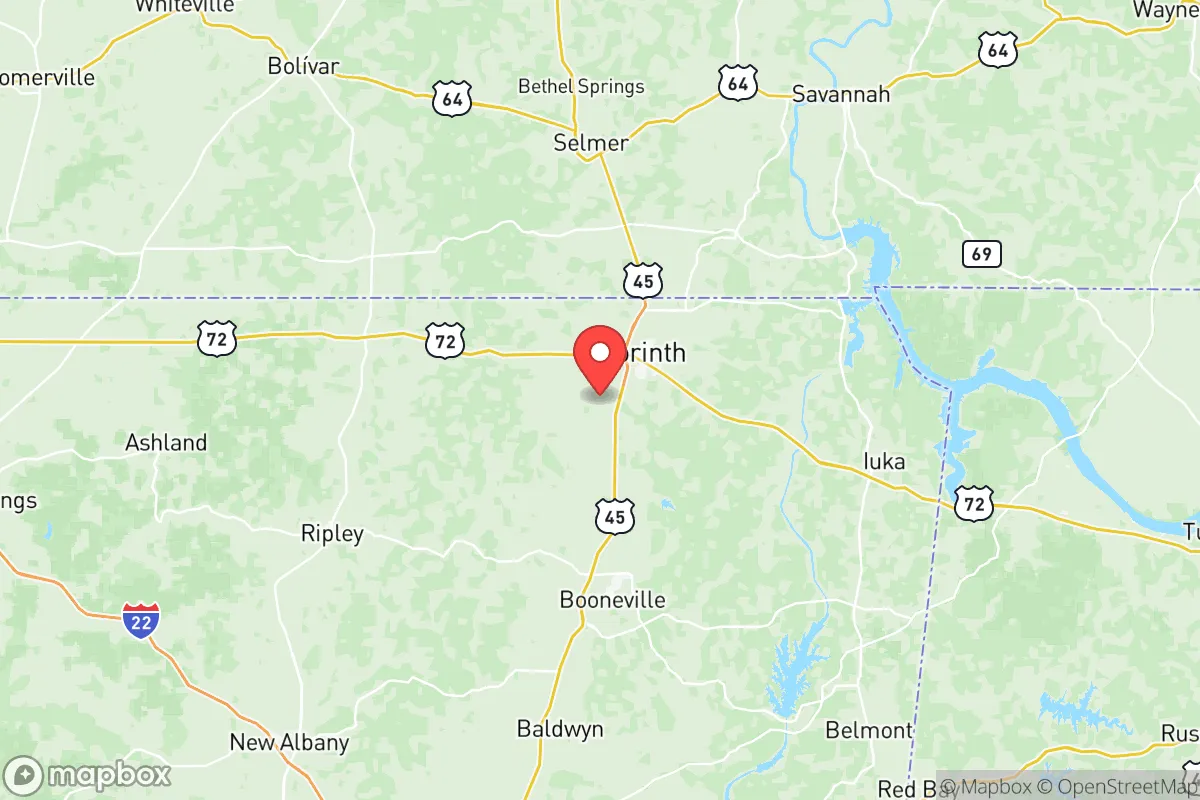
Alcorn County, Mississippi, offers a strategic blend of geographic insulation and practical self-sufficiency that appeals to relocation-minded individuals and families prioritizing resilience. Anchored by the city of Corinth, the county sits in the far northeastern corner of the state, roughly 90 miles east of Memphis and 100 miles west of Huntsville, Alabama — close enough to access major medical and supply hubs, yet far enough to avoid the immediate fallout risks associated with those larger metropolitan areas. The county’s position along the Tennessee River and its proximity to the Pickwick Lake reservoir provide natural water security, while the surrounding hill country and mixed hardwood forests offer defensible terrain and off-grid potential. For a reader thinking seriously about disaster readiness, Alcorn County presents a credible middle-ground option: not a remote wilderness, but not a suburban spillover zone either.
Geographic position and natural advantages for self-sufficiency
Alcorn County’s geography is defined by the Tennessee River’s impoundment at Pickwick Lake, which forms the county’s northern and western borders. This water feature is a major asset for long-term resilience: Pickwick Lake is a U.S. Army Corps of Engineers-managed reservoir with stable water levels, and the Tennessee River itself provides a navigable waterway that connects to the broader inland river system. The county sits within the Highland Rim physiographic region, characterized by rolling hills, limestone bluffs, and elevations ranging from 400 to 600 feet above sea level — high enough to avoid floodplain risks along the river, but not so rugged as to hinder access or construction. Soils in the area are predominantly silt loams and clay loams, suitable for small-scale agriculture, though row-crop farming is limited compared to the Mississippi Delta. The county’s 400 square miles include roughly 60% forest cover, offering timber resources, firewood, and wildlife for hunting. For a relocator, the key takeaway is that Alcorn County has reliable surface water, moderate defensible terrain, and enough arable land to support a garden or small homestead without requiring extreme off-grid adaptation.
Risks, exposures, and proximity to fallout-relevant landmarks
No location is without risk, and Alcorn County’s resilience profile includes several exposures worth weighing. The most significant man-made risk is the Tennessee Valley Authority’s (TVA) Browns Ferry Nuclear Plant, located roughly 40 miles northeast in Limestone County, Alabama. While 40 miles is outside the typical 10-mile emergency planning zone, it falls within the 50-mile ingestion pathway zone used by the NRC for long-term fallout considerations. Prevailing winds in the region are from the south and southwest, which would carry airborne material away from Alcorn County in most scenarios, but a shift during an event could change that calculus. The county is also within 90 miles of the Memphis metropolitan area (population ~1.3 million), which could become a source of evacuation pressure or supply chain disruption during a regional crisis. Natural hazards include tornadoes — Alcorn County sits in the southeastern edge of “Dixie Alley,” with an average of 12 tornado warnings per year — and occasional ice storms that can knock out power for days. Flooding is limited to low-lying areas near the Tennessee River and its tributaries, such as Hatchie Creek and Indian Creek, but most residential development in Corinth and surrounding communities sits on higher ground. Seismic risk is low, as the New Madrid Seismic Zone is roughly 150 miles to the northwest. For a relocator, the nuclear plant is the primary strategic concern, but the distance and prevailing wind patterns reduce its severity compared to living within 20 miles of a reactor.
Practical resilience for a relocator: food, water, energy, and defensibility
Alcorn County’s practical resilience hinges on its water access, energy infrastructure, and community layout. The Tennessee River and Pickwick Lake provide an essentially unlimited surface water source, and the county’s groundwater aquifers — primarily the McNairy and Ripley formations — yield adequate supplies for private wells at depths of 100–300 feet. The county’s electric grid is served by TVA through Alcorn County Electric Power Association, meaning power comes from a diversified mix of hydro, nuclear, and natural gas sources; however, TVA’s centralized grid is vulnerable to regional blackouts, so solar-plus-battery backup is a prudent investment for off-grid capability. Natural gas is available in Corinth and most suburban subdivisions, but rural properties rely on propane or wood heat. For food resilience, the county has a small but active agricultural base: there are roughly 400 farms in Alcorn County, with the most common products being hay, cattle, poultry, and timber. The Corinth Farmers Market operates seasonally, and local hunting for white-tailed deer and wild turkey is permitted on public lands like the 12,000-acre Pickwick Wildlife Management Area. Defensibility is moderate: the county’s road network is dominated by U.S. Highway 72 and State Route 2, both of which provide egress routes toward Alabama and Tennessee, but the rural road system includes numerous dead-end gravel roads and choke points that could be monitored or controlled. The county seat of Corinth has a historic downtown grid layout, but most residential areas are spread out, reducing population density and making it harder for external threats to concentrate. For a relocator, the practical takeaway is that Alcorn County offers strong water security, adequate energy options with some grid independence, and a defensible rural layout — but food self-sufficiency will require active effort, as the local grocery supply chain depends on regional distribution centers in Memphis and Tupelo.
Overall, Alcorn County presents a balanced strategic picture for the resilience-minded relocator. It avoids the high-risk zones of major metropolitan areas, nuclear plant proximity, and flood-prone lowlands, while retaining access to surface water, moderate defensible terrain, and a functional local economy centered on Corinth’s healthcare, manufacturing, and retail sectors. The county’s primary weaknesses — reliance on TVA grid power, exposure to tornadoes, and distance from specialized medical care — are manageable with planning and investment. For a family or individual looking to establish a long-term base with room for self-sufficiency, Alcorn County offers a credible, grounded option in the Mid-South that balances isolation with access, risk with reward.

* Values derived from national, state, county, city and local statistics and may differ in a specific area. Last updated: 2026-08-08T19:13:39.000Z
Narrative content on this page is AI-generated and may contain mistakes. Verify any details that matter before acting on them.
ReloMaps may earn a commission from affiliate links at no extra cost to you.

