
Photo: Wikipedia
Political ClimatePolitical Climate in Harrison County
Showing district-level results — no local-only data available.
Local Political AnalysisPolitical Analysis of Harrison County
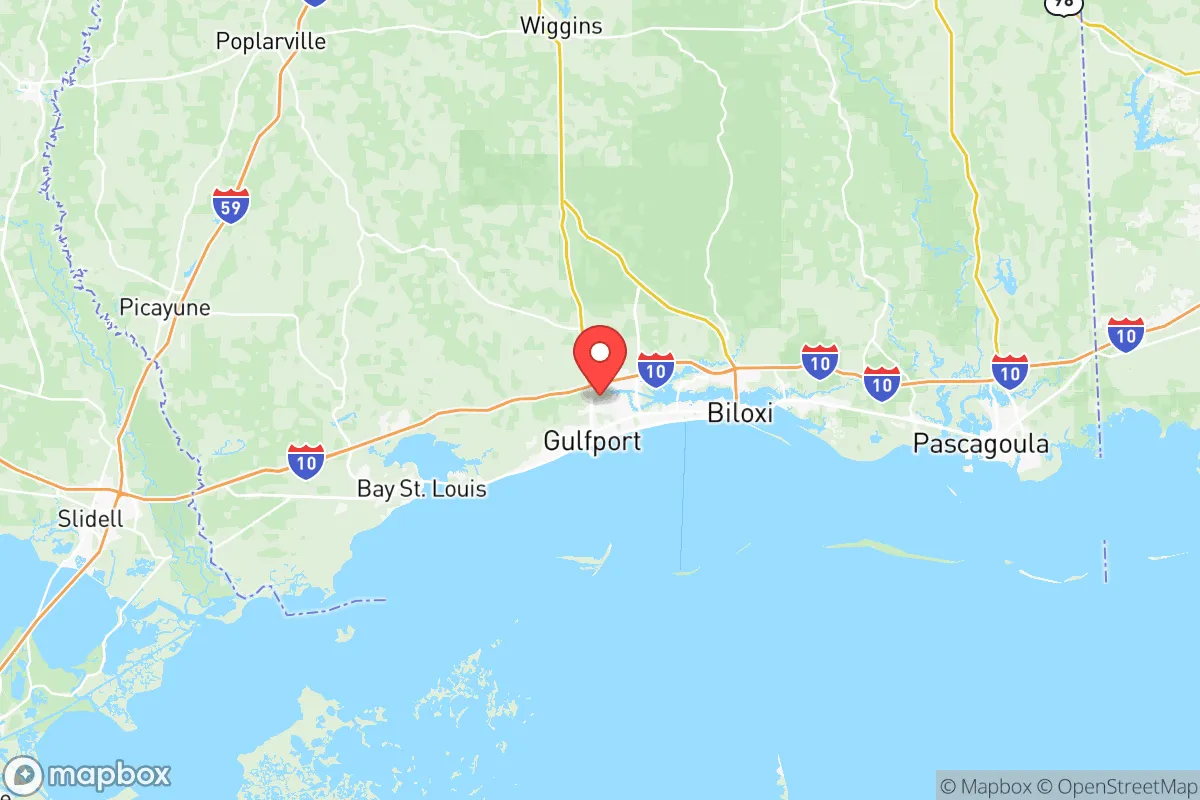
Harrison County, Mississippi, is a solidly conservative area with a Cook PVI of R+21, making it significantly more Republican than the state of Mississippi as a whole, which sits at R+11. This isn't a new development; the county has been a reliable red anchor on the Gulf Coast for decades, but the margin has actually widened in recent cycles as the more rural and suburban precincts have pulled further right. The real story, though, is the growing divide within the county itself, where you can see the political future of the region playing out in real time.
How it compares
While Mississippi as a state is reliably Republican, Harrison County is a whole different beast. The R+21 rating means it's about ten points more conservative than the state average, which is a massive gap. That difference is driven by the county's unique blend of military families from Keesler Air Force Base, a strong blue-collar workforce in the shipyards and casinos, and a deep-rooted evangelical community. Compare that to the state's overall numbers, which are pulled slightly left by the Jackson metro area and the Delta. In Harrison County, you don't see that kind of counterbalance. The real action is inside the county lines. Biloxi and Gulfport are the population centers, and they're reliably red, but they have pockets of blue. The precincts around the downtown areas and near the beach in Biloxi can sometimes swing closer to purple, especially in local races. But drive just a few miles north to D'Iberville or Saucier, and you're in deep-red territory where Republican candidates routinely win by 40 or 50 points. The swing precincts are really in the unincorporated areas and the smaller towns like Long Beach and Pass Christian, where a strong local candidate can sometimes peel off moderate voters, but the overall trend is still solidly conservative.
What this means for residents
For someone living here, the political climate means a government that generally stays out of your personal business. You're not going to see the kind of overreach you hear about in places like California or New York. Property taxes are low, there's no state income tax on wages, and the local school boards and city councils tend to be full of folks who believe in fiscal restraint and local control. That's a big deal. The concern, and it's a real one, is that the progressive ideology that's creeping into other parts of the country is starting to show up in some of the local school board races and city council meetings, especially around issues like curriculum and land use. It's still a small minority, but it's there, and it's something to keep an eye on. The county's strong Republican lean acts as a buffer, but it's not a force field.
On the cultural side, Harrison County has a distinct identity that sets it apart from the rest of Mississippi. The Gulf Coast has always had a more independent, live-and-let-live vibe, influenced by the seafood industry, tourism, and the military presence. You won't find the same kind of strict, dry-county mentality you see in some northern parts of the state. Alcohol is sold freely, casinos are a major economic driver, and the general attitude is more libertarian than the rest of Mississippi. That's a good thing for personal freedom. The long-term trajectory is a bit of a question mark. The county is growing, especially in the northern parts, and that growth brings new people from other states. If those new residents lean left, it could slowly shift the needle. But for now, the core values of limited government, personal responsibility, and a strong work ethic are still the dominant force here. It's a good place to be if you want to be left alone to live your life.

State Political ClimatePolitical Climate in Mississippi
State Political AnalysisPolitical Environment in the State
Mississippi is one of the most reliably Republican states in the country, with a Cook Partisan Voting Index of R+11, meaning it consistently votes about 11 points more Republican than the national average. Over the last two decades, the GOP has tightened its grip on every level of government – the last time a Democrat won statewide was in 2007 – and the state’s social conservatism, low taxes, and resistance to federal overreach make it a frequent destination for families and individuals seeking a government-light environment. Even so, don’t mistake uniform red for static: Jackson remains a stubborn blue island, and suburban growth around Memphis and the Gulf Coast is slowly reshaping the political map in ways worth watching.
Urban vs. rural divide
The classic city-versus-country split is stark here. The state’s only reliably Democratic stronghold is the Jackson metro area – specifically Hinds County, which routinely goes 70% Democratic and is anchored by the state capital’s sizable African American population and public-sector workforce. Meanwhile, the fast-growing suburban counties around Jackson – Madison and Rankin – are among the state’s most conservative, with Rankin County regularly voting north of 75% Republican. On the Gulf Coast, Biloxi, Gulfport, and Pascagoula lean Republican but are less intense; the military presence at Keesler Air Force Base and the tourism economy inject a pragmatic, small-business conservatism. The university towns – Oxford (Lafayette County) and Starkville (Oktibbeha County) – are slight Democratic leaners thanks to student and faculty populations, but they’re surrounded by deep-red countryside. The real engine of Republican dominance is the rural, small-town belt running from the Delta to the Alabama line, plus the explosive growth of DeSoto County (just below Memphis), which has become a solidly Republican exurban powerhouse. Tupelo and Hattiesburg add to the red column, though Hattiesburg’s university presence gives it a purple tint. In short, if you take out Jackson and a handful of small urban cores, Mississippi is overwhelmingly conservative.
Policy environment
State policy reflects the dominant Republican supermajority. Mississippi has a flat personal income tax that is being phased down – starting in 2022, lawmakers passed a series of cuts that will drop the top rate from 5% to 4% by 2026, with a goal of full elimination over time. The sales tax is 7% statewide (higher on groceries in some localities), but there’s no state property tax – counties handle that. On education, the state has expanded charter schools and passed a strong school choice law in 2024 that allows state funds to follow students to private or homeschool settings. Parents have broad rights: Mississippi was an early adopter of a Parents’ Bill of Rights (HB 1309, 2022) that codifies the right to review curricula and opt out of sex education. On healthcare, the state has famously refused Medicaid expansion under the ACA, keeping the rolls lean. The business climate is heavily deregulated – right-to-work, low tort costs, and no prevailing wage laws. Election laws include strict voter ID (passed 2011, in effect 2014) and no-excuse absentee voting was not expanded; you need a valid excuse to vote absentee. The state also passed a 2023 law barring private money from funding election administration (a response to the Zuckerberg-funded 2020 grants).
Trajectory & freedom
For a conservative audience, Mississippi has been moving in a decidedly freedom-friendly direction over the last decade. The state enacted constitutional carry (permitless carry of handguns) in 2023, making it the 25th state to do so. Religious liberty is protected by the 2014 Religious Freedom Restoration Act (SB 2681). On life, Mississippi passed a heartbeat ban in 2019, and after the Dobbs decision, a near-total abortion ban (trigger law) took effect in 2022 with no exceptions for rape or incest – a policy that remains in place. Parental rights in education were strengthened by the 2022 law banning classroom instruction on sexual orientation and gender identity in K–3 (often called the “Don’t Say Gay” law), and a subsequent 2023 law bars teachers from using preferred pronouns without parental consent. The state also adopted an anti-ESG law in 2023 requiring public investment managers to prioritize financial returns over environmental, social, or governance factors. On taxes, the trajectory is toward lower income taxes, which is widely seen as a check on government overreach. The only area where some conservatives might see a red flag is the state’s willingness to accept federal dollars – Mississippi still takes a heavy share of federal funding – but there’s been no drift toward progressive policy on guns, family, or education.
Civil unrest & political movements
Mississippi hasn’t seen the kind of street-level turmoil common in larger states, but there have been flashpoints. The Jackson water crisis in 2022–2023 – a failure of city infrastructure under a Democratic administration – sparked local protests and became a national argument about urban governance, with many conservatives pointing to it as a cautionary tale of progressive mismanagement. During the 2020 BLM protests, there was a notable rally in downtown Jackson but no widespread property damage or violence; the state’s capital is the only place where organized left-wing activism has a real footprint. On the Right, the Mississippi Tea Party remains active, particularly on election integrity and budget hawking. Immigration politics are muted – Mississippi has one of the smallest foreign-born populations in the country, and the state passed a 2011 law (HB 488) modeled on Arizona’s SB 1070, which remains on the books, requiring police to check immigration status during lawful stops. No city has declared itself a sanctuary, and there’s little appetite for it. Election integrity controversies have been minimal; the state’s strict voter ID and 2023 ban on private election funding keep the systems trusted by most conservatives. You won’t find the kind of charged rhetoric you see in Texas or Florida, but the underlying sentiment is solidly pro-law enforcement and skeptical of federal mandates.
Projection
Over the next five to ten years, Mississippi is likely to remain firmly Republican, but demographic shifts could introduce subtle changes. Suburban growth in DeSoto County (Southaven, Olive Branch) and along the Gulf Coast (Biloxi, Gulfport) is drawing in some out-of-state newcomers, many from California and the Northeast. These migrants tend to be fiscally conservative but may be socially less rigid – a pattern that could eventually nudge the suburbs toward a more moderate Republicanism. Jackson will continue to shrink and grow poorer, while its white suburban ring stays deep red. The Delta will keep losing population, reinforcing rural Republican dominance. The real wildcard is whether the state’s income tax cuts trigger a larger in-migration wave. If it does, Mississippi could see a political evolution similar to Tennessee or Florida – more conservative but with a libertarian streak on lifestyle issues. However, given the state’s small population and limited economic opportunity, the pace of change will be slow. New residents should expect a low-tax, high-tradition environment where government stays out of your gun safe and your child’s classroom, but also one where roads and broadband infrastructure lag behind richer states.
Bottom line for a new resident: If you’re moving to Mississippi for a freer, less regulated way of life, you’ll find it. The state government is firmly aligned with conservative values on taxes, guns, education, and family policy. Just understand that you’ll be living in a place where news from Jackson or Washington feels a million miles away – and most people like it that way. Keep an eye on DeSoto County and the Coast for where the state’s future political character is being written, but don’t expect the red to fade anytime soon.
* Values derived from national, state, county, city and local statistics and may differ in a specific area. Last updated: 2026-05-28T14:06:42.000Z
Narrative content on this page is AI-generated and may contain mistakes. Verify any details that matter before acting on them.
ReloMaps may earn a commission from affiliate links at no extra cost to you.

