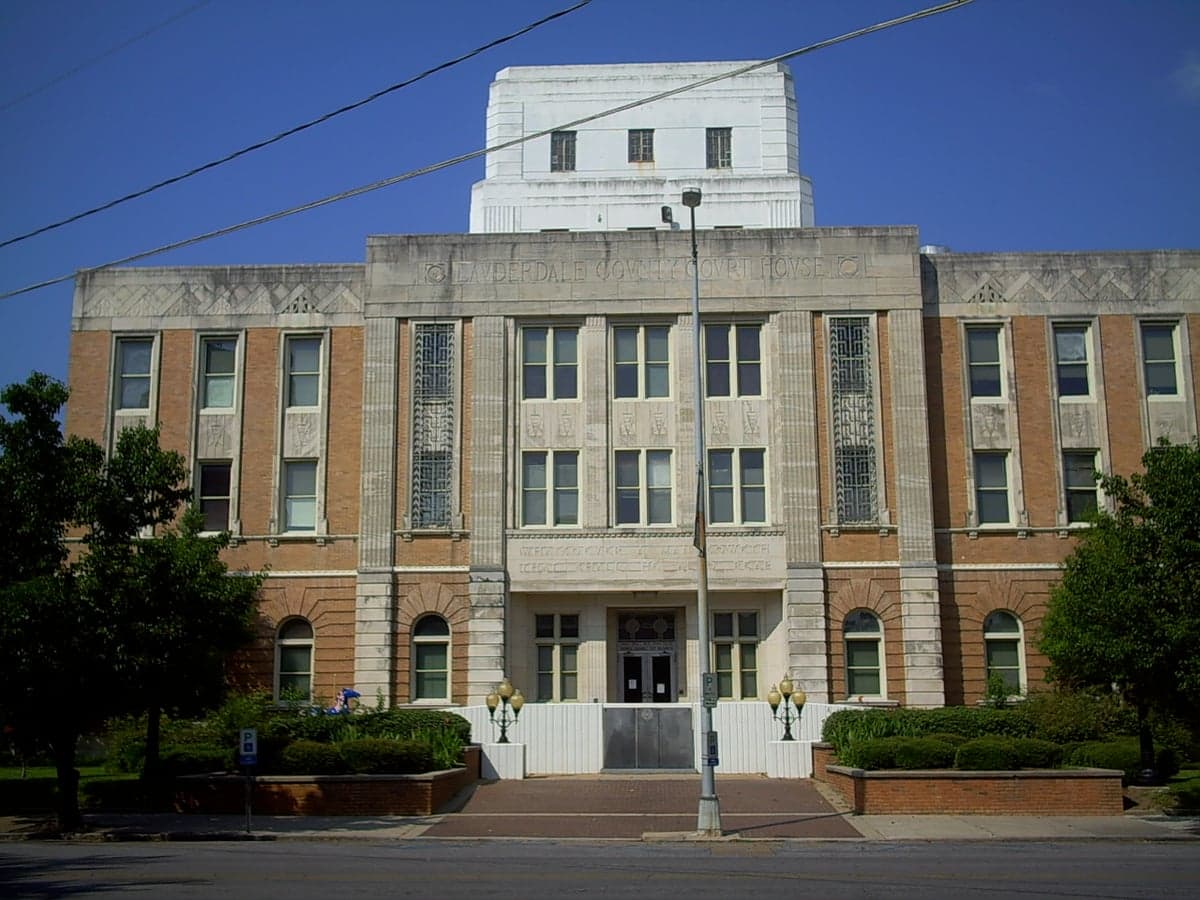
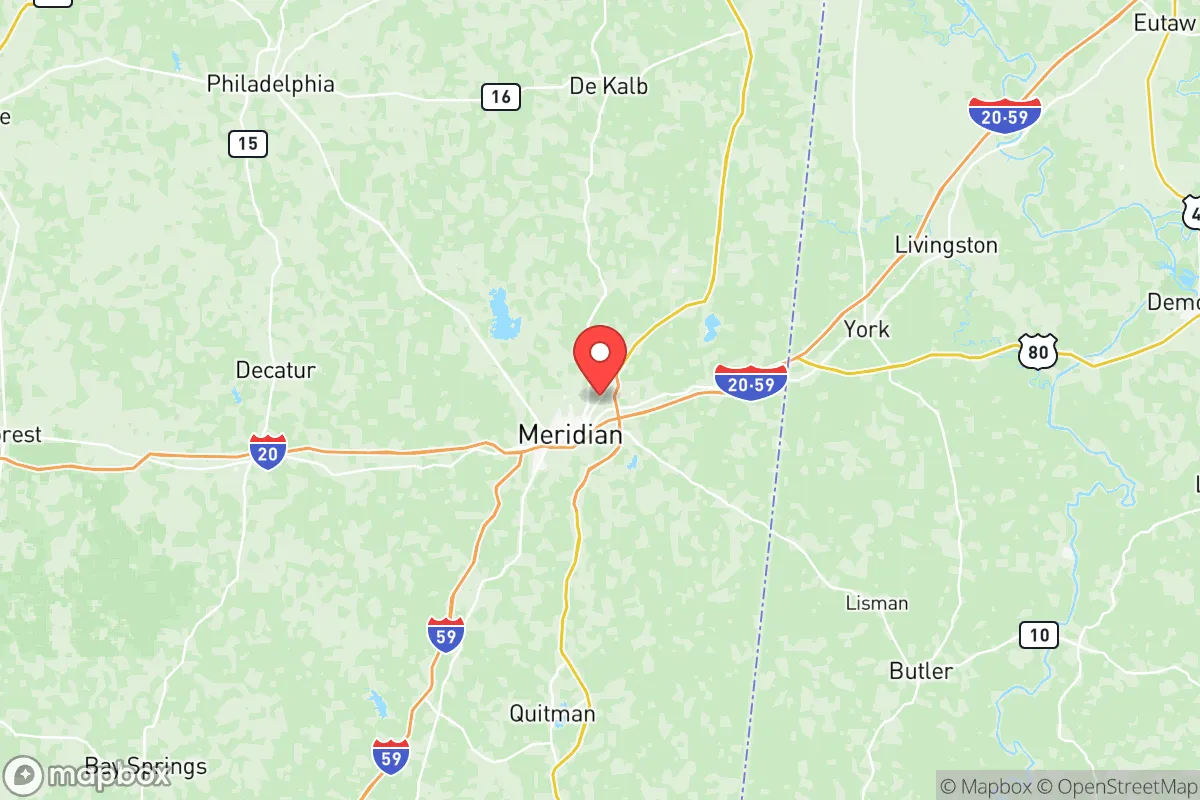
Photo: Wikipedia
Demographics of Lauderdale County
Affluence Level in Lauderdale County
A below-average socioeconomic profile. Incomes, home values, and educational attainment trail the U.S., with higher poverty and unemployment.
People of Lauderdale County
Lauderdale County, Mississippi, is home to 71,984 residents, a population shaped by a deep history of Indigenous settlement, European colonization, and the enduring legacy of the plantation and post-Reconstruction eras. Today, the county is nearly evenly split between White (50.7%) and Black (41.9%) residents, with a very small foreign-born population (0.9%) and minimal Hispanic (2.5%) or Asian (0.5%) communities. This demographic profile reflects a region that has experienced little of the recent international immigration seen in other parts of the Sun Belt, instead maintaining a character rooted in its Deep South heritage, with the city of Meridian serving as the historic and economic heart of the county.
Settlement & growth (pre-1960)
The land that is now Lauderdale County was originally inhabited by the Choctaw Nation, who controlled much of east-central Mississippi before European contact. French and Spanish explorers passed through the region in the 17th and 18th centuries, but significant European settlement did not begin until after the United States acquired the territory. The Treaty of Dancing Rabbit Creek in 1830 forced the Choctaw to cede their remaining lands, opening the area to American settlers. Lauderdale County was officially established in 1833, named after Colonel James Lauderdale, a Tennessee militia officer killed in the War of 1812.
The first major wave of settlers were Anglo-American farmers from the Upper South, primarily Virginia, North Carolina, and Tennessee, who arrived in the 1830s and 1840s. These families were drawn by the promise of fertile, inexpensive land for cotton cultivation. They established small farms and plantations, and the county's economy quickly became dependent on enslaved African American labor. By 1860, enslaved people made up a majority of the county's population, a pattern that would shape the region's demographics for generations. The town of Marion, founded in 1834, served as the original county seat and a hub for this early agricultural society.
The arrival of the railroad in the 1850s transformed the county. The Mobile and Ohio Railroad built a line through the area, and the town of Meridian was founded in 1854 at the junction of that line and the Southern Railroad of Mississippi. Meridian rapidly eclipsed Marion as the commercial and population center, drawing merchants, railroad workers, and speculators. During the Civil War, Meridian was a critical Confederate supply depot and hospital center, and its destruction by Union General William T. Sherman in 1864 remains a defining historical event. After the war, the county's economy struggled through Reconstruction, but the railroad continued to drive growth.
The post-Reconstruction era saw the establishment of a rigid Jim Crow system, and the Black population, though large, was systematically disenfranchised and segregated. The early 20th century brought some industrial development to Meridian, including railroad repair shops, textile mills, and a growing timber industry. This period also saw the arrival of small numbers of European immigrants, particularly Italian and Lebanese families, who settled in Meridian and established businesses in the downtown area. However, these groups remained a tiny fraction of the overall population. The Great Migration, which saw millions of Black Southerners move to Northern and Western cities between 1910 and 1970, significantly reduced the county's Black population share, though it remained substantial. By 1960, the county's population was roughly 60% White and 40% Black, a ratio that has shifted only slightly in the decades since.
Modern era (post-1965)
The 1965 Hart-Cellar Act, which dramatically reshaped U.S. immigration patterns, had a minimal impact on Lauderdale County. Unlike many parts of the South that experienced a surge in Hispanic and Asian immigration after 1965, Lauderdale County remained overwhelmingly native-born. The foreign-born population today is just 0.9%, one of the lowest rates in Mississippi. The small Hispanic community (2.5%) and the even smaller East/Southeast Asian community (0.5%) are concentrated almost entirely in Meridian, where they work in healthcare, manufacturing, and service industries. The Indian subcontinent population (0.2%) is also tiny and primarily composed of professionals in the medical field, many of whom are associated with the local hospitals.
The most significant demographic shift since 1965 has been domestic rather than international. The county experienced a period of population decline from the 1970s through the 1990s, as the loss of railroad and manufacturing jobs prompted out-migration, particularly among younger residents. The population peaked at roughly 78,000 in 1970 and fell to around 71,000 by 2000. This decline has stabilized in recent years, with the population holding steady at approximately 72,000. Suburbanization has been limited; the unincorporated communities of Collinsville, Toomsuba, and Bailey have seen some residential growth, but Meridian remains the dominant population center, housing roughly 60% of the county's residents. The county's rural areas, including the historic settlements of Marion and Chunky, have seen population loss as younger generations move to larger cities.
Racially, the county has become slightly more diverse, but the change is modest. The White population share has declined from roughly 60% in 1970 to 50.7% today, while the Black population share has increased from roughly 40% to 41.9%. The Hispanic and Asian populations, while still very small, have grown from near-zero in 1970 to their current levels. The county's educational attainment remains low, with only 21.7% of adults holding a bachelor's degree or higher, a figure that lags behind both the state and national averages. This reflects the ongoing challenge of retaining college-educated residents, who often leave for larger job markets in Jackson, Birmingham, or Atlanta.
The future
Lauderdale County's population is projected to remain relatively stable over the next 10 to 20 years, with modest growth or slight decline depending on economic conditions. The county is unlikely to experience the rapid diversification seen in other parts of the South, as its low foreign-born population and limited job growth in high-tech or professional services sectors offer few pull factors for new immigrants. The Hispanic and Asian populations will likely continue to grow slowly, but they will remain small minorities. The county's cultural identity will remain firmly rooted in its Black and White Southern heritage, with Meridian serving as the focal point for community life, commerce, and civic engagement.
The biggest demographic question for the future is whether the county can retain its younger residents. The out-migration of college-educated young adults, particularly Black and White alike, has been a persistent trend. If local economic development efforts, such as the expansion of the Naval Air Station Meridian or growth in the healthcare sector, can create more skilled jobs, the county may see a stabilization or even a modest increase in its college-educated population. Conversely, continued stagnation could lead to further population decline and an aging demographic profile. For someone moving in now, Lauderdale County offers a deeply rooted, slow-changing community where the past remains visible in the present, and where the pace of life is defined more by tradition than by transformation.

* Values derived from national, state, county, city and local statistics and may differ in a specific area. Last updated: 2026-07-29T22:32:40.000Z
Narrative content on this page is AI-generated and may contain mistakes. Verify any details that matter before acting on them.
ReloMaps may earn a commission from affiliate links at no extra cost to you.

