
Photo: Wikipedia
Demographics of Lee County
Affluence Level in Lee County
A middle-class area roughly in line with national averages across income, home values, education, and employment.
People of Lee County
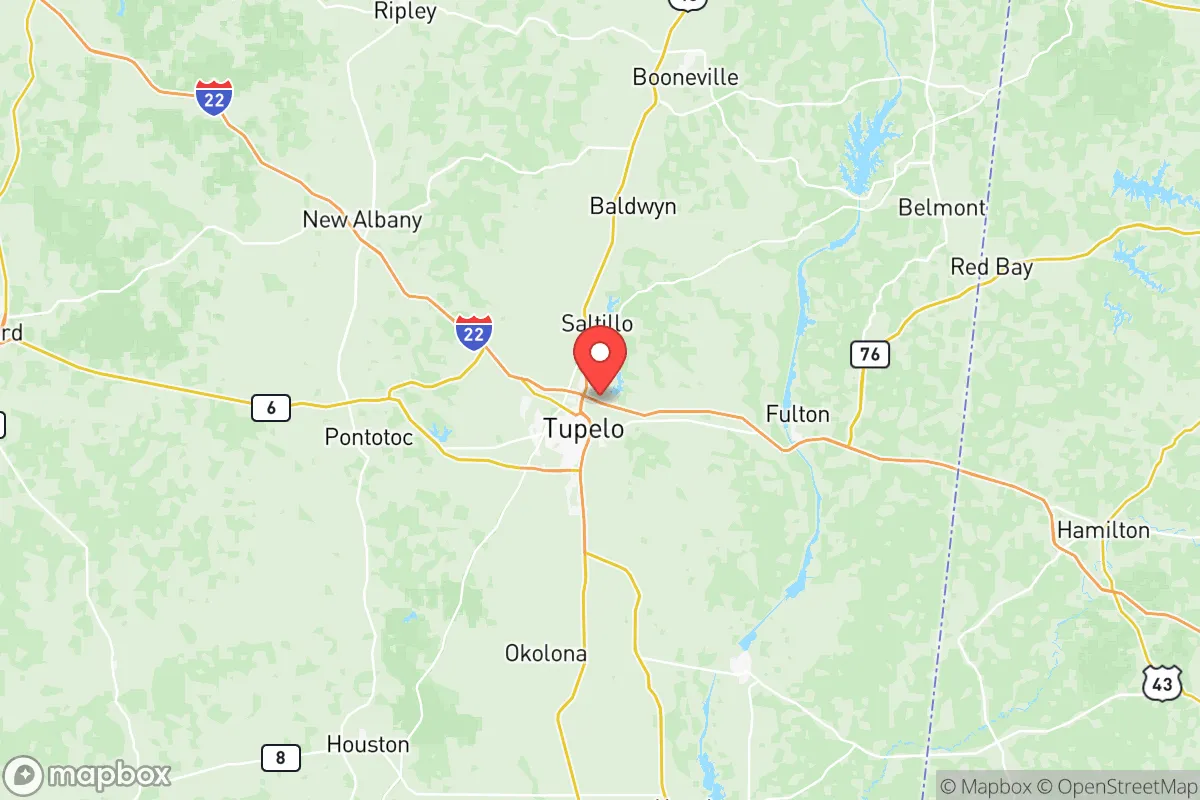
The people of Lee County, Mississippi, today number 83,138, forming a community that is predominantly white (62.9%) with a substantial Black minority (29.9%) and a very small foreign-born population (1.5%). The county's identity is rooted in its role as the northeastern anchor of Mississippi's manufacturing and education corridor, anchored by the city of Tupelo and shaped by a history of agricultural settlement, post-war industrialization, and steady, modest growth. Distinctive markers include a strong sense of local pride tied to Tupelo's status as the birthplace of Elvis Presley, a deeply rooted evangelical Christian culture, and a workforce that balances traditional Southern values with modern industrial employment.
Settlement & growth (pre-1960)
Before American settlement, the area that is now Lee County was part of the traditional homelands of the Chickasaw people, who controlled much of northeastern Mississippi. The Chickasaw were forcibly removed in the 1830s under the Indian Removal Act, opening the land to white settlers. Lee County itself was established in 1866, carved from parts of Itawamba and Pontotoc counties, and named for Confederate General Robert E. Lee.
The first major wave of American settlers were Scots-Irish and English farmers who moved into the region from the Upper South, particularly Virginia, North Carolina, and Tennessee, in the 1830s and 1840s. They were drawn by the availability of fertile, inexpensive land for cotton cultivation. These early settlers established small farming communities that would later become the towns of Tupelo, Saltillo, Guntown, and Verona. Tupelo, founded in 1860 as a railroad stop on the Mobile and Ohio Railroad, quickly became the county's commercial and transportation hub.
After the Civil War and Reconstruction, the county's economy remained heavily agricultural, with cotton as the dominant crop. The Black population grew significantly during this period, as formerly enslaved people remained in the area as sharecroppers and tenant farmers. By the early 20th century, Tupelo had emerged as a regional trading center, and the arrival of the railroad spurred modest industrial growth. The 1930s brought the Tennessee Valley Authority (TVA) and rural electrification, which transformed daily life and enabled small manufacturing to take root. The post-World War II era saw the first significant diversification away from agriculture, with the establishment of furniture manufacturing and light industry in Tupelo and the surrounding towns of Shannon and Plantersville.
Modern era (post-1965)
The 1965 Hart-Cellar Act had a minimal direct impact on Lee County, as the region did not attract significant international immigration. The foreign-born population remains very low at 1.5%, and the county's racial and ethnic composition has shifted primarily through domestic migration and natural change rather than new immigration waves. The Hispanic population, now 3.4%, began to grow slowly in the 1990s and 2000s, largely driven by workers in construction, poultry processing, and agriculture, with small concentrations in Tupelo and Verona.
The most significant demographic shift since the 1960s has been the suburbanization of Tupelo and the growth of outlying towns. As Tupelo's manufacturing base expanded — particularly in automotive parts, furniture, and food processing — the city's population grew, and new subdivisions spread into unincorporated areas and neighboring municipalities. The Black population, which had been concentrated in rural areas and in Tupelo's older neighborhoods, became more dispersed as middle-class families moved into newer subdivisions. The Asian population (East and Southeast Asian) remains very small at 0.7%, and the Indian subcontinent population is even smaller at 0.3%, with most individuals employed in professional roles such as medicine, engineering, and academia at institutions like the University of Mississippi's Tupelo campus and North Mississippi Medical Center.
Domestic migration patterns have been modest. Lee County has not experienced the rapid Sun Belt growth seen in parts of Texas or Florida, but it has attracted some retirees and remote workers from higher-cost areas in the Northeast and Midwest, drawn by the low cost of living and the presence of the North Mississippi Medical Center, one of the largest private hospitals in the state. The county's population grew steadily but slowly from about 75,000 in 2000 to 83,138 in 2024, reflecting a combination of natural increase and modest in-migration.
The future
Lee County's population is projected to continue growing slowly, likely reaching 90,000 to 95,000 by 2040. The county is becoming slightly more diverse, driven primarily by the growth of the Hispanic population, which is expected to rise to 5-7% of the total, and a slow increase in the Asian and Indian populations as professional opportunities expand. The Black population share is likely to remain stable or increase modestly, while the white population share will continue a gradual decline as the county's overall diversity increases.
New residential development is concentrating in the southern and western parts of Tupelo, as well as in the towns of Saltillo and Guntown, which are becoming bedroom communities for Tupelo's workforce. The county's cultural identity is evolving from a purely rural, agricultural heritage toward a more suburban, manufacturing-and-services-based economy, but the core values of community, faith, and family remain deeply embedded. For someone moving in now, Lee County offers a stable, affordable, and safe environment with a strong sense of place, but with limited ethnic diversity and a pace of change that is gradual rather than transformative.
In summary, Lee County is becoming a slightly more diverse, steadily growing, and increasingly suburbanized corner of northeastern Mississippi, where the legacy of its agricultural and railroad past is giving way to a future shaped by manufacturing, healthcare, and education. For a new resident, the county offers a low-cost, family-oriented lifestyle with a strong community fabric, but with demographic change that is slow and incremental rather than dramatic.

* Values derived from national, state, county, city and local statistics and may differ in a specific area. Last updated: 2026-08-16T15:10:34.000Z
Narrative content on this page is AI-generated and may contain mistakes. Verify any details that matter before acting on them.
ReloMaps may earn a commission from affiliate links at no extra cost to you.

