
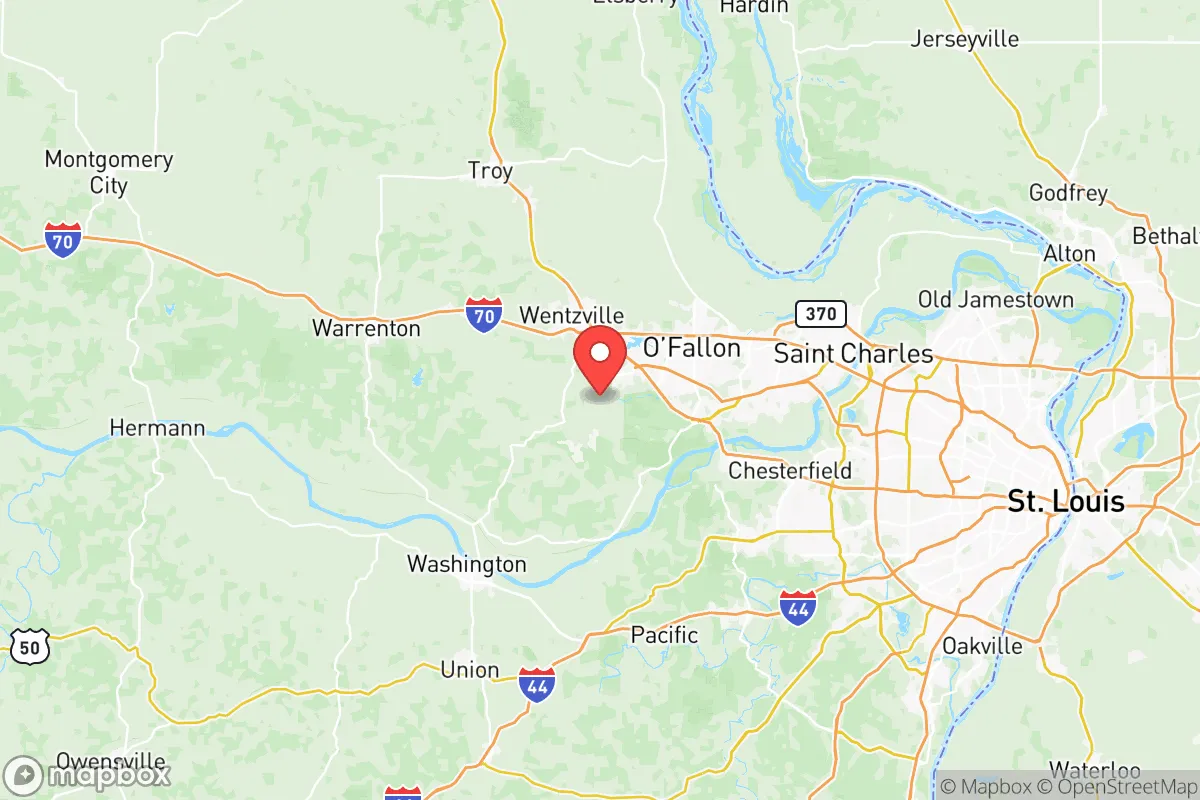
Photo by Mike Gattorna on Unsplash
Political ClimatePolitical Climate in St Charles County
Showing district-level results — no local-only data available.
Local Political AnalysisPolitical Analysis of St Charles County
St. Charles County has been a reliable Republican stronghold for decades, but the political landscape here is more nuanced than the county's overall red tint suggests. While the county leans Republican with a Cook PVI of R+4, that's actually less conservative than the state of Missouri as a whole, which sits at R+8. That difference might not sound huge, but it tells you a lot about the subtle shifts happening on the ground, especially as the county grows and changes.
How it compares
The gap between St. Charles County's R+4 and Missouri's R+8 is driven by a few key factors. The county's western and northern towns—places like Wentzville, O'Fallon, and Lake St. Louis—are where you'll find the most reliably red precincts. These are the areas where you see strong support for Second Amendment rights, lower taxes, and a general skepticism of government overreach. But the eastern edge of the county, particularly St. Charles City and the older parts of St. Peters, has seen a slow but steady shift. These areas are more likely to have swing precincts, and you'll find a higher concentration of voters who lean left on social issues. The county's growth has also brought in transplants from the St. Louis city and county, and that's diluted the old-school conservative base a bit. Compared to the rest of Missouri, St. Charles County is a bellwether—it's not as deep red as the rural counties to the west, but it's still a long way from the blue pockets in Columbia or Kansas City.
What this means for residents
For folks who value personal freedom and limited government, the trend is a little concerning. The county's Republican leadership has historically been pretty good about keeping taxes low and staying out of your business, but the growing progressive influence in the eastern towns is starting to show up in local elections. You're seeing more talk about zoning restrictions, "equity" initiatives in schools, and even some chatter about gun control measures at the municipal level. The county's school boards have become a real battleground, with conservative parents pushing back against curriculum overreach and critical race theory. If you're the kind of person who thinks the government should stay out of your home, your wallet, and your family's values, you'll want to keep an eye on those local races—especially in St. Charles City and St. Peters, where the progressive tilt is most noticeable.
The cultural and policy distinctions here are real but subtle. St. Charles County still has a strong sense of community and a "live and let live" attitude, but the pressure is mounting. The county's Republican machine is still in control, but it's not as dominant as it was ten years ago. If you're moving here from a deep-red rural area, you'll notice the difference in the air—more diversity of thought, more people willing to challenge the status quo. For a conservative who values personal liberty, the key is to stay engaged. The county's trajectory is still in your hands, but only if you show up and vote in those local primaries. The next few years will tell us whether St. Charles County stays a bastion of freedom or starts drifting toward the kind of government overreach you see in the coastal states.

State Political ClimatePolitical Climate in Missouri
State Political AnalysisPolitical Environment in the State
Missouri has been a reliably Republican state for most of the past two decades, carrying a Cook Partisan Voting Index of R+8, meaning it votes about eight points more Republican than the national average. The state hasn’t backed a Democrat for president since Bill Clinton in 1996, and the GOP holds supermajorities in both chambers of the legislature. But don’t let the red veneer fool you — the political landscape is a patchwork of deep-red rural counties, increasingly blue urban cores, and a handful of critical swing suburbs that have shifted hard to the right in recent cycles, making the state a fascinating case study in how conservative governance is actually playing out on the ground.
Urban vs. rural divide
The political map of Missouri is a classic tale of two Missouris. The urban crescent — St. Louis City, St. Louis County, Kansas City, and Columbia — votes overwhelmingly Democratic. St. Louis City alone delivered over 80% of its vote to Joe Biden in 2020, while Kansas City and Boone County (home to the University of Missouri) followed suit. These areas are the engine of the state’s progressive movement, pushing for higher minimum wages, stricter gun laws, and expanded Medicaid. Meanwhile, the rest of the state is deeply Republican. The rural Ozarks, the Bootheel, and the northern plains are among the most conservative regions in the country. Greene County (Springfield) and Christian County (just south of Springfield) are reliably red, with Christian County voting +45 points for Trump in 2020. The real story, though, is the suburbs. St. Charles County, once a swing area, has become a GOP stronghold, voting +18 for Trump in 2020. Conversely, St. Louis County’s inner-ring suburbs like University City and Clayton are solidly blue, while outer-ring suburbs like Wildwood and Chesterfield are more competitive but trending right. The 2020 election saw Platte County (north of Kansas City) flip from blue to red, a sign that the suburban shift toward the GOP is accelerating.
Policy environment
Missouri’s policy environment is a mixed bag for conservatives. On the plus side, the state has a flat income tax rate of 5.3%, which was cut from 5.5% in 2023, and the legislature is actively working toward eliminating the income tax entirely. Property taxes are low, and there is no estate tax. The state is a right-to-work state, though that law was repealed by ballot initiative in 2018 — a rare loss for labor reform. On education, Missouri has a robust school choice program, including charter schools in Kansas City and St. Louis, and a tax-credit scholarship program for private school tuition. However, the state’s public school system is heavily unionized, and the Missouri National Education Association remains a powerful political force. Missouri’s gun laws are among the most permissive in the nation, with constitutional carry (no permit needed to carry a concealed firearm) and a “Second Amendment Preservation Act” that attempts to nullify federal gun laws. On healthcare, the state expanded Medicaid in 2021 via ballot initiative, a move that many conservatives opposed but that has since become a settled fact. Election laws are a bright spot: Missouri has strict voter ID requirements, no same-day registration, and a ban on ballot harvesting. The state also passed a law in 2022 requiring all ballots to be hand-counted in certain precincts, though that has faced legal challenges.
Trajectory & freedom
Missouri is trending in a decidedly pro-freedom direction, at least by conservative metrics. The 2021 “Second Amendment Preservation Act” (SB 39) was a landmark law that declares federal gun restrictions unenforceable in Missouri, drawing a direct line in the sand against federal overreach. In 2023, the legislature passed a law banning gender-affirming care for minors, overriding the governor’s veto. Parental rights were strengthened with the “Parental Bill of Rights” (HB 2414), which gives parents explicit authority over their children’s education and medical decisions. On the economic freedom front, the state has been cutting taxes and reducing regulations, with a particular focus on occupational licensing reform. However, there are concerning trends. The expansion of Medicaid, while popular, has increased the state’s dependency on federal funding. And the 2020 protests in Ferguson and Kansas City over police brutality led to calls for police reform, though the legislature has largely resisted. Missouri’s medical autonomy is strong — there is no vaccine mandate, and the state banned COVID-19 vaccine passports in 2021. Property rights are generally respected, though there have been fights over eminent domain for renewable energy projects.
Civil unrest & political movements
Missouri has a history of civil unrest that still echoes today. The 2014 Ferguson protests, sparked by the shooting of Michael Brown, were a national flashpoint and led to the “Ferguson Effect” — a decline in police morale and a spike in crime. Since then, the Black Lives Matter movement has been active in St. Louis and Kansas City, with periodic protests and clashes with counter-protesters. On the right, the “Patriot” movement is strong, particularly in rural areas and the Ozarks. In 2020, the “Boogaloo” movement had a visible presence in Missouri, with armed protesters at the state capitol. Immigration politics are relatively quiet, as Missouri is not a border state, but there have been fights over sanctuary city policies. St. Louis City declared itself a “sanctuary city” in 2017, but the state legislature has repeatedly tried to ban such policies, with a 2023 law threatening to withhold state funding from any city that refuses to cooperate with federal immigration enforcement. Election integrity remains a hot-button issue. Missouri’s 2020 election was relatively smooth, but the state’s GOP-led legislature has passed multiple laws tightening voting procedures, including a ban on drop boxes and stricter signature verification. There is no serious secessionist movement, but there is a strong strain of nullification rhetoric, particularly around gun laws and federal mandates.
Projection
Over the next 5-10 years, Missouri is likely to become even more Republican, but with a sharper urban-rural divide. In-migration is a key factor: people are moving to Missouri from blue states like Illinois and California, drawn by lower taxes and a more conservative culture. St. Charles County is expected to continue its rapid growth, solidifying its status as a GOP stronghold. Meanwhile, St. Louis City and Kansas City will likely become even more Democratic as they lose moderate voters to the suburbs. The state’s demographic trends are favorable for conservatives: the white, rural population is aging, but the Hispanic population is growing, and many of these new residents are culturally conservative. The biggest wildcard is the state’s abortion politics. Missouri was the first state to ban abortion after the Dobbs decision, with no exceptions for rape or incest. This could mobilize suburban women against the GOP, but so far, the 2022 and 2023 elections have not shown a significant backlash. If the state eliminates the income tax, as many Republicans hope, it could trigger a wave of in-migration that further cements the conservative majority. However, the growing power of the state’s urban areas could lead to more ballot initiatives that bypass the legislature, as we saw with Medicaid expansion and medical marijuana.
For a conservative relocating to Missouri, the bottom line is this: you’ll find a state that largely respects your freedoms — on guns, taxes, education, and medical choices — but you’ll need to pick your county carefully. If you want a deep-red, low-regulation environment, look at Christian County, St. Charles County, or the Ozarks. If you want a more moderate, suburban feel with good schools, consider Platte County or the outer ring of St. Louis County. Just avoid the urban cores unless you’re prepared for high crime, high taxes, and a progressive local government. Missouri is a state where your vote matters, and where conservative values are still the law of the land — for now.
* Values derived from national, state, county, city and local statistics and may differ in a specific area. Last updated: 2026-05-12T10:43:13.000Z
Narrative content on this page is AI-generated and may contain mistakes. Verify any details that matter before acting on them.
ReloMaps may earn a commission from affiliate links at no extra cost to you.

