
Photo: Wikipedia
Demographics of Mobridge, SD
Affluence Level in Mobridge, SD
A middle-class area roughly in line with national averages across income, home values, education, and employment.
People of Mobridge, SD
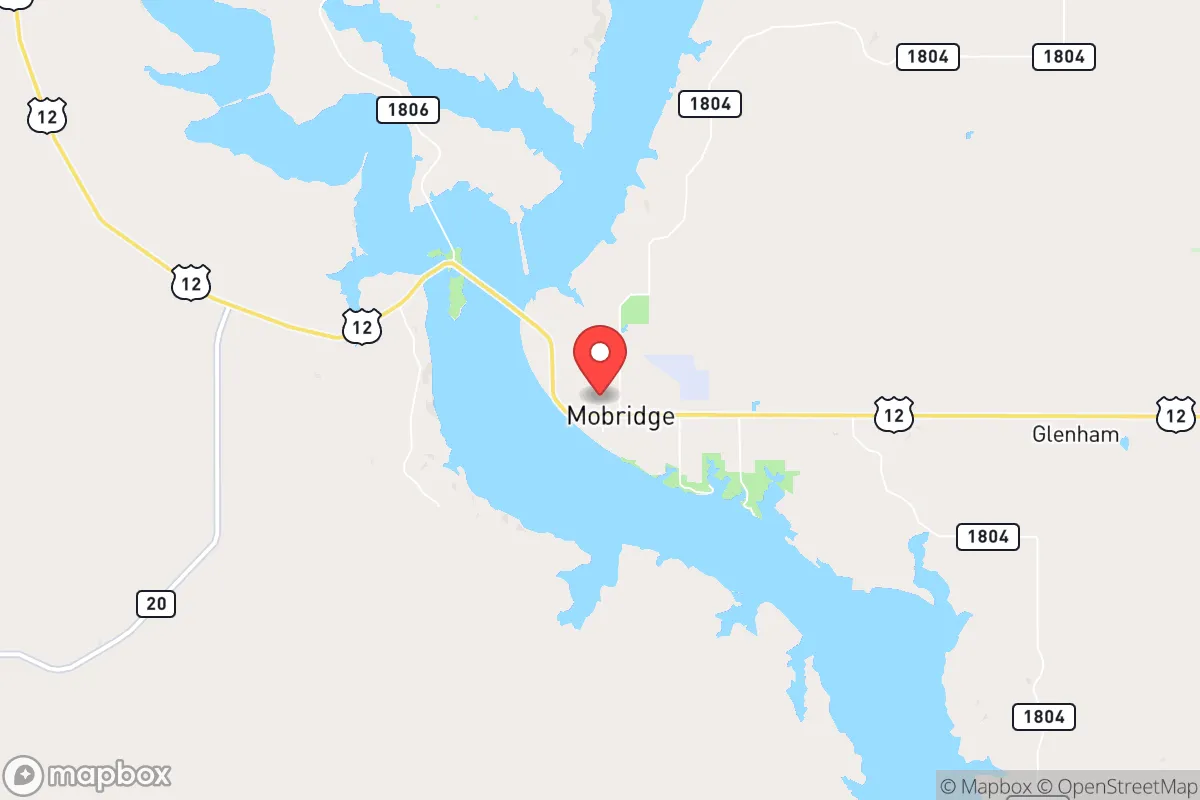
The people of Mobridge, South Dakota, today form a small, predominantly white community of 2,928 residents, with a notably high college attainment rate of 31.5% and a foreign-born population of 0.0%. The city’s identity is shaped by its location on the Missouri River and the Standing Rock Indian Reservation border, creating a distinctive blend of Lakota and settler heritage. With 68.5% of residents identifying as white and a negligible Hispanic (1.3%) and East/Southeast Asian (0.2%) presence, Mobridge remains one of the most ethnically homogeneous small cities in the upper Great Plains. Its character is quiet, family-oriented, and deeply rooted in the agricultural and transportation history that first drew people here.
How the city was settled and grew
Mobridge’s human history begins not with European settlement but with the Lakota people, who controlled the Missouri River valley long before the railroad arrived. The city itself was founded in 1906 as a railroad town, named for the combination of “Mobridge” (a portmanteau of “Missouri” and “bridge”) after the Chicago, Milwaukee & St. Paul Railway built a bridge across the river. The original population was overwhelmingly white, drawn by railroad construction jobs and the promise of homesteading on the surrounding prairie. The first wave of settlers—mostly German, Norwegian, and Irish immigrants from the Midwest—built homes in what is now the West Side neighborhood, near the original depot and grain elevators. By the 1910s, a small but distinct Riverside District emerged along the Missouri, housing railroad workers and their families in modest frame houses. The city’s growth peaked in the 1930s with the construction of the Oahe Dam project, which brought a temporary influx of construction workers, though most left after completion. The South Hill area developed in the 1940s and 1950s as a middle-class enclave for merchants and professionals serving the agricultural trade.
Modern era (post-1965)
After the 1965 Immigration Act, Mobridge saw virtually no new foreign-born population—the 0.0% foreign-born figure today reflects a city that did not participate in the post-1965 immigration waves that transformed larger cities. Instead, the modern era has been defined by domestic out-migration and demographic aging. The East End neighborhood, built in the 1970s and 1980s, absorbed the few new residents who arrived: mostly white retirees from rural farms and young families drawn by low housing costs. The Lakeview Addition, a subdivision platted in the 1990s near the reservoir, attracted a small number of professionals working at the Indian Health Service hospital or the local school district. The Hispanic population, at 1.3%, is almost entirely concentrated in the West Side rental properties, reflecting seasonal agricultural labor in surrounding sugar beet and sunflower fields. The East/Southeast Asian population (0.2%) is limited to a handful of medical professionals at the hospital, with no distinct ethnic enclave. The city’s white population has declined from roughly 85% in 1990 to 68.5% today, but this shift is due almost entirely to the departure of young white adults for college and jobs in larger cities, not to in-migration of other groups.
The future
Mobridge’s population is heading toward continued slow decline and further homogenization. The city lost 5% of its population between 2010 and 2020, and the trend is expected to continue as the median age rises (currently estimated at 44, above the state average). The foreign-born population will likely remain near zero, as there are no industries or refugee resettlement programs to attract immigrants. The Hispanic population may grow modestly—perhaps to 3-5% by 2040—driven by agricultural labor demand, but these families tend to settle in the West Side rental stock rather than forming a permanent enclave. The East/Southeast Asian and Indian populations will remain negligible, limited to occasional medical professionals who rarely stay long-term. The most significant demographic change will be the continued out-migration of young adults, leaving an older, whiter population concentrated in the South Hill and Lakeview Addition neighborhoods. The city is not tribalizing into distinct enclaves; rather, it is becoming a smaller, more uniformly white and aging community.
For someone moving in now, Mobridge offers a stable, safe, and culturally homogeneous environment where the population is shrinking but not diversifying. The city’s future is one of quiet consolidation, not transformation—a place where the people who remain share a common heritage and a slow-paced, family-oriented lifestyle. New residents will find a community that values self-reliance and tradition, but should expect limited ethnic diversity and a population that is more likely to be retired than raising young children.

* Values derived from national, state, county, city and local statistics and may differ in a specific area. Last updated: 2026-04-23T12:56:36.000Z
Narrative content on this page is AI-generated and may contain mistakes. Verify any details that matter before acting on them.
ReloMaps may earn a commission from affiliate links at no extra cost to you.

