
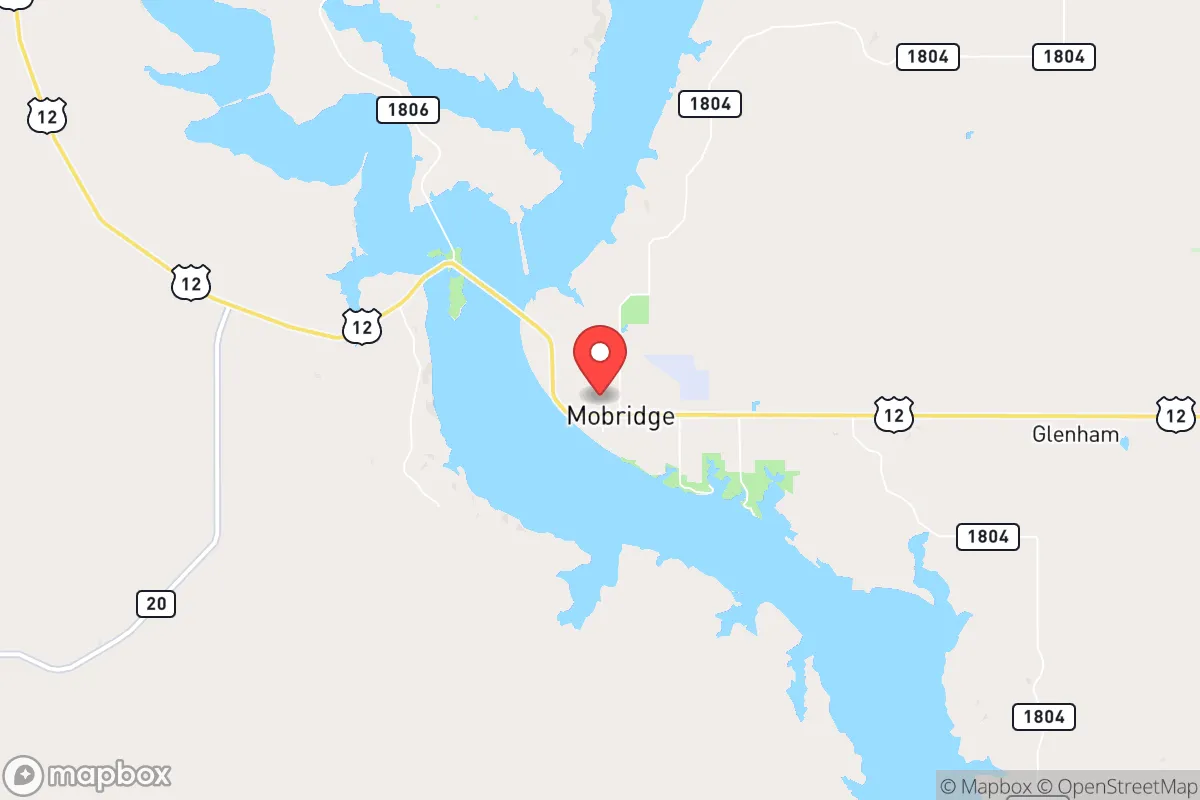
Photo: Wikipedia
Political ClimatePolitical Climate in Mobridge, SD
District shown is the primary district for this city’s centroid. Cities may span multiple districts.
Inherited from parent state — no local data available.
Local Political AnalysisPolitical Analysis of Mobridge, SD
Mobridge, South Dakota, is about as solidly conservative as small-town America gets, with a Cook PVI of R+15 that tells you exactly where the political winds blow around here. This isn't a place that's flipped or waffled in recent cycles—it's been reliably red for decades, and the local culture reflects that. If you're looking at the political climate, the short version is: this is a community that values personal liberty, limited government, and a live-and-let-live approach, as long as you're not trying to impose progressive mandates on the rest of us. The trajectory has been steady, though there's a quiet concern among longtime residents about creeping government overreach from both state and federal levels, especially on issues like property rights and local control.
How it compares
Compared to the rest of South Dakota, Mobridge sits comfortably in the conservative camp, but it's not the most extreme corner of the state. Head west to places like Lemmon or Bison, and you'll find even deeper red territory—those areas are often R+20 or more in local voting patterns. Drive east to Aberdeen or Watertown, and you'll see a slightly more moderate mix, though still solidly Republican. The real contrast is with the state's liberal pockets, like Brookings (home to South Dakota State University) or the tourist-heavy parts of the Black Hills around Rapid City, where you'll find more progressive leanings on environmental regulations and social issues. Mobridge, by contrast, is a place where the county commission still pushes back on state-level mandates that feel like overreach—like when Pierre tried to impose stricter land-use rules a few years back. Locals here remember when the feds tried to dictate grazing policies on private land, and the pushback was fierce. That independent streak is what sets Mobridge apart from the more compliant towns to the east.
What this means for residents
For folks living here, the political climate means a lot of day-to-day freedom that you don't get in more progressive areas. There's no city council debating mask mandates or vaccine passports—those ideas would get laughed out of the room. Property taxes are low, zoning is minimal, and you can pretty much do what you want with your land as long as you're not bothering the neighbors. That said, there's a growing unease about the long-term trend. The state legislature in Pierre has been flirting with more centralized control over local schools and health departments, and some of us see that as a slippery slope. If you're a conservative who values personal responsibility over government programs, Mobridge is still a great fit. But keep an eye on the next few election cycles—if the progressive push from out-of-state money starts influencing local races, we could see a shift in the next decade. For now, though, the culture here is still rooted in self-reliance and a healthy skepticism of anyone who thinks they know better than you do.
One cultural distinction worth noting: Mobridge has a strong Native American presence, with the Standing Rock Reservation just across the Missouri River. That brings a unique dynamic to local politics, especially around issues like tribal sovereignty and resource management. Most longtime residents are respectful of that boundary, but there's occasional friction when federal or state agencies try to impose rules that affect both sides of the river. The local attitude is generally: let the tribes handle their own affairs, and let us handle ours. That hands-off approach is a big part of what makes Mobridge feel like a place where government stays out of your business—for now, at least. If you're looking for a community that still believes in the Second Amendment, low taxes, and the right to live without a permission slip from some bureaucrat, you'll find a lot of like-minded folks here. Just don't expect the politics to change anytime soon—this town knows what it likes, and it likes being left alone.

State Political ClimatePolitical Climate in South Dakota
State Political AnalysisPolitical Environment in the State
South Dakota is one of the most reliably Republican states in the nation, with a dominant conservative coalition that has held unified control of the governorship and both legislative chambers for decades. The state’s partisan lean has only deepened over the past 20 years, driven by a rural, culturally traditional population and a steady influx of conservative-leaning migrants from blue states. In 2024, Donald Trump carried the state by over 30 points, and Republicans hold every statewide office and supermajorities in the legislature. The trajectory is clear: South Dakota is becoming more, not less, conservative, with a policy environment that increasingly prioritizes individual liberty, limited government, and cultural traditionalism.
Urban vs. rural divide
The political map of South Dakota is starkly divided between a few small urban centers and the vast rural expanse. The largest metro, Sioux Falls, is the state’s economic engine and a moderate-to-conservative stronghold, though it has a slightly more diverse electorate than the rest of the state. Minnehaha County, home to Sioux Falls, voted for Trump by about 15 points in 2024, a margin that has narrowed slightly as the city grows with out-of-state transplants. Rapid City, the second-largest city, is more reliably red, with Pennington County voting for Trump by over 20 points. The real conservative firepower comes from the rural counties: Harding County in the northwest and Gregory County in the south regularly deliver 80-90% Republican margins. The only notable exception is Brookings, home to South Dakota State University, which leans more moderate and occasionally flips for Democrats in local races. The divide is not ideological—both urban and rural areas are conservative—but cultural: Sioux Falls is more suburban and professional, while the rural counties are deeply agrarian and libertarian-leaning.
Policy environment
South Dakota’s policy environment is a model of small-government conservatism. The state has no personal or corporate income tax, a low 4.5% sales tax, and property taxes that are among the lowest in the nation. The regulatory posture is aggressively pro-business: there are no state-level occupational licensing requirements for dozens of trades, and the state has a right-to-work law. Education policy is dominated by school choice: the state has a robust voucher program and a charter school law, though most districts remain traditional public schools. Healthcare is a mixed bag: the state expanded Medicaid under the Affordable Care Act in 2023 via a ballot initiative, a rare progressive win that many conservatives opposed, but the legislature has since tightened eligibility and added work requirements. Election laws are among the most secure in the nation: voter ID is required, same-day registration is not allowed, and the state has a clean voter roll maintenance process. The state also has a constitutional carry law for firearms, no permit required, and a near-total ban on abortion after six weeks, with no exceptions for rape or incest.
Trajectory & freedom
South Dakota is moving decisively toward greater personal freedom, particularly in areas of gun rights, parental rights, and economic liberty. In 2023, Governor Kristi Noem signed a law banning gender-affirming care for minors, making South Dakota one of the first states to do so. The same year, the legislature passed a parental rights bill that requires schools to notify parents of any curriculum related to sexuality or gender identity. On guns, the state has expanded constitutional carry and preempted local gun ordinances. On taxation, the legislature has repeatedly cut the sales tax on groceries and is considering a full elimination of the state sales tax on food. However, there are concerns: the state’s COVID-19 response was notably heavy-handed, with Noem imposing a state of emergency that lasted over a year, though she resisted lockdowns and mask mandates. More recently, the legislature has moved to limit executive emergency powers, a direct response to that overreach. Property rights remain strong, with no state-level zoning mandates and a robust eminent domain protection law. The trajectory is toward more freedom, but vigilance is needed to ensure the state doesn’t backslide on emergency powers or school curriculum control.
Civil unrest & political movements
South Dakota has seen relatively little civil unrest compared to other states, but there have been notable flashpoints. The Standing Rock protests in 2016-2017, centered on the Dakota Access Pipeline, drew thousands of activists from across the country and resulted in clashes with law enforcement. The state’s response was criticized by both left and right: the left saw it as a crackdown on indigenous rights, while conservatives saw it as a necessary defense of property rights and energy infrastructure. More recently, the Noem administration’s feud with the Cheyenne River Sioux Tribe over COVID-19 checkpoints on tribal land highlighted ongoing tensions between state and tribal sovereignty. On the right, the South Dakota Freedom Caucus has emerged as a powerful force in the legislature, pushing for further tax cuts, school choice expansion, and restrictions on local government authority. There is no significant secession or nullification movement, but the state has a strong strain of libertarian thought, with some rural counties passing resolutions asserting local control over federal lands. Immigration politics are muted, as the state has a very small foreign-born population, but the legislature has passed laws requiring E-Verify and opposing sanctuary city policies. Election integrity is not a major controversy here; the state’s system is widely trusted, and there have been no significant fraud allegations.
Projection
Over the next 5-10 years, South Dakota is likely to become even more conservative and free-market oriented. The primary driver is in-migration from blue states, particularly California, Illinois, and Minnesota, as people seek lower taxes and fewer regulations. These newcomers tend to be conservative-leaning, but they also bring more suburban, professional sensibilities that could moderate the state’s hardline libertarian edge. The Sioux Falls metro is expected to continue growing, potentially shifting the balance of power slightly toward the center-right. However, the rural counties are losing population, which could reduce their political clout over time. The biggest wildcard is the state’s fiscal future: as the population grows, pressure to fund infrastructure and schools will increase, potentially leading to tax increases that conservatives will resist. The legislature is likely to continue pushing for school choice expansion, possibly including education savings accounts. On social issues, expect further restrictions on abortion and gender-related policies, as well as continued resistance to federal overreach on environmental and land-use regulations. A new resident moving in now should expect a state that is stable, safe, and increasingly aligned with traditional conservative values, but with a growing urban-rural cultural divide that could create friction over the next decade.
For a conservative-leaning individual or family considering relocation, South Dakota offers a rare combination of low taxes, strong gun rights, parental control in education, and a culture that values self-reliance. The state is not without its challenges—harsh winters, limited healthcare access in rural areas, and a growing urban center that may eventually moderate the politics—but the overall trajectory is positive for those seeking freedom from government overreach. If you value a state where your vote counts, your rights are protected, and your tax dollars stay in your pocket, South Dakota is one of the best bets in the nation. Just be prepared for the cold, and keep an eye on Sioux Falls—it’s where the future of the state will be decided.
* Values derived from national, state, county, city and local statistics and may differ in a specific area. Last updated: 2026-04-23T12:56:36.000Z
Narrative content on this page is AI-generated and may contain mistakes. Verify any details that matter before acting on them.
ReloMaps may earn a commission from affiliate links at no extra cost to you.

