Photo: Wikipedia
Demographics of Monroeville, PA
Affluence Level in Monroeville, PA
A below-average socioeconomic profile. Incomes, home values, and educational attainment trail the U.S., with higher poverty and unemployment.
People of Monroeville, PA
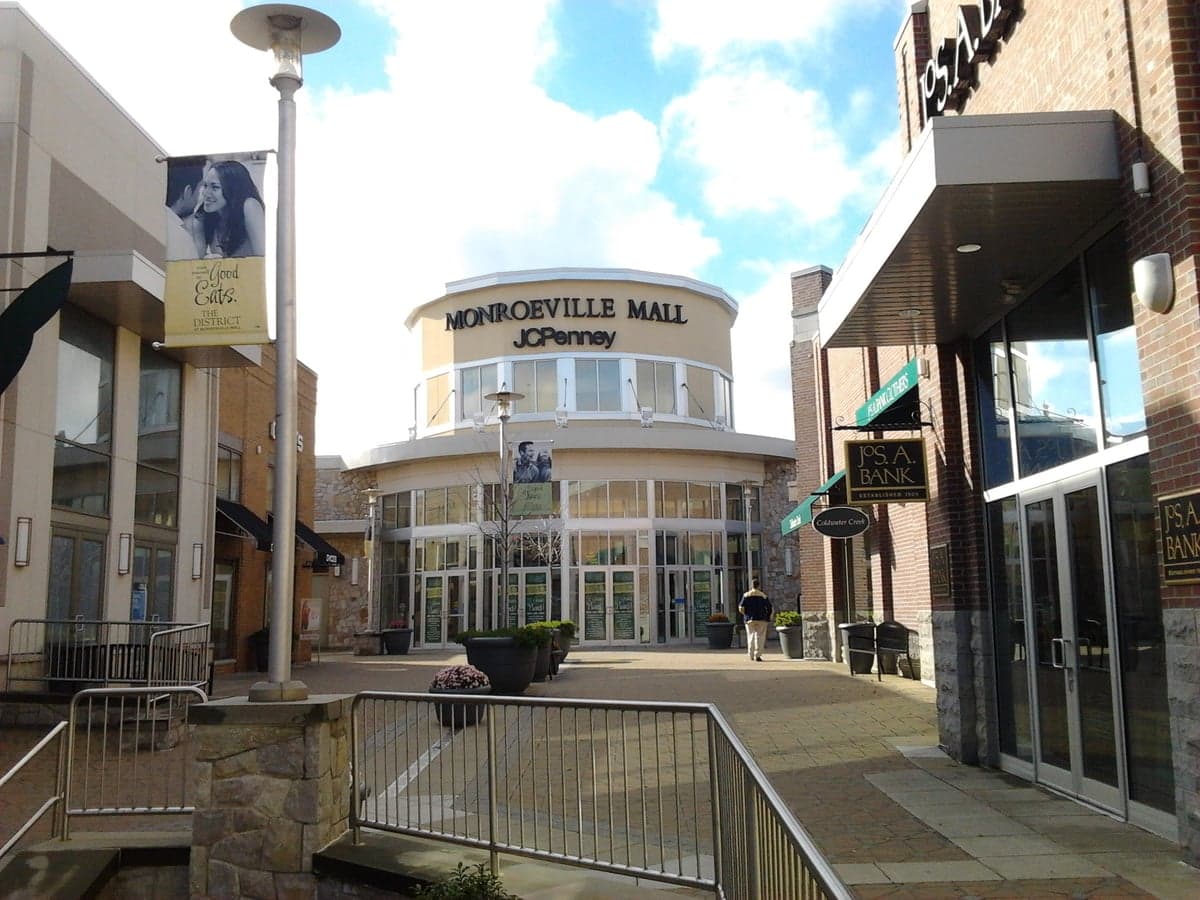
Monroeville, Pennsylvania, is a diverse, middle-class suburb of Pittsburgh with a population of 28,383 that has evolved from a rural farming crossroads into a commercial and residential hub. Its residents are a mix of long-standing white ethnic families, a significant Black community (15.2%), and growing populations of Indian-subcontinent (3.7%) and Hispanic (4.2%) residents. The city is characterized by its high educational attainment—45.7% of adults hold a college degree—and a stable, family-oriented character anchored by the Monroeville Mall and major employers like UPMC East. While still majority white (69.6%), Monroeville is more racially and ethnically diverse than many of its neighboring communities in Allegheny County.
How the city was settled and grew
Monroeville’s original population was drawn by agriculture and the arrival of the Pennsylvania Railroad in the mid-19th century, which connected the area to Pittsburgh. The first European settlers were predominantly German and Scots-Irish farmers who established homesteads along what is now Route 22 (William Penn Highway). The village of Pitcairn, a rail hub just east of Monroeville, drew Irish and Italian laborers who worked on the railroad and in the nearby coal mines. The area remained sparsely populated until the post-World War II era, when the construction of the Pennsylvania Turnpike (I-76) and the Parkway East (I-376) transformed Monroeville into a commuter suburb. The 1950s and 1960s saw a massive wave of white ethnic families—primarily of Italian, Polish, and German descent—moving from Pittsburgh’s inner-city neighborhoods into newly built subdivisions like Mosside Boulevard and Miracle Mile. These families were drawn by affordable single-family homes, good schools, and the promise of suburban stability. The opening of the Monroeville Mall in 1969 cemented the city’s role as a regional retail and employment center.
Modern era (post-1965)
Following the 1965 Hart-Cellar Act and the broader suburbanization of Pittsburgh’s Black population, Monroeville began to see significant demographic change. The Black population grew steadily from the 1970s onward, driven by middle-class Black families leaving the city of Pittsburgh for better schools and housing. Today, Black residents make up 15.2% of the population, with concentrations in neighborhoods like Haymaker and the area around Northern Pike. The Indian-subcontinent community (3.7%) began growing in the 1990s and 2000s, attracted by professional jobs at UPMC East, the Monroeville business park, and the region’s technology sector. Many Indian families settled in the Old William Penn Highway corridor and the newer subdivisions near Mosside Boulevard. The Hispanic population (4.2%) has grown more recently, with families from Mexico and Central America moving into rental housing and apartments along Route 22. East and Southeast Asian residents (1.9%) include a mix of Chinese, Korean, and Vietnamese families, many of whom are professionals or small business owners. The foreign-born population remains modest at 3.3%, but the city’s diversity is increasingly visible in its restaurants, churches, and community events.
The future
Monroeville’s population is likely to continue diversifying slowly, with the white share declining gradually as younger, more diverse families move in and older white residents age in place. The Indian-subcontinent and Hispanic communities are the fastest-growing segments, driven by chain migration and employment opportunities in healthcare and retail. The Black population is stable and well-established, with deep roots in the community. The city is not tribalizing into distinct ethnic enclaves; rather, neighborhoods like Mosside and Haymaker are becoming more mixed as new residents buy homes in previously homogeneous areas. The biggest demographic challenge is an aging population—many of the original post-war homeowners are now elderly, and the city will need to attract younger families to maintain its tax base. The high college attainment rate (45.7%) suggests that Monroeville will continue to appeal to educated professionals, particularly those working in Pittsburgh’s growing healthcare and technology sectors.
For someone moving in now, Monroeville offers a stable, diverse, and well-educated community with strong schools and convenient access to Pittsburgh. It is becoming a more inclusive suburb where long-time white ethnic families live alongside Black, Indian, and Hispanic neighbors, though the pace of change is gradual rather than rapid. The city’s future depends on its ability to attract and retain young families while managing the transition of its aging housing stock and commercial corridors.

* Values derived from national, state, county, city and local statistics and may differ in a specific area. Last updated: 2026-05-01T11:48:32.000Z
Narrative content on this page is AI-generated and may contain mistakes. Verify any details that matter before acting on them.
ReloMaps may earn a commission from affiliate links at no extra cost to you.

