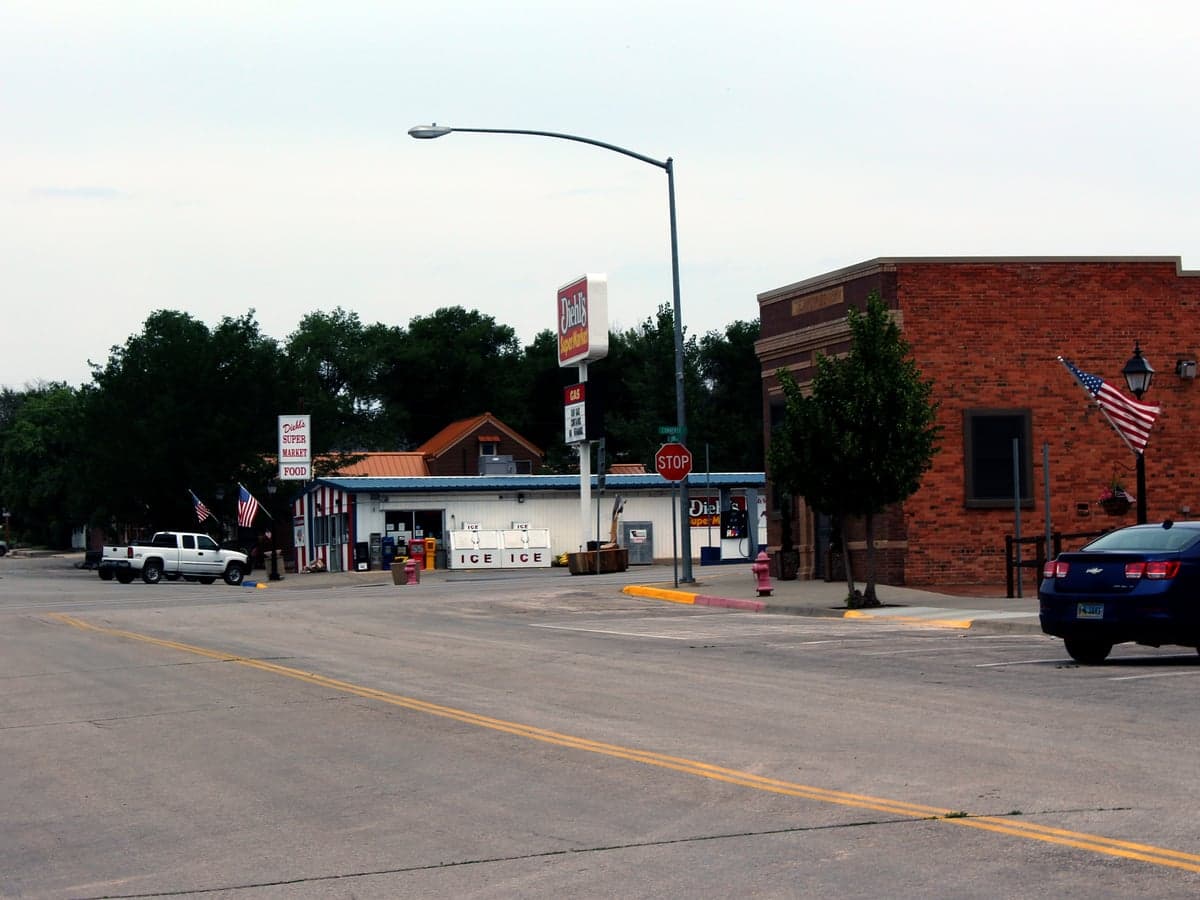
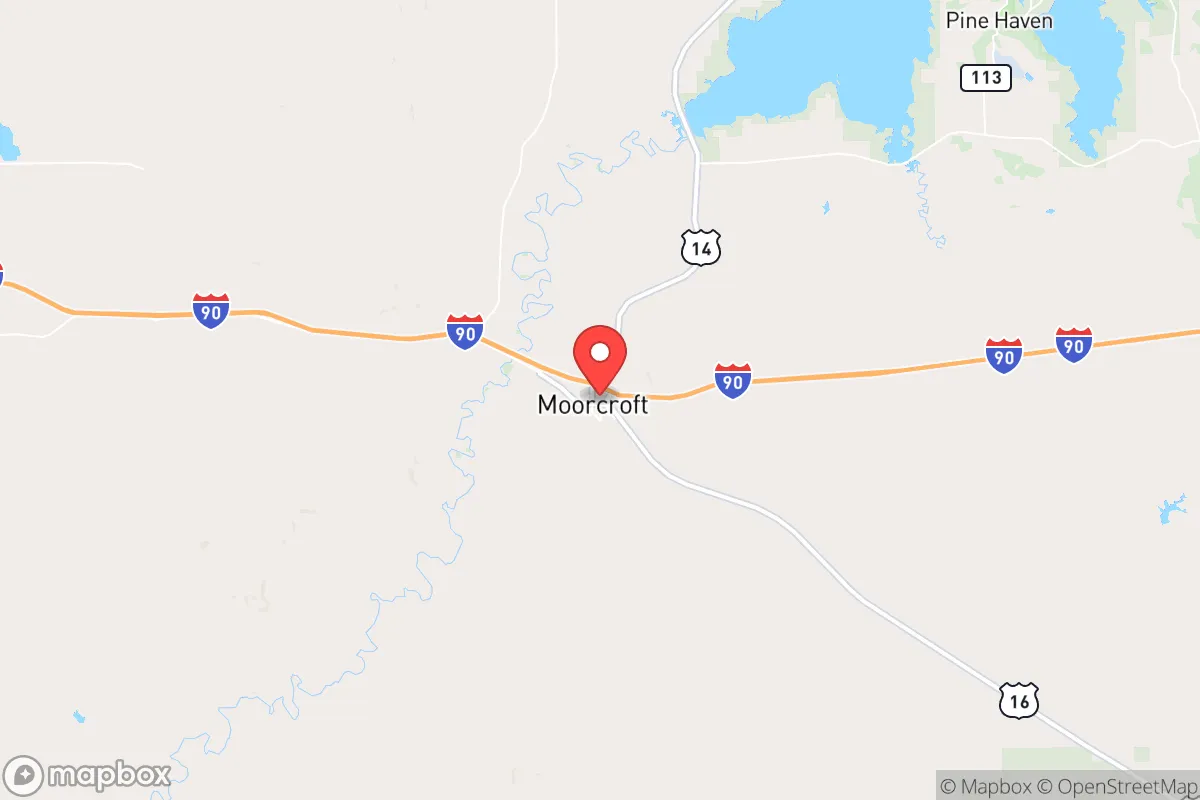
Photo: Wikipedia
Demographics of Moorcroft, WY
Affluence Level in Moorcroft, WY
A middle-class area roughly in line with national averages across income, home values, education, and employment.
People of Moorcroft, WY
The people of Moorcroft, Wyoming, today number just over 1,060 residents, forming one of the most ethnically homogeneous small towns in the American West. With a population that is 97.8% white and a foreign-born rate of 0.0%, Moorcroft’s character is defined by deep-rooted, multi-generational families tied to the land and extractive industries. The town’s identity is distinctly rural, working-class, and culturally conservative, with a median age that skews older and a college attainment rate of only 11.3% — reflecting a community where practical trades and ranching have long taken precedence over higher education.
How the city was settled and grew
Moorcroft’s human history begins not with colonial settlement but with the railroad. Founded in 1890 as a station stop on the Chicago, Burlington and Quincy Railroad, the town was named after a railroad official, W.S. Moorcroft. The first wave of settlers were railroad workers, homesteaders, and ranchers drawn by the promise of land under the Homestead Act and the need for a supply hub along the expanding rail line. These early residents — overwhelmingly of Northern European stock, primarily German, Irish, and Scandinavian — built the first homes along what is now Railroad Avenue, the historic core where the depot and stockyards once stood. By the 1910s, a second wave arrived as coal mining began in the nearby Wyodak and Rochelle fields, bringing a more transient population of miners who settled in simple company-built houses in the North End district, just north of the tracks. The town’s growth remained modest through the mid-20th century, peaking at around 1,200 in the 1950s before the decline of rail and small-scale mining led to a gradual population drop. The South Side neighborhood, developed in the 1940s and 1950s, housed the families of ranchers and small business owners who formed the stable, property-owning backbone of the community.
Modern era (post-1965)
After the 1965 Hart-Cellar Act, Moorcroft saw virtually no immigration-driven demographic change — the foreign-born share has remained at 0.0% for decades. Instead, the modern era has been shaped by domestic out-migration and a slow, steady aging of the existing population. The 1970s and 1980s brought a modest influx of families from other parts of Crook County and neighboring Campbell County, drawn by employment at the Belle Ayr and Eagle Butte coal mines — large surface mines that opened south of town. These new residents, almost entirely white and from the surrounding region, settled in the West Moorcroft subdivision, a small cluster of ranch-style homes built in the late 1970s. The 1990s and 2000s saw a slight uptick in Hispanic residents (now 0.5%), primarily workers in the oil and gas fields of the Powder River Basin, but this population has remained transient and very small. The East End, near the old highway alignment, has become a quiet pocket of retirees and long-term residents, while the Downtown Historic District — centered on the intersection of U.S. 14 and WY 51 — retains a handful of original commercial buildings but has seen little new residential development. No significant Asian, Black, or Indian subcontinent communities have ever formed in Moorcroft; the town remains almost entirely white and native-born.
The future
Moorcroft’s population trajectory points toward continued slow decline and demographic homogenization. The town’s 2020 census count of 1,062 represents a 6% drop from 2010, and projections from the Wyoming Department of Administration and Information suggest a further 5-10% decline by 2035 as the older cohort passes away and younger adults leave for larger job markets in Gillette (30 miles west) or out of state. The West Moorcroft subdivision has seen no new construction since 2005, and the North End has several vacant lots and boarded-up homes. There is no evidence of new immigrant settlement — the 0.0% foreign-born rate is expected to persist — and the Hispanic share is likely to plateau below 1%. The town is not tribalizing into distinct ethnic enclaves because there are no ethnic groups to form them; instead, the small population is becoming more geographically concentrated in the South Side and Downtown areas, where the remaining services — a grocery store, a gas station, a K-12 school — are located. The only potential growth vector is energy-related: if coal or oil prices spike, a temporary influx of workers could occur, but these are typically single men who do not put down roots.
For someone moving in now, Moorcroft offers a stable, low-crime, culturally uniform environment where nearly everyone shares a similar background and worldview. The trade-off is clear: you gain a tight-knit, predictable community with very low housing costs, but you also accept limited economic opportunity, a shrinking tax base, and a population that is aging and not being replaced. This is a place that will likely look very much the same in 20 years — just smaller and older.

* Values derived from national, state, county, city and local statistics and may differ in a specific area. Last updated: 2026-04-21T11:34:17.000Z
Narrative content on this page is AI-generated and may contain mistakes. Verify any details that matter before acting on them.
ReloMaps may earn a commission from affiliate links at no extra cost to you.

