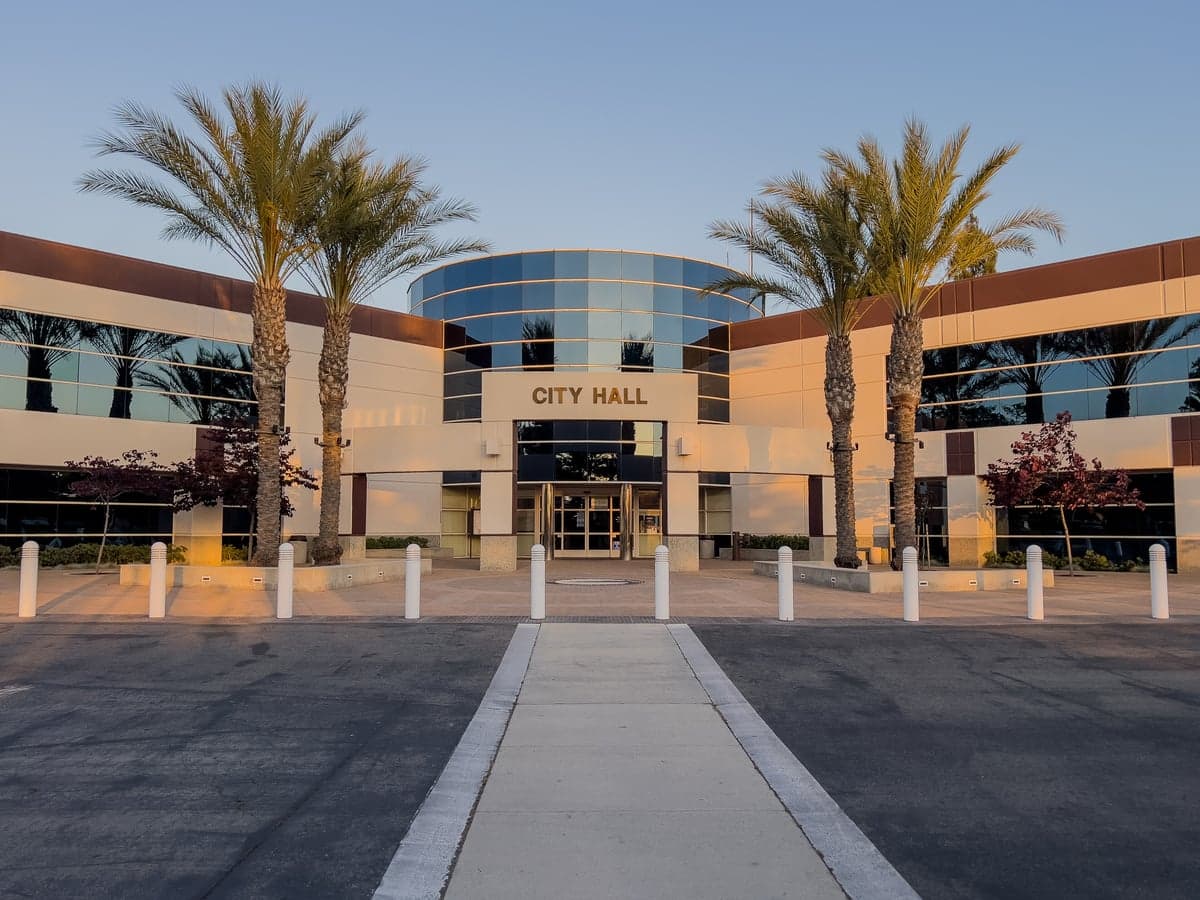
Photo: Wikipedia
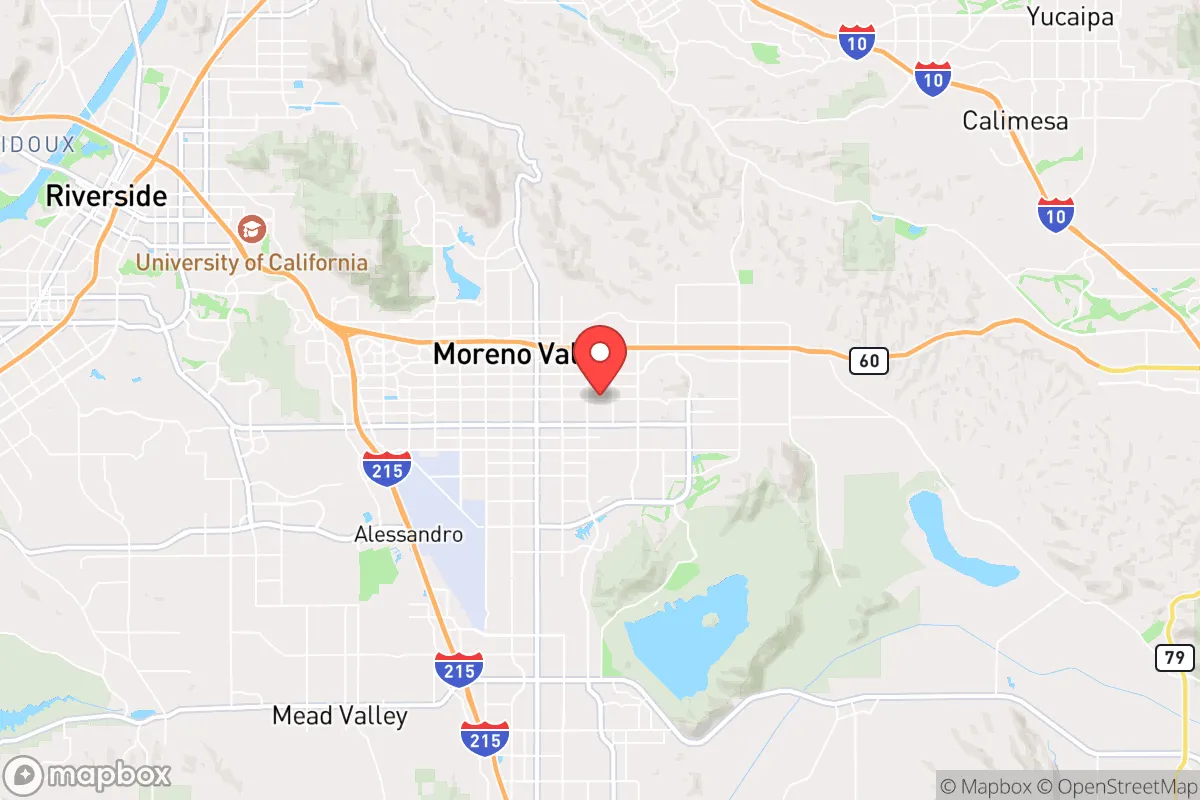
Personal Sovereignty in Moreno Valley, CA
Moderate friction. Expect trade-offs in some aspect of personal liberty and independence.
What does Personal Sovereignty tell us?
Personal Sovereignty measures your capacity for self-reliance and independence with minimal government friction. Higher scores mean fewer barriers between you and the way you want to live... but it assumes you have the space you need and good neighbors.
What does this tell us?
Personal Sovereignty measures your capacity for self-reliance and independence with minimal government friction. Higher scores mean fewer barriers between you and the way you want to live... but it assumes you have the space you need and good neighbors.
State Policy
Energy independence: Importer (33% of energy produced in-state)
Personal Liberty
Homesteading

Personal Liberty Analysis
Moreno Valley, California presents a complex and often contradictory environment for personal sovereignty, one that requires a clear-eyed assessment for anyone prioritizing autonomy, self-reliance, and minimal government overreach. While the city itself sits in Riverside County, a region with a more mixed political landscape than coastal California, it remains firmly under the thumb of state-level policies that systematically erode individual freedoms. For the strategic relocator—whether a single prepper or a family seeking to insulate themselves from societal instability—the trade-offs here are stark: you gain affordable land relative to Los Angeles and Orange County, but you inherit a legal and regulatory framework that actively discourages self-sufficiency, limits self-defense options, and taxes heavily to fund a sprawling welfare state. This analysis breaks down the specific sovereignty factors that matter most to those with a survivalist or conservative mindset.
Tax burden and regulatory posture: How California’s state apparatus impacts your wallet and projects
The most immediate assault on personal sovereignty in Moreno Valley comes from California’s tax and regulatory regime. The state’s top marginal income tax rate of 13.3%—the highest in the nation—applies to earnings above roughly $1 million, but even middle-class households face a combined state and local tax burden that ranks among the top five states. Property taxes are capped at 1% of assessed value under Proposition 13, but that’s deceptive: Moreno Valley’s sales tax rate of 8.75% (including county and local add-ons) and high gas taxes (over $0.60 per gallon in state excise taxes) mean you’re constantly nickel-and-dimed. For the prepper focused on stockpiling supplies, every purchase—from freeze-dried food to building materials—carries that extra levy. Regulatory posture is even more hostile: California’s California Environmental Quality Act (CEQA) can be weaponized by neighbors to delay or kill any significant property modification, from adding a workshop to installing solar panels. Building permits in Riverside County are notoriously slow and expensive, with fees often exceeding $5,000 for a simple addition. This isn’t a place where you can quietly improve your property without bureaucratic oversight.
Self-defense and gun law specifics: Navigating California’s restrictive firearms environment
For anyone serious about self-defense, Moreno Valley sits inside a state that treats gun ownership as a heavily regulated privilege, not a right. California’s Roster of Handguns Certified for Sale limits new handgun purchases to models with microstamping and other features, effectively banning many popular defensive firearms like the Glock 19 Gen 5 or Sig Sauer P320. The state’s assault weapons ban prohibits common rifles like the AR-15 by name, and the recent California Firearm Safety Certificate (FSC) requirement mandates a written test and background check for every purchase. Magazine capacity is capped at 10 rounds—a severe limitation for home defense against multiple intruders. Concealed carry is technically possible, but Riverside County is a “may issue” county, meaning the sheriff has discretion; while the current sheriff, Chad Bianco, is more pro-2A than many, the process still requires a “good cause” statement, a $100+ fee, and a 16-hour training course. Open carry is illegal. For the prepper, this means you can own a bolt-action rifle or a shotgun without much hassle, but building a serious defensive arsenal requires navigating a maze of paperwork, waiting periods (10 days), and annual registration fees for certain firearms. Ammunition purchases now require a background check and a $1 fee per transaction, adding friction to stockpiling.
Self-reliance and homesteading viability: Lot sizes, zoning, and off-grid feasibility
Moreno Valley’s suburban character limits serious homesteading, but there are pockets of opportunity. The city’s zoning is predominantly residential with minimum lot sizes of 6,000 to 7,200 square feet in most subdivisions, though some older neighborhoods near the Box Springs Mountains offer parcels of 0.5 to 1 acre. These larger lots are rare and command a premium—expect to pay $500,000+ for a fixer-upper on a half-acre. Raising chickens is allowed on lots of 6,000 square feet or more, but goats, pigs, or larger livestock are prohibited in most residential zones. Beekeeping is permitted with a registration fee of $25 per year. Off-grid feasibility is nearly zero: California’s building codes require connection to the municipal water and sewer systems in urbanized areas, and solar panels must be grid-tied to qualify for net metering. Rainwater collection is legal but limited to 5,000 gallons of storage without a permit, and greywater systems require a licensed plumber. The city’s water rates are among the highest in the Inland Empire, with a typical household paying $80–$120 per month, and drought restrictions can ban outdoor watering during dry years. For the serious prepper, Moreno Valley is a compromise: you can have a garden and a few chickens, but true self-sufficiency—off-grid power, private wells, livestock—is effectively illegal.
Personal liberties: Parental rights, medical autonomy, speech, and property
California’s progressive state government has systematically eroded several key personal liberties that matter to conservative families. Parental rights are under direct assault: the state’s Education Code prohibits schools from notifying parents if a child requests to change their gender identity or pronouns, and the 2024 law AB 1955 explicitly bans school districts from requiring parental notification. This means your child could be socially transitioned at school without your knowledge. Medical autonomy is similarly constrained: vaccine mandates for school attendance remain in place (though COVID-19 mandates were dropped in 2023), and the state’s public health officer retains broad emergency powers to impose lockdowns, mask mandates, and business closures. During the 2020–2021 period, Riverside County enforced some of the strictest business closures in the state, with Moreno Valley restaurants and gyms shuttered for months. Free speech is nominally protected, but the state’s “hate speech” laws and social media liability statutes create a chilling effect—posting about “critical race theory” or “gender ideology” on public platforms can lead to doxxing or employer retaliation. Property rights are the weakest link: California’s rent control laws (AB 1482) cap annual rent increases at 5% plus inflation, and Moreno Valley has its own local rent stabilization ordinance for apartments built before 1995. This means if you own rental property, your income is capped by government fiat. For homeowners, the state’s “builder’s remedy” allows developers to bypass local zoning if a city hasn’t approved a state-mandated housing plan, potentially leading to high-density apartments next to single-family homes.
In the broader context of personal sovereignty, Moreno Valley offers a mixed bag that leans negative for the survivalist or prepper. Compared to states like Texas, Idaho, or Montana, where property rights, gun laws, and parental authority are far stronger, California’s regulatory grip is a constant drag. However, within California, Moreno Valley is a relative bright spot: its lower home prices (median around $480,000 vs. $900,000 in Los Angeles) and larger lot sizes give you more physical space to operate, and Riverside County’s more conservative sheriff and local government provide a buffer against the worst of Sacramento’s overreach. The city’s proximity to the San Jacinto Mountains and the Mojave Desert also offers escape routes for those planning for societal collapse. But if your priority is maximum autonomy—the ability to own an AR-15, homeschool without state interference, drill a well, and keep your tax money—Moreno Valley is a compromise at best)Skip it entirely. The strategic relocator should view this area as a temporary staging ground, not a final redoubt.

* Values derived from national, state, county, city and local statistics and may differ in a specific area. Last updated: 2026-04-24T19:01:13.000Z
Narrative content on this page is AI-generated and may contain mistakes. Verify any details that matter before acting on them.
ReloMaps may earn a commission from affiliate links at no extra cost to you.

