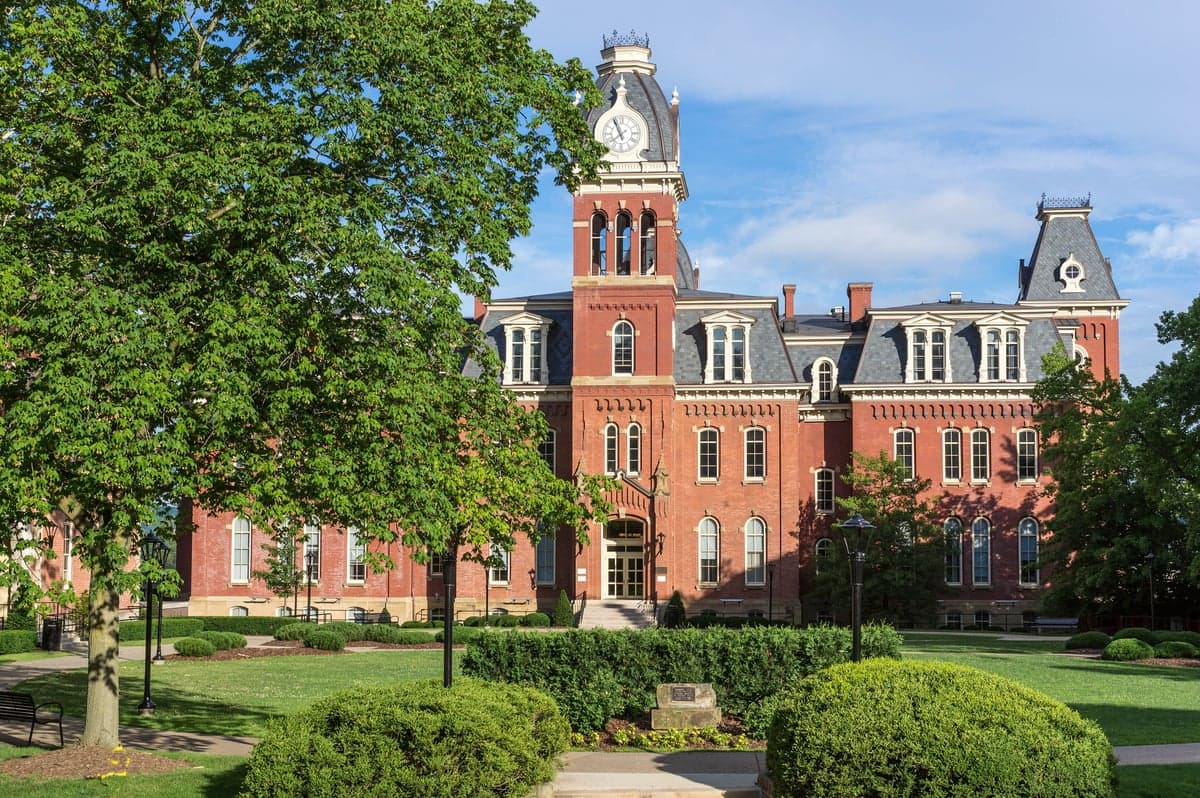
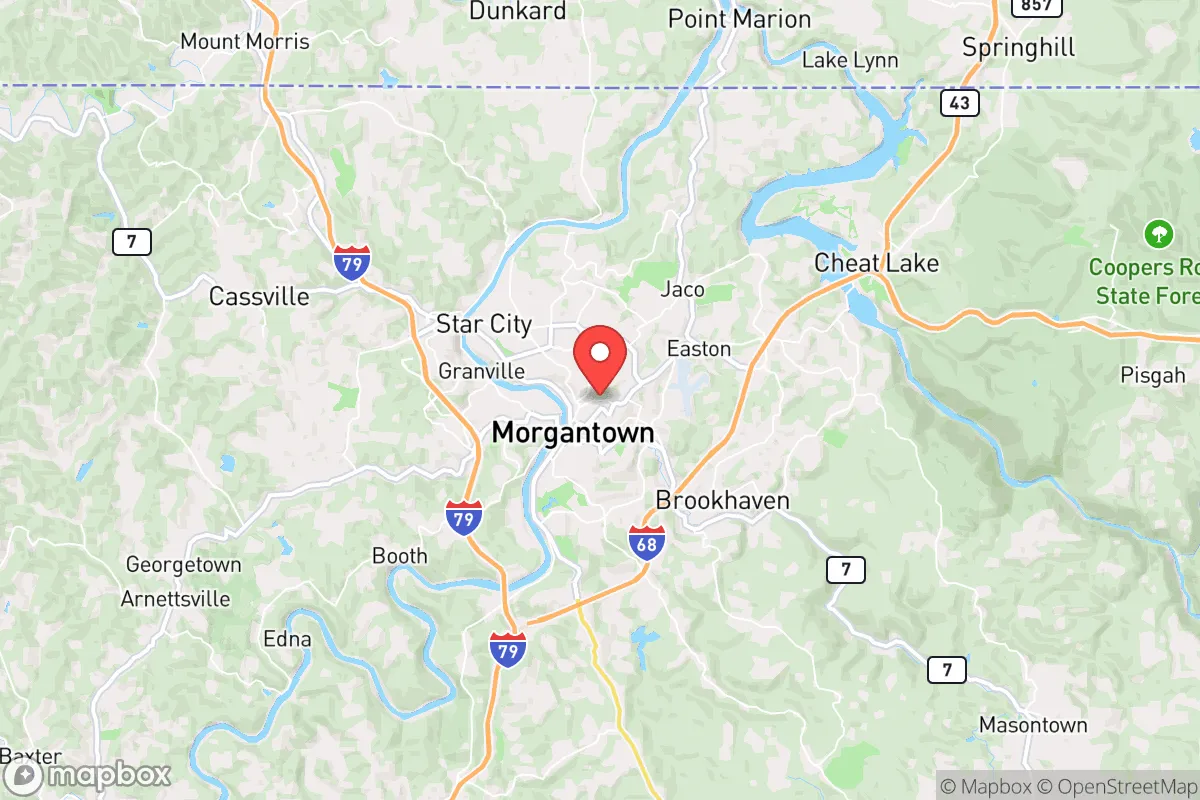
Photo: Wikipedia
Demographics of Morgantown, WV
Affluence Level in Morgantown, WV
A below-average socioeconomic profile. Incomes, home values, and educational attainment trail the U.S., with higher poverty and unemployment.
People of Morgantown, WV
Morgantown, West Virginia, is a city of roughly 30,000 residents that feels both older and younger than its numbers suggest—older in its deep Appalachian roots, younger in the constant churn of West Virginia University students and faculty who give the city a transient, educated energy. The population is predominantly white (84.2%), with small but distinct minority communities: 4.2% Black, 4.0% Hispanic, 3.3% East and Southeast Asian, and 0.6% Indian (subcontinent). With 58.1% of adults holding a college degree, Morgantown is one of the most educated cities in the state, and its 4.0% foreign-born share reflects a modest but steady international presence tied almost entirely to the university and its research sectors.
How the city was settled and grew
Morgantown’s founding population was overwhelmingly Scots-Irish and German, moving into the Monongahela River valley in the late 1700s after the end of the French and Indian War opened the region to settlement. The original land grants attracted farmers and millers, and the town was formally established in 1785 around a ford on the river. Through the 19th century, the population grew slowly as a market and transport hub for surrounding coal and timber operations. The arrival of the Baltimore and Ohio Railroad in the 1850s brought a wave of Irish laborers, who settled in the Greenmont neighborhood, building homes on the steep hillsides above the rail yards. A second wave of Italian and Eastern European immigrants arrived in the early 1900s to work in the expanding glass and coal industries; many of these families put down roots in South Park, where the historic brick rowhouses and working-class cottages still reflect that era. The city remained overwhelmingly white and native-born through the mid-20th century, with the Black population—never large—concentrated in the First Ward area near the river, a pattern common to many Appalachian industrial towns.
Modern era (post-1965)
The 1965 Hart-Cellar Act had a modest but visible effect on Morgantown, primarily through the university. The first significant post-1965 arrivals were East and Southeast Asian graduate students and faculty—Chinese, Korean, and Vietnamese—who settled in the University District neighborhoods around Evansdale and the Health Sciences campus. These communities remain small (3.3% of the city population) but are highly educated and concentrated in STEM and medical fields. The Indian subcontinent population (0.6%) arrived slightly later, in the 1990s and 2000s, also tied to WVU’s engineering and computer science programs; they tend to live in newer apartment complexes near the Suncrest area rather than in historic neighborhoods. The Hispanic population (4.0%) is the most diverse in origin, including both long-established families from the Southwest who came for construction and service jobs and a newer wave of Central American immigrants working in restaurants and hospitality; they are scattered across the city but have a small cluster in the Sabraton area. Domestic in-migration since 1970 has been dominated by retirees from elsewhere in West Virginia and by out-of-state students who stay after graduation—a pattern that has kept the city’s white share high but its median age low. Suburbanization pushed many native-born white families into Cheat Lake and Westover (technically outside city limits), leaving the urban core more transient and more diverse than the surrounding county.
The future
Morgantown’s population is likely to remain stable or grow slowly, driven almost entirely by WVU enrollment and the health care sector. The foreign-born share is expected to increase incrementally as the university recruits more international students, particularly from East and Southeast Asia and India, but these groups tend to be transient—many leave after graduation—so the permanent immigrant community will grow only if local tech and medical employers retain them. The Hispanic population is the most likely to expand through natural increase and continued labor migration, but it will remain a small share of the total. The city is not tribalizing into distinct ethnic enclaves; rather, it is homogenizing around a university-town identity, with most minority groups living in mixed neighborhoods near campus. The biggest demographic shift is internal: the native-born white population is aging, and younger white families continue to move to the suburbs, leaving the city core increasingly dominated by students and young professionals. For a newcomer, Morgantown offers a safe, educated, and politically moderate environment where the dominant culture is still Appalachian-rooted but increasingly shaped by the university’s global reach.
Morgantown is becoming a more diverse, more educated, and more transient place—a university town that draws people from around the world but holds onto its Appalachian character. For someone moving in now, the city offers a stable, low-crime environment with a strong sense of place, but the population churn means that deep community roots take time to build. The neighborhoods that matter most—Greenmont, South Park, Suncrest, and the University District—each tell a different part of the story, and understanding them is key to finding where you fit.

* Values derived from national, state, county, city and local statistics and may differ in a specific area. Last updated: 2026-04-23T05:54:11.000Z
Narrative content on this page is AI-generated and may contain mistakes. Verify any details that matter before acting on them.
ReloMaps may earn a commission from affiliate links at no extra cost to you.

