 Popular
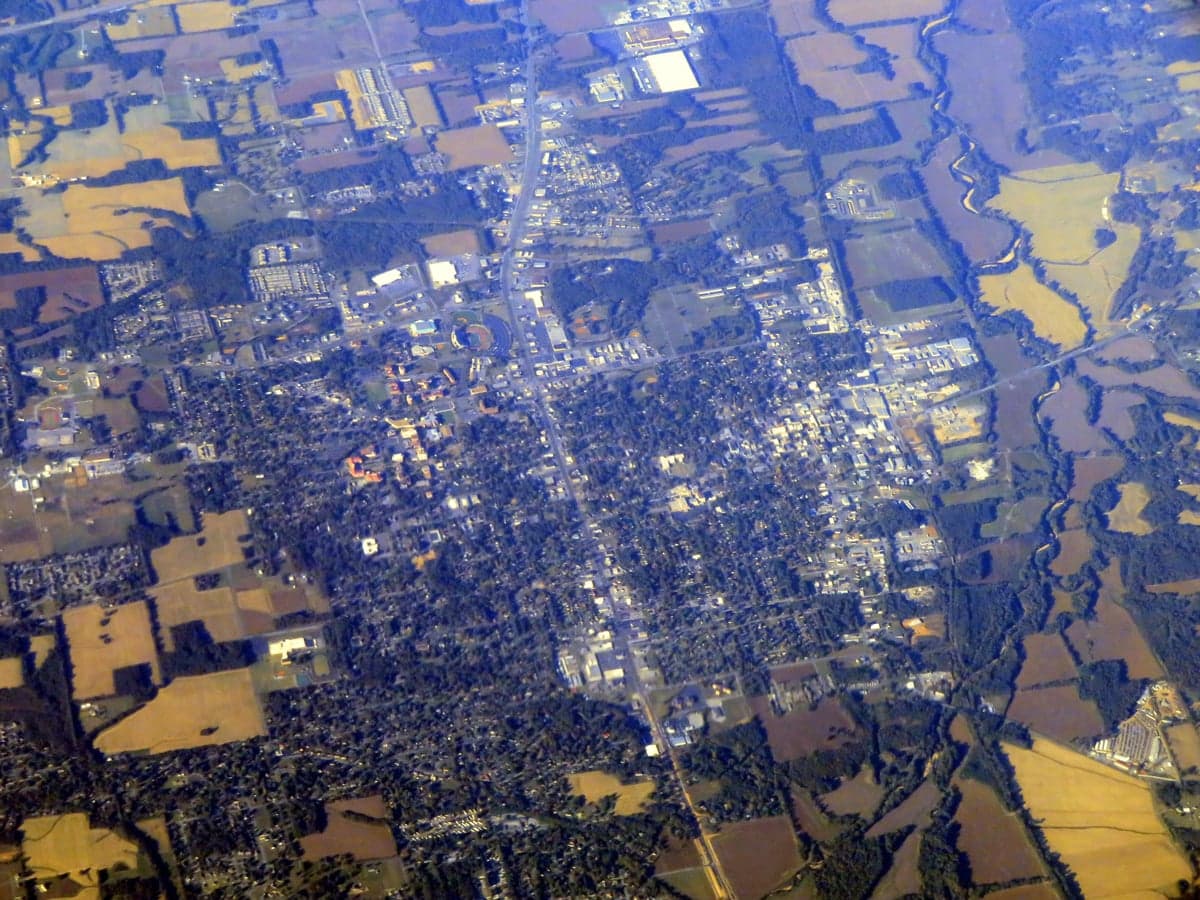
Photo: Wikipedia
Demographics of Murray, KY
Affluence Level in Murray, KY
A below-average socioeconomic profile. Incomes, home values, and educational attainment trail the U.S., with higher poverty and unemployment.
People of Murray, KY
Murray, Kentucky, is a small, predominantly white college town of 17,888 residents, shaped by its role as the home of Murray State University and its position as the economic and cultural hub of Calloway County. The city’s population is notably more educated than the state average, with 37.0% holding a bachelor’s degree or higher, and remains overwhelmingly native-born, with only 2.6% foreign-born residents. Distinctive markers include a strong sense of local identity, a visible university influence, and a social fabric that is both stable and slowly diversifying, particularly through the university’s recruitment of international students and faculty.
How the city was settled and grew
Murray was founded in 1822 as the seat of the newly formed Calloway County, drawing its earliest settlers—primarily of English, Scots-Irish, and German descent—from Virginia, North Carolina, and Tennessee. These families were attracted by the promise of fertile, inexpensive land in the Jackson Purchase region, a tract acquired from the Chickasaw Nation in 1818. The original town grid was laid out around the courthouse square, and the surrounding countryside filled with small farms. The arrival of the Nashville, Chattanooga and St. Louis Railway in the 1870s transformed Murray from a sleepy county seat into a regional trading center, spurring the growth of the Historic Downtown district, where merchants and professionals built homes along Main and Maple Streets. A second wave of growth came with the founding of Murray State Normal School (now Murray State University) in 1922, which drew faculty and staff from across the Midwest and Upper South. Many of these early academics settled in the College Heights neighborhood, a tree-lined area of Craftsman and Colonial Revival homes just north of campus, which remains a stable, professional-class enclave today.
Modern era (post-1965)
The post-1965 era brought modest but meaningful demographic shifts. The 1965 Immigration and Nationality Act had a limited direct effect on Murray, as the city’s foreign-born population remains low at 2.6%. However, Murray State University’s deliberate international recruitment—particularly of East/Southeast Asian students from China, Vietnam, and South Korea—created a small but visible Asian community (2.4% of the city’s population) concentrated in off-campus rental housing near the university, especially in the University Farms and Hickory Hills subdivisions. The city’s Black population (6.7%) has deep local roots, dating to the post-Reconstruction era, and is historically centered in the North Murray area, near the intersection of KY-94 and KY-121, where several African American churches and a community center remain active. The Hispanic population (3.2%) is a more recent arrival, growing steadily since the 1990s as agricultural and construction work drew families from Mexico and Central America; many have settled in the South Murray corridor along US-641, where lower housing costs and proximity to the county’s produce farms provide economic opportunity. The Indian-subcontinent population (0.5%) is almost entirely tied to Murray State, with faculty and graduate students living in the College Station apartment complex and surrounding rental properties near campus.
The future
Murray’s population is projected to grow slowly, likely reaching 19,000–20,000 by 2040, driven primarily by university enrollment and regional healthcare expansion. The city is not homogenizing into a single identity; rather, it is becoming more tribalized, with distinct enclaves forming along educational and ethnic lines. The university-adjacent neighborhoods (College Heights, University Farms) will continue to attract a transient, educated population, while the historic Black community in North Murray and the newer Hispanic corridor in South Murray are likely to remain stable but separate. The East/Southeast Asian community, largely composed of students and recent graduates, is expected to plateau unless the university significantly expands its international recruitment. The Indian-subcontinent population, similarly tied to academic hiring, will remain small and fluid. The white native-born majority (82.2%) is aging, and the city’s future growth will depend on whether it can retain young families and attract new residents from outside the region—a challenge given the limited job base outside of education and healthcare.
For someone moving to Murray now, the city offers a stable, safe, and family-oriented environment with a strong university presence and a low cost of living. The population is becoming slightly more diverse, but the pace is slow, and the city remains culturally conservative and community-focused. New residents should expect to find a place where social circles often form around church, school, and university ties, and where the most vibrant growth is concentrated in the neighborhoods closest to campus.

* Values derived from national, state, county, city and local statistics and may differ in a specific area. Last updated: 2026-04-21T09:18:55.000Z
Narrative content on this page is AI-generated and may contain mistakes. Verify any details that matter before acting on them.
ReloMaps may earn a commission from affiliate links at no extra cost to you.

