 Popular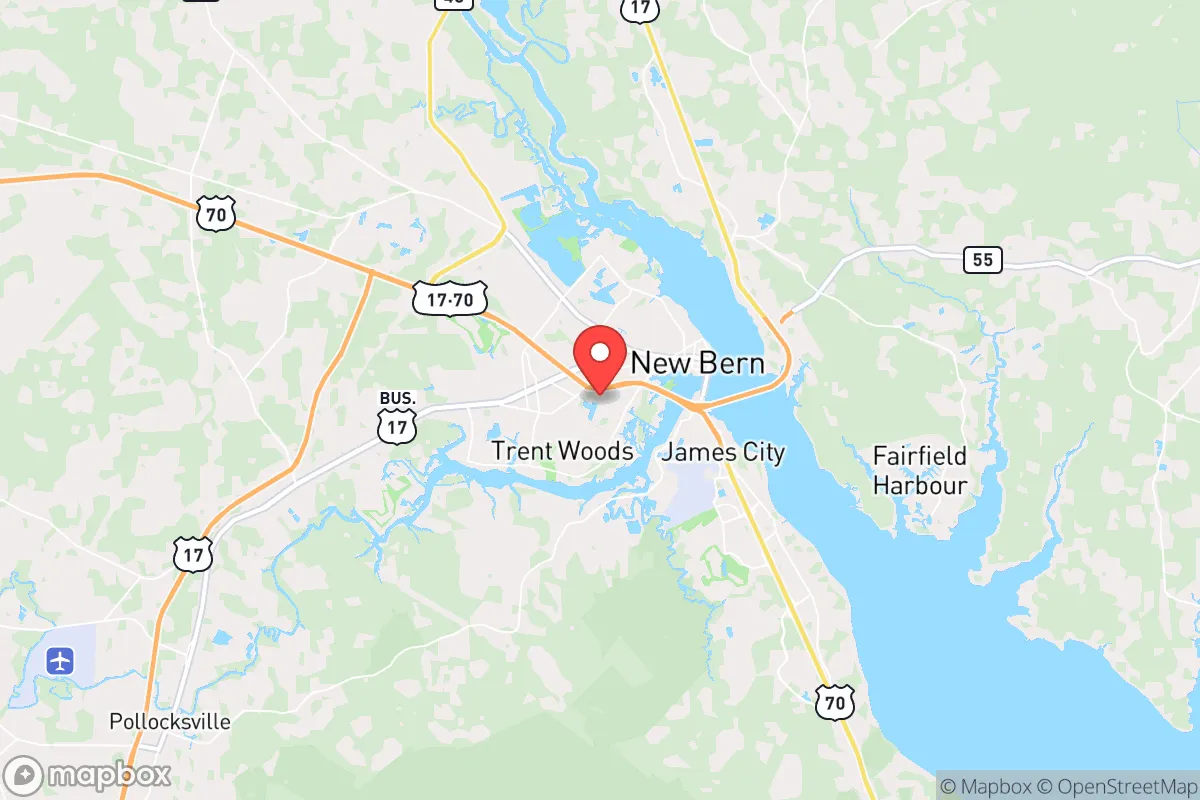
Photo: Wikipedia
Demographics of New Bern, NC
Affluence Level in New Bern, NC
A below-average socioeconomic profile. Incomes, home values, and educational attainment trail the U.S., with higher poverty and unemployment.
People of New Bern, NC
The people of New Bern, North Carolina today number 31,563, forming a community that is notably more diverse than the surrounding Craven County region. The city’s population is characterized by a 53.6% white majority alongside a substantial 28.7% Black or African American population, a growing 6.1% Hispanic community, and a 5.5% East/Southeast Asian presence. With only 1.7% foreign-born residents and a 29.6% college-educated rate, New Bern retains a distinctly native-born, working-to-middle-class character, blending historic Southern roots with a modest but visible influx of new groups.
How the city was settled and grew
New Bern’s population history begins with its founding in 1710 by Swiss and German Palatine settlers, who established the city as the second oldest in North Carolina. These early European colonists built the core of what is now the Downtown Historic District, laying out a grid of streets along the Neuse and Trent Rivers. The city’s early growth was driven by its role as a colonial capital and a port for the naval stores and lumber industries. By the early 19th century, enslaved African labor was central to the economy, and a free Black community also emerged. After the Civil War, newly freed African Americans established neighborhoods like Duffyfield and Greenbrier, which remain predominantly Black communities today. The late 19th and early 20th centuries saw modest growth from rural white migration into areas like Trent Woods, a planned suburban development that attracted middle-class families. Through the mid-20th century, New Bern’s population remained overwhelmingly native-born and biracial—white and Black—with little foreign immigration.
Modern era (post-1965)
The post-1965 period brought gradual demographic shifts, though New Bern did not experience the rapid ethnic diversification seen in larger Southern cities. The most significant change has been the growth of the Hispanic population, now at 6.1%, concentrated in newer subdivisions and apartment complexes along the U.S. 70 corridor west of downtown. This community is largely composed of domestic migrants from other parts of North Carolina and the U.S., rather than direct foreign arrivals. The East/Southeast Asian population, at 5.5%, is a more recent addition, with many families settling in the Brices Creek area and near the CarolinaEast Medical Center, drawn by professional opportunities in healthcare and the military-related economy of nearby Cherry Point Marine Corps Air Station. The Indian subcontinent population remains negligible at 0.2%. White flight from downtown to suburbs like Trent Woods and Taberna accelerated in the 1970s and 1980s, while Black residents increasingly concentrated in established neighborhoods like Duffyfield and Greenbrier. The city’s overall population has grown modestly, with the white share declining from roughly 60% in 2000 to 53.6% today, while the Hispanic and Asian shares have risen from near zero.
The future
New Bern’s population is trending toward greater but still moderate diversity. The Hispanic and East/Southeast Asian communities are growing, but from a small base, and the city’s low foreign-born rate (1.7%) suggests these increases will come primarily from domestic migration and natural increase rather than international immigration. The Black population share has remained stable over the past two decades, indicating a settled, multi-generational community rather than a rapidly changing one. The white population is slowly declining as a share but remains the majority. The city is not tribalizing into starkly divided enclaves; rather, neighborhoods like Brices Creek and Taberna are becoming more mixed, while older Black neighborhoods remain largely homogeneous. Over the next 10-20 years, New Bern is likely to become slightly more Hispanic and Asian, but it will remain a predominantly native-born, English-speaking city with a strong biracial character. The college-educated share (29.6%) may rise slowly as retirees and remote workers are drawn to the historic downtown and riverfront amenities.
For someone moving to New Bern now, the city offers a stable, moderately diverse community with deep historical roots. It is not a rapidly changing or highly polarized place, but one where established Black and white populations coexist alongside small but growing Hispanic and Asian communities. The low foreign-born rate and modest growth mean that newcomers will find a city that is still very much shaped by its Southern and colonial past, with a population that values tradition and stability over rapid transformation.

* Values derived from national, state, county, city and local statistics and may differ in a specific area. Last updated: 2026-05-03T20:27:40.000Z
Narrative content on this page is AI-generated and may contain mistakes. Verify any details that matter before acting on them.
ReloMaps may earn a commission from affiliate links at no extra cost to you.

