Photo: Wikipedia
Demographics of New Haven, CT
Affluence Level in New Haven, CT
A low-income area with significant economic hardship. Household wealth and educational attainment are well below national averages.
People of New Haven, CT
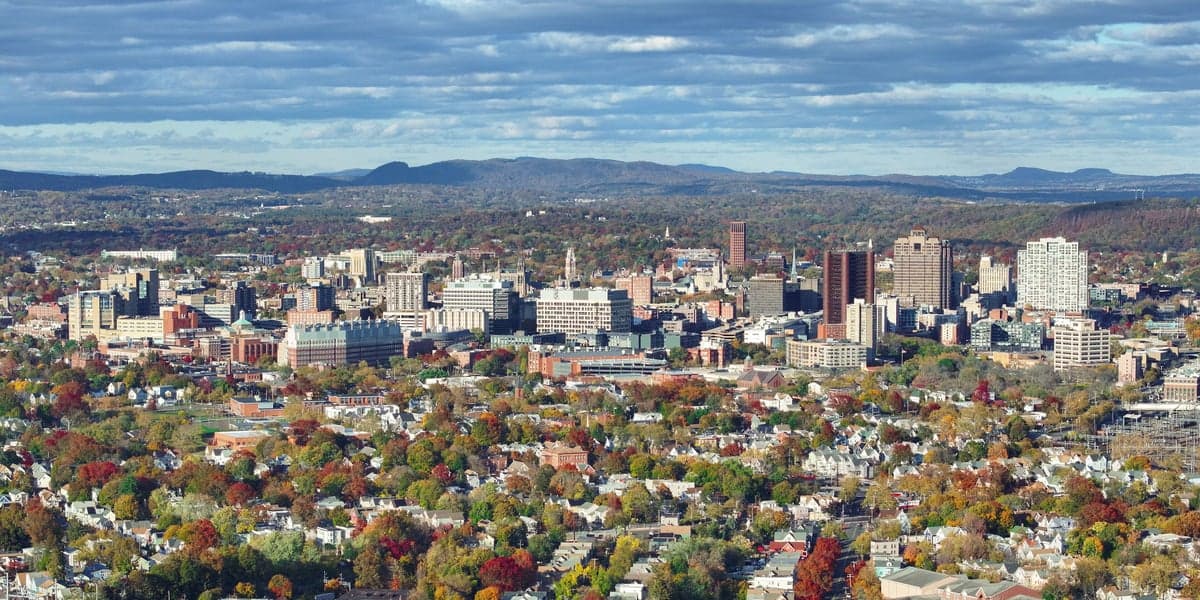
New Haven, Connecticut, is a dense, historically layered city of 132,893 residents, defined by its role as a global university town and a regional economic hub. Its population is notably diverse and evenly split among three major groups: 31.2% Hispanic, 29.3% White, and 29.0% Black, with a smaller but growing East/Southeast Asian community at 4.1% and an Indian-subcontinent population at 1.0%. The city is highly educated, with 37.7% of adults holding a college degree, a figure driven largely by Yale University and its affiliated medical and research institutions. This creates a distinctive social character—a mix of long-standing, working-class ethnic enclaves, a transient student and academic population, and a professional class tied to the city's hospitals and biotech sector.
How the city was settled and grew
New Haven was founded in 1638 by English Puritan colonists who purchased the land from the Quinnipiac tribe. The original settlement was a theocratic, walled community centered on the nine-square grid that remains the downtown core today. For the next two centuries, the city's population remained overwhelmingly English and Protestant, driven by maritime trade and manufacturing. The first major demographic shift came with the Irish Potato Famine (1845–1852), which brought tens of thousands of Irish immigrants who settled in the Hill and Fair Haven neighborhoods, building the city's Catholic infrastructure. Italian immigrants followed in large numbers between 1890 and 1920, concentrating in Wooster Square, which became a tightly knit Italian-American enclave. At the same time, Eastern European Jews arrived, settling in the Edgewood and Westville areas. By 1910, New Haven was a majority-immigrant city, with nearly 70% of residents either foreign-born or children of immigrants. The Great Migration of African Americans from the South began during World War I and accelerated through the 1950s, with Black families moving into the Dixwell and Newhallville neighborhoods, which became the heart of the city's Black community.
Modern era (post-1965)
The 1965 Hart-Cellar Immigration Act reshaped New Haven's population as profoundly as any earlier wave. The most dramatic change has been the rise of the Hispanic population, which grew from under 2% in 1970 to over 31% today. This wave began with Puerto Ricans in the 1970s, who settled in Fair Haven and the Hill, followed by a steady influx of Mexicans, Dominicans, and Central Americans from the 1990s onward. Fair Haven is now the city's primary Hispanic commercial corridor, with bodegas, churches, and community organizations serving a predominantly Spanish-speaking population. Simultaneously, the city's Black population peaked around 1980 at roughly 40% and has since declined to 29%, as middle-class Black families moved to suburban towns like Hamden, West Haven, and Branford. The White population, which was over 60% in 1970, has fallen to 29.3%, driven by both suburban flight and the replacement of older ethnic neighborhoods with student housing. The East/Southeast Asian community (4.1%) is a newer, smaller wave, concentrated near Yale's medical campus in the Dwight neighborhood and in the East Rock area, where many graduate students and medical professionals live. The Indian-subcontinent population (1.0%) is similarly small and professional, often tied to the biotech and IT sectors.
The future
New Haven's population is trending toward a more polarized, education-driven demographic structure. The city is not homogenizing; rather, it is tribalizing into distinct enclaves based on income and education. The Hispanic population is the fastest-growing segment, projected to become a plurality or outright majority within 10–15 years, driven by both immigration and higher birth rates. This growth is concentrated in Fair Haven and the Hill, where the population is younger and more family-oriented. Meanwhile, the White population is bifurcating: a growing share is made up of highly educated, affluent professionals and academics who live in East Rock, Wooster Square, and downtown, while working-class White ethnic neighborhoods have largely disappeared. The Black population is likely to continue a slow decline as out-migration to suburbs persists, though Newhallville and Dixwell remain stable, older communities. The East/Southeast Asian and Indian populations, while small, are growing steadily through university and hospital recruitment, and are likely to remain concentrated in the Yale-adjacent neighborhoods. The foreign-born share (10.9%) is below the national average but rising, driven almost entirely by Latin American immigration.
For someone moving to New Haven today, the city offers a choice between two distinct worlds: the dense, walkable, highly educated core around Yale and downtown, or the more traditional, family-oriented, working-class Hispanic and Black neighborhoods in the outer wards. The city is becoming more stratified by education and income, with the university's expansion driving up housing costs and displacing lower-income residents in areas like Dwight and East Rock. New Haven is not a melting pot in the classic sense—it is a city of parallel communities, each with its own institutions, languages, and economic trajectories. A newcomer should expect a vibrant but fragmented social landscape, where neighborhood choice largely determines daily experience.

* Values derived from national, state, county, city and local statistics and may differ in a specific area. Last updated: 2026-04-30T05:54:41.000Z
Narrative content on this page is AI-generated and may contain mistakes. Verify any details that matter before acting on them.
ReloMaps may earn a commission from affiliate links at no extra cost to you.

