Photo: Wikipedia
Demographics of Atlantic County
Affluence Level in Atlantic County
A middle-class area roughly in line with national averages across income, home values, education, and employment.
People of Atlantic County
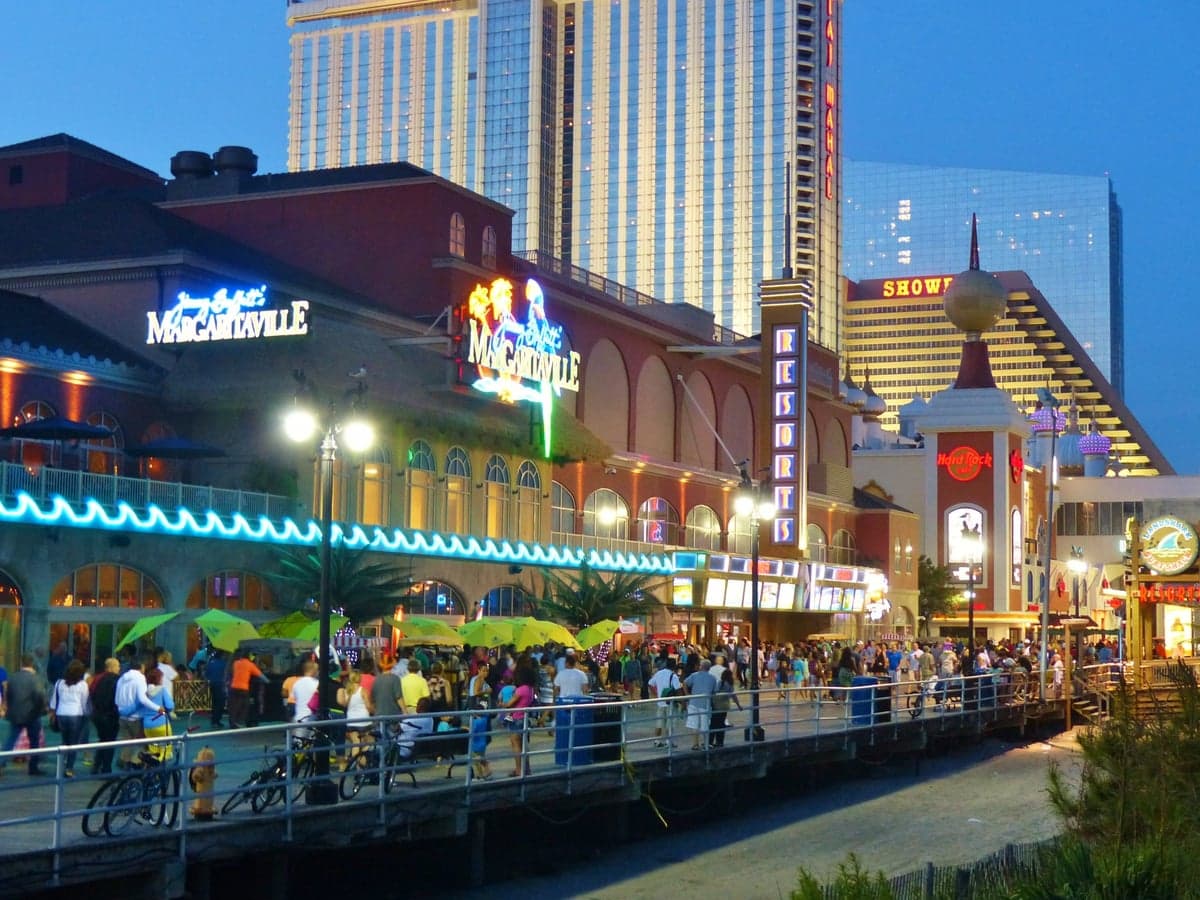
Atlantic County, New Jersey, is a study in contrasts: a coastal region where the glitz of Atlantic City’s casino corridor meets the quiet, family-oriented suburbs of Egg Harbor Township and the rural stretches of Hammonton. With a population of 274,704, the county is majority-white (54.5%) but increasingly diverse, shaped by a 19.9% Hispanic population, a 13.2% Black community, and growing East/Southeast Asian (4.5%) and Indian-subcontinent (3.2%) enclaves. The foreign-born share sits at 7.0%, and 31.2% of adults hold a college degree, reflecting a workforce that balances tourism, healthcare, and agriculture. The county’s identity is rooted in its role as a resort destination and a gateway for immigrants seeking opportunity in the Garden State’s southern reaches.
Settlement & growth (pre-1960)
Before European contact, the area now known as Atlantic County was home to the Lenape people, specifically the Unalachtigo band, who lived along the rivers and coastal bays, fishing and farming. Dutch and Swedish traders visited in the 1600s, but permanent European settlement began in earnest under English control after 1664, when the region became part of West Jersey. The first English settlers, largely Quakers and other dissenting Protestants, established small farming communities in what are now Egg Harbor City and Mays Landing (the county seat) in the early 1700s. These early colonists were primarily of English and Dutch stock, drawn by fertile soil and access to the Great Egg Harbor River for transport.
The 19th century brought transformative waves. The construction of the Camden and Atlantic Railroad in 1854 turned Atlantic City from a sleepy fishing village into a seaside resort, attracting tourists and workers alike. Irish immigrants arrived in large numbers during the 1840s and 1850s, many laboring on the railroad and in the new hotels. They settled in Atlantic City’s “Ducktown” neighborhood and in Brigantine, where they worked as fishermen and dockhands. Germans followed in the 1850s and 1860s, founding Egg Harbor City as a planned German agricultural colony; by 1870, the town was overwhelmingly German-speaking, with its own newspapers and breweries. Italian immigrants began arriving in the 1880s, drawn by work in the railroad yards, construction, and the burgeoning tourism industry. They concentrated in Atlantic City’s “Little Italy” (around the present-day Chelsea neighborhood) and in Hammonton, where they took up farming, especially in the blueberry and cranberry bogs that still define the area.
The early 20th century saw the Great Migration of Black Americans from the South, who came to Atlantic City for jobs in hotels, restaurants, and domestic service. By 1930, Atlantic City’s Black population had grown to over 10,000, concentrated in the Northside neighborhood and in Pleasantville, which became a hub for Black-owned businesses and churches. Eastern European Jews arrived in the 1910s and 1920s, many working as shopkeepers and hoteliers in Atlantic City and Ventnor City. The post-World War II era brought a wave of Puerto Rican migrants, who settled in Atlantic City and Absecon, working in the casinos and hospitality sector. Suburbanization accelerated in the 1950s and 1960s, with white families moving to Linwood and Northfield, creating bedroom communities for workers commuting to Atlantic City and Philadelphia.
Modern era (post-1965)
The 1965 Hart-Cellar Act reshaped Atlantic County’s demographics by opening immigration from Asia and Latin America. The most significant post-1965 wave has been Hispanic, primarily from Puerto Rico, the Dominican Republic, and Mexico. By 2024, Hispanics made up 19.9% of the county’s population, with large concentrations in Atlantic City (where they are nearly 40% of residents) and Pleasantville. These communities are anchored by Catholic parishes, Spanish-language media, and a growing number of Hispanic-owned businesses, particularly in construction, landscaping, and food service. The Black population, at 13.2%, has become more suburban, with significant communities in Egg Harbor Township and Hamilton Township, reflecting a broader trend of Black middle-class flight from Atlantic City’s urban core.
East/Southeast Asian communities (4.5%) are a newer presence, with Filipinos and Vietnamese arriving in the 1980s and 1990s, many working in healthcare and casino hospitality. They have established small enclaves in Egg Harbor Township and Galloway Township, where Asian grocery stores and churches have appeared. The Indian-subcontinent population (3.2%) is even more recent, growing rapidly since 2000, driven by professionals in healthcare, IT, and casino management. They concentrate in Egg Harbor Township and Linwood, where newer subdivisions have attracted families seeking good schools and safe neighborhoods. Domestic migration has also reshaped the county: the decline of Atlantic City’s casino industry after 2014 triggered an outflow of workers, but the county has seen an influx of retirees from northern New Jersey and New York, drawn by lower property taxes and coastal living. Suburbanization continues, with Hammonton and Mullica Township absorbing growth as exurban commuter towns for Philadelphia and Atlantic City.
The future
Atlantic County is slowly diversifying, but the trend is toward distinct enclaves rather than wholesale integration. The Hispanic population is projected to grow, potentially reaching 25-30% by 2040, driven by higher birth rates and continued immigration from Puerto Rico and Central America. The East/Southeast Asian and Indian-subcontinent communities are likely to grow as well, though from a smaller base, as professionals continue to be attracted by the region’s lower cost of living compared to northern New Jersey. The white population, while still a majority, is aging and declining in absolute numbers, as younger whites move to faster-growing regions in the South and West. The county is not homogenizing; instead, it is tribalizing into distinct ethnic and economic zones: the coastal suburbs (Linwood, Northfield) remain predominantly white and affluent; Atlantic City and Pleasantville are increasingly Hispanic and Black; and the inland towns (Hammonton, Egg Harbor City) retain a white ethnic, working-class character. The casino industry’s stabilization and the growth of healthcare and logistics jobs will likely anchor the economy, but the county’s cultural identity will remain fragmented between the resort-driven diversity of the coast and the more traditional, family-oriented inland communities.
For someone moving in now, Atlantic County offers a choice: the dense, diverse, and sometimes gritty urban environment of Atlantic City, or the quieter, more homogeneous suburbs and exurbs. The county is becoming more diverse, but not in a way that erases its historical character—rather, it is adding layers of new communities alongside the old. The key question for a newcomer is which layer they want to join, and whether they are comfortable with a region that is still defining what it means to be a multi-ethnic, post-industrial coastal community.

* Values derived from national, state, county, city and local statistics and may differ in a specific area. Last updated: 2026-05-21T09:11:36.000Z
Narrative content on this page is AI-generated and may contain mistakes. Verify any details that matter before acting on them.
ReloMaps may earn a commission from affiliate links at no extra cost to you.

