Photo: Wikipedia
Demographics of New Market, MD
Affluence Level in New Market, MD
An upper-middle-class area. Household wealth, education levels, and homeownership run ahead of national benchmarks.
People of New Market, MD
New Market, Maryland, is a small, tightly-knit historic town of 1,588 residents that retains a distinctly traditional American character, with a population that is 81.0% White and highly educated—69.0% hold a college degree. The town’s identity is rooted in its 19th-century heritage as a stagecoach stop and its modern role as a quiet, family-oriented enclave within fast-growing Frederick County. With a foreign-born population of just 0.4%, New Market is notably less diverse than the surrounding county, attracting residents who prioritize historic charm, low crime, and a slower pace of life over urban amenities.
How the city was settled and grew
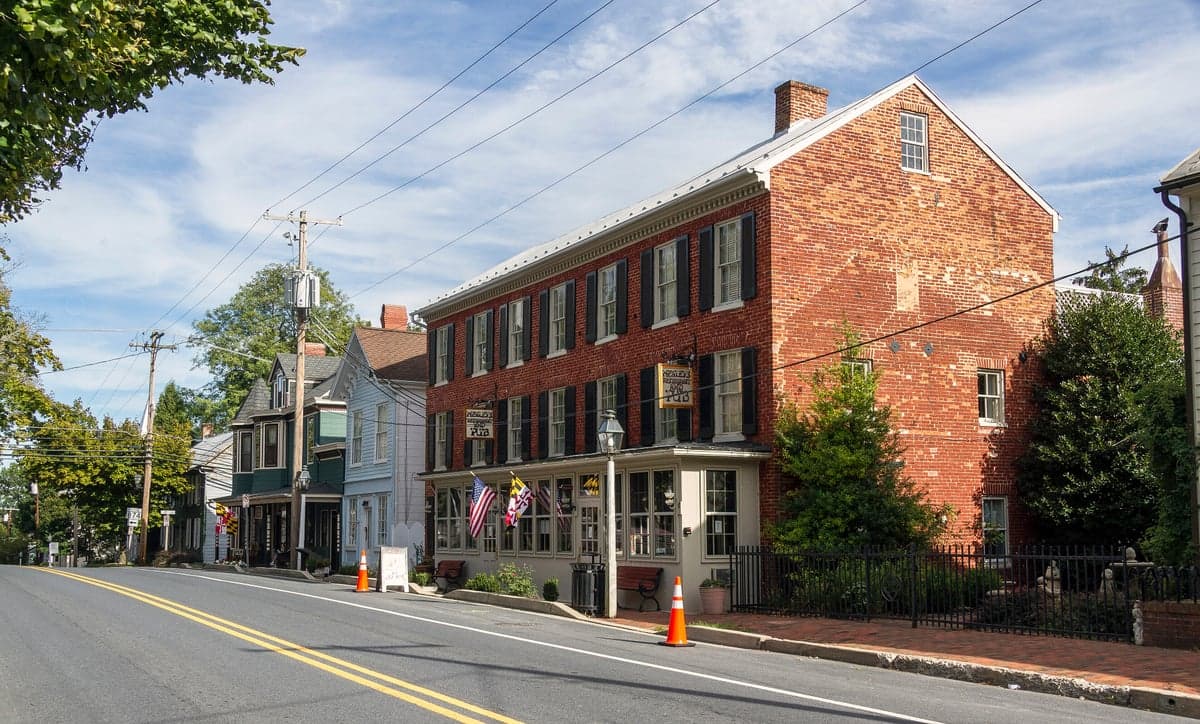
New Market was founded in 1793 along the National Pike (now Main Street), a major westward thoroughfare that drew its first wave of settlers: English and German farmers, merchants, and innkeepers who built the town’s iconic brick and frame houses. These early residents were drawn by land grants from the Calvert family and the promise of trade along the stagecoach route. The historic Main Street corridor became the commercial and residential spine, lined with the homes of craftsmen and shopkeepers. A second wave arrived in the mid-19th century as the Baltimore and Ohio Railroad extended service, bringing Irish and German laborers who settled in modest cottages along Bald Hill Street and Old National Pike. The town remained a small, predominantly Protestant farming community through the early 1900s, with its population hovering around 300. The post-World War II era saw little change, as New Market’s historic district designation (1975) preserved its 18th- and 19th-century architecture but limited new development, keeping the population stable and overwhelmingly White.
Modern era (post-1965)
The 1965 Immigration and Nationality Act had minimal direct impact on New Market, as the town’s small size and lack of rental housing or industrial jobs did not attract the immigrant waves that reshaped larger Maryland cities. Instead, the town’s modern growth has come from domestic in-migration, particularly from Washington, D.C., and Baltimore professionals seeking historic homes and good schools. The New Market Historic District absorbed most of this influx, with families restoring 19th-century homes along Main Street and Bald Hill Street. A newer subdivision, Wisteria, built in the 1990s and 2000s on the town’s eastern edge, attracted younger families and commuters, adding a small number of Black (4.8%) and Hispanic (5.2%) residents. The East/Southeast Asian community (2.1%) and Indian-subcontinent population (0.2%) are concentrated in these newer single-family homes, reflecting broader Frederick County trends of educated professionals moving into the area. The town’s racial composition has shifted only modestly since 2000, when it was 93% White, with most diversity arriving through the Wisteria and Springfield Manor subdivisions rather than the historic core.
The future
New Market’s population is projected to grow slowly, likely reaching 1,800–2,000 by 2040, driven by infill development on the town’s remaining agricultural parcels and continued spillover from Frederick’s expanding tech and biotech sectors. The population is becoming slightly more diverse, with the Hispanic and Asian shares expected to rise to 8–10% and 4–5% respectively, as new subdivisions like Villages of New Market attract a broader mix of professionals. However, the town’s high home prices (median over $500,000) and strict historic preservation rules will likely limit significant demographic change, keeping the population predominantly White and college-educated. The cultural identity is evolving from a quiet historic village into a bedroom community for Frederick and D.C. workers, with residents valuing the town’s preserved character over ethnic diversity. The next decade will see a gradual aging of the population, as many original historic-district homeowners retire, while younger families fill the newer subdivisions.
For someone moving in now, New Market offers a stable, safe, and historically rich environment with excellent schools and a strong sense of community, but little racial or ethnic diversity. It is becoming a slightly more varied, commuter-oriented town, but its core identity as a traditional, family-focused historic enclave will persist for the foreseeable future.

* Values derived from national, state, county, city and local statistics and may differ in a specific area. Last updated: 2026-08-26T18:52:14.000Z
Narrative content on this page is AI-generated and may contain mistakes. Verify any details that matter before acting on them.
ReloMaps may earn a commission from affiliate links at no extra cost to you.

