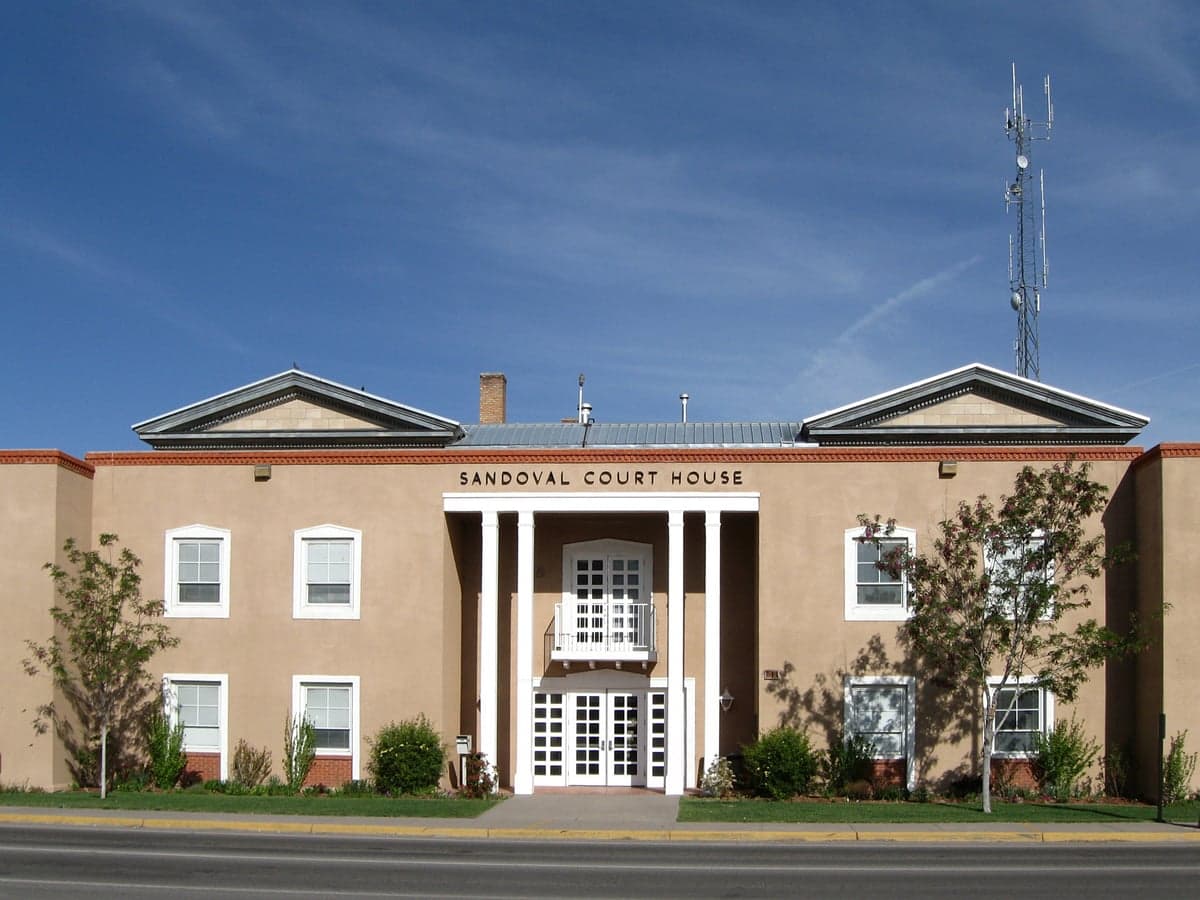
Photo: Wikipedia
Demographics of Sandoval County
Affluence Level in Sandoval County
A middle-class area roughly in line with national averages across income, home values, education, and employment.
People of Sandoval County
Sandoval County’s 151,538 residents form a tri-cultural mosaic defined by its Native American pueblos, Hispanic land-grant communities, and a growing Anglo suburban corridor. The county is one of New Mexico’s most demographically balanced, with a 41.9% white population and a 39.5% Hispanic population, while Native American communities—primarily from the Pueblo of Sandia, Pueblo of Jemez, and Pueblo of Zia—maintain sovereign enclaves within its borders. Only 2.4% of residents are foreign-born, reflecting deep multi-generational roots rather than recent immigration, and the county’s identity is shaped by the tension between its rural, traditional past and the suburban expansion spilling north from Albuquerque.
Settlement & growth (pre-1960)
Human history in Sandoval County begins with the Pueblo peoples, who have inhabited the Rio Grande valley and the Jemez Mountains for over a millennium. The Pueblo of Sandia, just north of Albuquerque, and the Pueblo of Jemez, in the county’s western mountains, are among the oldest continuously occupied settlements in North America. Spanish colonization arrived in the late 1500s, bringing Franciscan missionaries and settlers who established land grants along the Rio Grande. The town of Bernalillo, founded in the 1690s as a Spanish farming community, became the county’s early commercial hub and remains a center of Hispanic culture and the annual San Lorenzo Feast.
After the U.S. takeover in 1848, Anglo-American settlement was slow. The Atchison, Topeka and Santa Fe Railway reached Bernalillo in 1880, spurring a modest influx of merchants, ranchers, and miners drawn to the nearby Cerrillos Hills and the Jemez Mountains. The town of Cuba, in the county’s northwest, was founded in the 1880s by Hispanic homesteaders and later attracted Anglo ranchers. The early 1900s saw a small wave of Italian and Yugoslav immigrants who worked in the coal mines around Grants (now in Cibola County) and the railroad yards in Bernalillo, but Sandoval County remained overwhelmingly rural and Hispanic through the 1950s. The 1940 census counted just 8,000 residents, and the county’s economy was dominated by subsistence farming, sheep ranching, and timber from the Jemez National Forest.
World War II brought the first significant demographic shift. The Manhattan Project’s Los Alamos Laboratory, just across the county line, drew scientists and engineers to the region, and some settled in the eastern edge of Sandoval County. The 1950s saw the beginning of suburban spillover from Albuquerque, with small subdivisions appearing in Rio Rancho, then a tiny crossroads. But the county’s population remained under 15,000 as late as 1960, and its character was still defined by the pueblos and Hispanic villages like Jemez Springs and Ponderosa.
Modern era (post-1965)
The 1965 Hart-Cellar Act had minimal direct impact on Sandoval County—its foreign-born population remains just 2.4% today—but the domestic migration that reshaped the Sun Belt transformed the county. The real catalyst was the planned community of Rio Rancho, incorporated in 1981. Originally a speculative development by the Amrep Corporation, Rio Rancho marketed itself as an affordable alternative to Albuquerque, and its population exploded from 2,000 in 1970 to over 50,000 by 2000. This wave was overwhelmingly Anglo, middle-class families from the Rust Belt and California seeking cheaper housing and lower taxes. Today, Rio Rancho is the county’s largest city, with a population of roughly 100,000, and its demographic profile—roughly 55% white, 35% Hispanic—reflects its role as a suburban bedroom community for Albuquerque’s white-collar workforce.
The 1980s and 1990s also saw the growth of Placitas, an unincorporated community on the eastern slope of the Sandia Mountains, which attracted artists, retirees, and second-home owners from out of state. Meanwhile, the county’s Native American pueblos experienced a resurgence in population and political power. The Pueblo of Sandia opened the Sandia Resort & Casino in 1994, which became a major employer and funded infrastructure, health care, and education for its 4,000 enrolled members. The Pueblo of Jemez and Pueblo of Zia similarly expanded their tribal governments and enterprises, including the Jemez Mountain Trail tourism corridor.
Hispanic communities in Bernalillo, Cuba, and Jemez Springs have seen slower growth but remain culturally dominant in the county’s rural western half. The Hispanic population is overwhelmingly native-born, with deep roots in the Spanish land grants, and has maintained Spanish-language use and Catholic traditions. The county’s Black population is just 2.0%, concentrated in Rio Rancho and Bernalillo, while East/Southeast Asian communities (1.4%) and Indian subcontinent residents (0.1%) are small and dispersed, primarily professionals working at Intel’s Rio Rancho plant or at Sandia National Laboratories.
The future
Sandoval County’s population is projected to grow to roughly 170,000 by 2035, driven almost entirely by continued suburban expansion in Rio Rancho and the Placitas corridor. This growth is homogenizing the eastern half of the county into a typical Southwestern exurb, with chain retail, master-planned subdivisions, and a commuter culture oriented toward Albuquerque. The western half—the pueblos, Cuba, Jemez Springs, and the Jemez Mountains—is likely to remain rural and traditional, with slower growth and stronger preservation of Hispanic and Native American identities.
The immigrant communities are not growing significantly; the foreign-born share has been stable for decades, and new arrivals are mostly professionals from other U.S. states rather than international migrants. The county is not tribalizing into distinct enclaves so much as sorting by geography: the suburban east is becoming more Anglo and politically moderate, while the rural west and the pueblos remain more Hispanic and Native, with stronger Democratic leanings. The Native American population is growing faster than the county average due to higher birth rates, and tribal governments are increasingly assertive in land-use and water-rights disputes.
For a new resident, the cultural identity of Sandoval County is bifurcated. The eastern suburbs offer a familiar, car-dependent Sun Belt lifestyle with good schools and low crime, but little of the historic character that defines the rest of the county. The western pueblos and villages offer a deeper connection to New Mexico’s indigenous and Hispanic heritage, but with fewer economic opportunities and longer commutes. The county’s future is one of managed growth in the east and cultural preservation in the west, with the two halves coexisting but rarely converging.

* Values derived from national, state, county, city and local statistics and may differ in a specific area. Last updated: 2026-05-12T00:17:19.000Z
Narrative content on this page is AI-generated and may contain mistakes. Verify any details that matter before acting on them.
ReloMaps may earn a commission from affiliate links at no extra cost to you.

