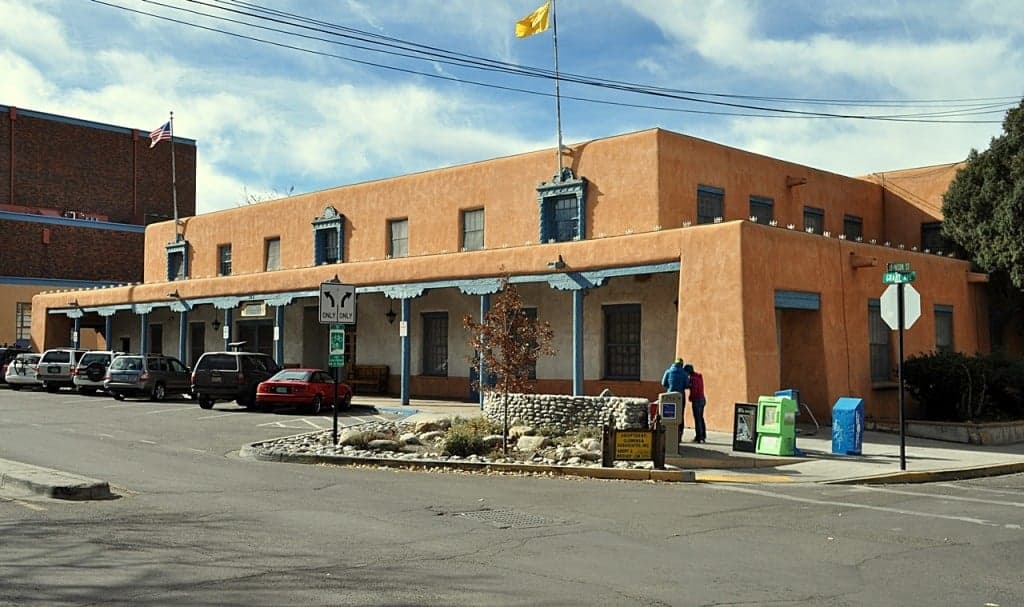
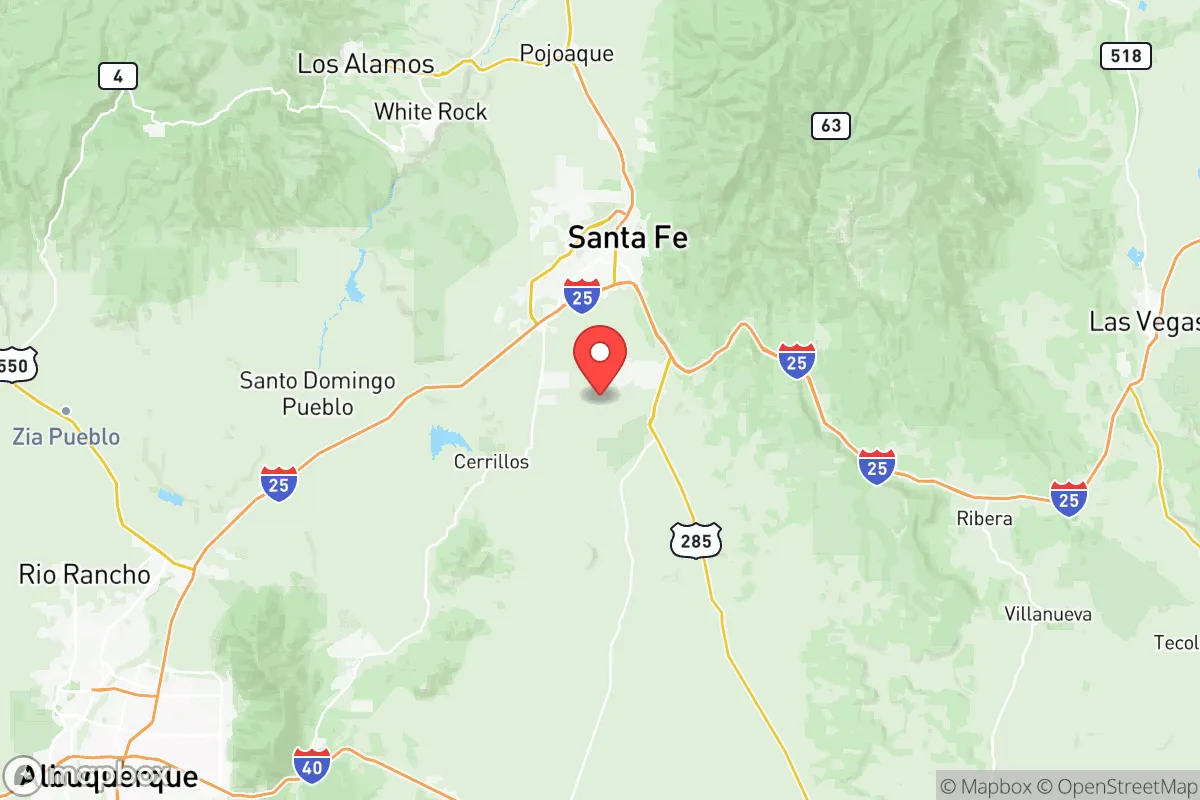
Photo: Wikipedia
Demographics of Santa Fe County
Affluence Level in Santa Fe County
A middle-class area roughly in line with national averages across income, home values, education, and employment.
People of Santa Fe County
Santa Fe County is home to 155,175 residents, a population defined by its deep Hispanic and Native American roots, a substantial Anglo arts-and-government cohort, and a notably high education level — 44.2% of adults hold a bachelor’s degree or higher. The county’s identity is a layered blend of centuries-old Hispano villages, Pueblo Indian communities, and a more recent influx of out-of-state transplants drawn to the region’s cultural cachet and mountain scenery. With a foreign-born share of just 6.9%, Santa Fe County is less immigrant-driven than many Western counties, but its internal demographic story — the shift from rural Hispano dominance to a more mixed, college-educated population — is one of the most consequential in New Mexico.
Settlement & growth (pre-1960)
The human history of Santa Fe County begins with the Tewa-speaking Pueblo peoples, who have occupied the Rio Grande valley and its tributaries for over a thousand years. The Ohkay Owingeh, Pojoaque, Nambe, Tesuque, and San Ildefonso Pueblos — all within or adjacent to the county — were established long before European contact. These communities practiced irrigated agriculture and built the multi-story adobe structures that later inspired the region’s architectural style. The Spanish entrada of 1598 under Juan de Oñate brought the first European settlers, who established Santa Fe as the capital of the province of Nuevo México in 1610. Spanish colonists, a mix of soldiers, farmers, and Franciscan missionaries, intermarried with Pueblo peoples, creating the genízaro and mestizo populations that form the core of today’s Hispano community.
The Pueblo Revolt of 1680 expelled the Spanish for 12 years, but when they returned in 1692 under Diego de Vargas, they resettled the same villages and added new land grants. Throughout the 18th and early 19th centuries, the county’s population remained overwhelmingly Spanish-speaking and Catholic, clustered in the Santa Fe urban core and in farming villages like Agua Fría, Chimayó, and Cerrillos. The Santa Fe Trail, opened in 1821, brought a trickle of Anglo-American traders and merchants, but the U.S. takeover after the Mexican-American War (1846–1848) did not immediately transform the ethnic makeup. The county remained majority Hispanic and Pueblo Indian through the 19th century, with Anglo arrivals limited to territorial officials, military personnel, and a few merchants.
The 20th century brought two significant changes. First, the Santa Fe Railway (the Atchison, Topeka and Santa Fe) established repair shops and a division point in Lamy, the county’s rail hub, attracting a small number of Anglo and Mexican railroad workers. Second, the emergence of the Santa Fe art colony — centered on the Palace of the Governors and Canyon Road — drew Anglo artists, writers, and anthropologists from the 1910s onward. This group, though numerically small, established the cultural brand that would later drive in-migration. By 1960, the county’s population was roughly 70% Hispanic, 25% Anglo, and 5% Native American, with the Pueblo communities remaining in their ancestral villages and the Hispano population spread across the county’s many rural acequia-irrigated settlements.
Modern era (post-1965)
The post-1965 period in Santa Fe County is less about international immigration and more about domestic migration from other U.S. states. The Hart-Cellar Act had a muted effect here — the county’s foreign-born population today is only 6.9%, well below the national average of 13.7%. The small immigrant presence is split between Mexican nationals (many working in construction, hospitality, and landscaping) and a modest number of European retirees and second-home owners. There is no significant East/Southeast Asian or Indian-subcontinent enclave; those groups together account for just 1.5% of the population. The county’s Black population is negligible at 0.8%.
The real demographic engine has been domestic in-migration, particularly from California, Texas, Colorado, and the East Coast. Beginning in the 1970s and accelerating through the 1990s and 2000s, affluent Anglos — retirees, second-home buyers, remote workers, and artists — moved to Santa Fe and the surrounding unincorporated areas like Eldorado at Santa Fe and La Cienega. This wave was drawn by the city’s reputation as an arts destination, its mild climate, and its relatively low cost of living compared to coastal metros. The result has been a steady demographic shift: the Hispanic share of the county’s population has fallen from roughly 70% in 1960 to 48.0% today, while the non-Hispanic white share has risen to 44.1%. The county’s college-educated share — 44.2% — is nearly double the national average, reflecting the professional and cultural profile of the in-migrants.
Suburbanization has been limited by the county’s topography and land-use policies. Most growth has occurred in the Santa Fe city limits and in master-planned subdivisions like Eldorado, a large unincorporated community southeast of the city that is predominantly Anglo and affluent. The Pueblo communities have experienced modest population growth but remain culturally distinct, with many members living on trust lands and maintaining traditional governance. The Hispano population, meanwhile, has become more suburban and economically diverse, with many families moving into newer subdivisions in the Santa Fe city limits and the Pojoaque Valley area.
The future
Santa Fe County is likely to continue its gradual demographic shift toward a more Anglo, college-educated, and older population. In-migration from out of state shows no signs of slowing, driven by remote work, retirement, and the city’s enduring appeal as a lifestyle destination. The Hispanic share will probably continue to decline slowly, not because of out-migration but because in-migrants are disproportionately non-Hispanic white. The county’s Native American population, concentrated in the Pueblos, is expected to remain stable in absolute numbers but shrink as a share of the total. The foreign-born share may rise slightly as the hospitality and construction sectors attract more Mexican workers, but it will likely remain well below national averages.
The cultural identity of the county is becoming more polarized. The Anglo in-migrant population tends to cluster in Santa Fe’s east side, Eldorado, and the Pojoaque Valley, while the Hispano population remains more dispersed across the county’s historic villages and the south side of the city. The Pueblo communities maintain a separate social and political identity, with their own governments and school systems. This is not a region that is homogenizing; rather, it is tribalizing into distinct enclaves defined by ethnicity, income, and lifestyle. The next 10–20 years will likely see continued tension between the preservationist impulses of the Hispano and Pueblo communities and the development pressures brought by affluent newcomers.
For someone moving in now, Santa Fe County offers a place where the past is still very much present — but where the future is being written by newcomers. The county is becoming a more expensive, more educated, and more culturally bifurcated place. The deep Hispano and Pueblo roots remain the foundation, but the superstructure is increasingly Anglo and professional. Anyone relocating here should expect a community that values its history but is actively being reshaped by the same forces — remote work, wealth migration, and cultural tourism — that are transforming the Mountain West as a whole.

* Values derived from national, state, county, city and local statistics and may differ in a specific area. Last updated: 2026-05-28T04:57:34.000Z
Narrative content on this page is AI-generated and may contain mistakes. Verify any details that matter before acting on them.
ReloMaps may earn a commission from affiliate links at no extra cost to you.

