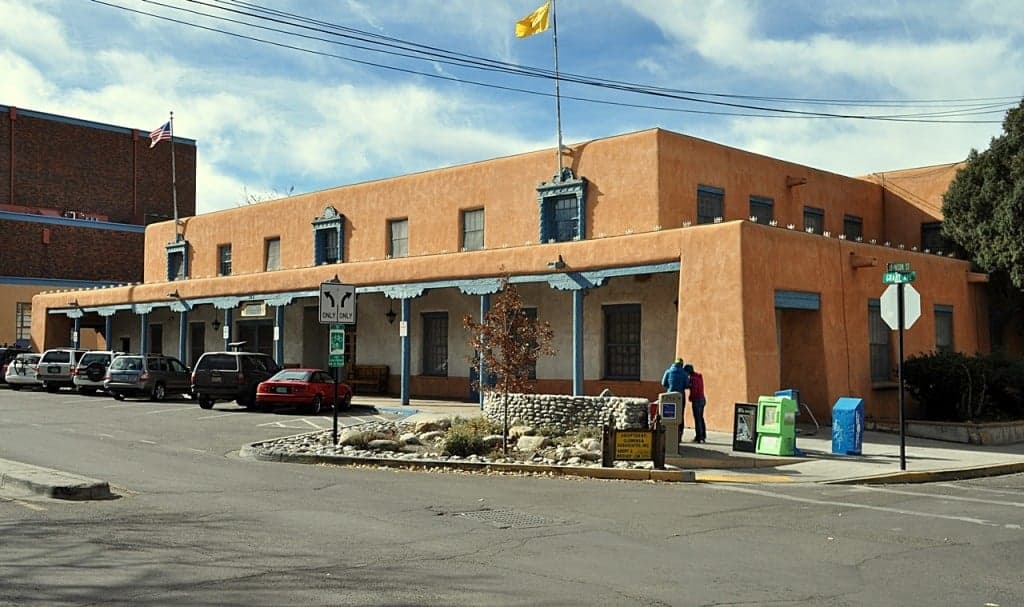
Photo: Wikipedia
Personal Sovereignty in Santa Fe County
Viable for self-reliance. Generally workable, though some barriers may limit total independence.
What does Personal Sovereignty tell us?
Personal Sovereignty measures your capacity for self-reliance and independence with minimal government friction. Higher scores mean fewer barriers between you and the way you want to live... but it assumes you have the space you need and good neighbors.
What does this tell us?
Personal Sovereignty measures your capacity for self-reliance and independence with minimal government friction. Higher scores mean fewer barriers between you and the way you want to live... but it assumes you have the space you need and good neighbors.
State Policy
Energy independence: Net exporter (250% of energy produced in-state)
Personal Liberty
Homesteading

Personal Liberty Analysis
Santa Fe County presents a deeply conflicted environment for personal sovereignty, where the allure of high-desert autonomy clashes with one of New Mexico’s most progressive regulatory and tax regimes. For the strategic relocator—particularly those with a survivalist or prepper mindset—the county offers stunning geography and a sparse population in its outer reaches, but the political center of gravity in the city of Santa Fe itself leans heavily toward government expansion and collective mandates. The practical reality is that your level of personal freedom in Santa Fe County will vary dramatically depending on whether you settle in the county seat, the rural village of Edgewood, the historic enclave of Chimayó, or the remote stretches near Glorieta or Lamy. Understanding these micro-differences is essential before committing to a move.
Tax burden and regulatory posture: how state and county policies affect your wallet and autonomy
New Mexico’s state-level tax structure is a mixed bag for those seeking to minimize government extraction. There is no state inheritance or estate tax, which is a clear win for wealth preservation. However, the state’s gross receipts tax (GRT)—essentially a sales tax on nearly all services and goods—is among the highest in the nation. In Santa Fe County, the combined state and local GRT rate sits at roughly 8.4375%, with the city of Santa Fe itself adding an extra layer that pushes the rate closer to 9% in some areas. This means every transaction, from buying a generator to hiring a contractor for a bunker build, carries a heavy government surcharge. Property taxes are relatively low by national standards—around 0.85% of assessed value—but the county’s assessment practices have been known to lag behind market realities, creating surprise tax bills for new owners. The regulatory posture in unincorporated parts of the county, such as Agua Fría or La Cienega, is far more lenient than inside Santa Fe city limits, where building permits, water rights enforcement, and short-term rental restrictions are aggressively managed. For the prepper, the key takeaway is that the county’s tax burden is regressive and transaction-heavy, punishing active commerce and self-reliance projects more than passive land holding.
Self-defense and gun law specifics: what you can and cannot do in Santa Fe County
New Mexico is a shall-issue state for concealed carry, meaning that if you meet basic criteria—age 21, no felony record, completion of a certified training course—the county sheriff must issue a license. Santa Fe County Sheriff’s Office processes these applications without the overt hostility seen in some urban jurisdictions, but the process is not instant; expect a 30- to 60-day wait. Open carry is legal without a permit for anyone 19 or older who can legally possess a firearm, and this is a common sight in rural areas like Edgewood and Glorieta, where residents routinely carry sidearms while running errands. However, the state’s 2021 red flag law (HB 8) remains a significant concern for liberty-minded individuals. It allows law enforcement or family members to petition for temporary firearm seizure based on vague “extreme risk” criteria, with no criminal charge required. Santa Fe County has seen a moderate number of these petitions filed, primarily in the city proper. The county also has no Second Amendment sanctuary resolution, unlike more rural counties in eastern New Mexico. For the prepper, the practical advice is to avoid living within Santa Fe city limits if you value unfettered gun rights; the rural areas of the county, particularly around Lamy and Chimayó, have a stronger culture of self-defense and less likelihood of red flag enforcement. Magazine capacity and NFA items are governed by state law, which currently has no bans on standard-capacity magazines or suppressors, though that could change with the state’s Democratic supermajority.
Self-reliance and homesteading viability: lot sizes, zoning, and off-grid feasibility
Santa Fe County’s zoning and land-use rules are a patchwork that rewards those who do their homework. In the unincorporated areas, minimum lot sizes for residential development are typically 1 acre in the county’s “Rural” zone, but many parcels in the eastern part of the county near Edgewood and Glorieta are zoned for 2.5- to 5-acre minimums, which provides genuine space for gardens, livestock, and water catchment. Off-grid living is technically feasible but heavily constrained by water rights law. New Mexico follows the prior appropriation doctrine, meaning you must have a valid water right to collect rainwater in significant quantities—though a 2015 law clarified that rooftop catchment for household use is allowed without a permit for up to 1,000 gallons of storage. Solar panels are unregulated at the county level, and net metering is available through the local utility, PNM, but the bureaucratic hoops for grid-tied systems are substantial. Septic systems are permitted by the New Mexico Environment Department, and the county enforces strict setback requirements from wells and property lines. For the serious homesteader, the area around Chimayó and the high desert near Lamy offers the best combination of large parcels (10+ acres are still available), minimal HOA restrictions, and a community culture that values self-sufficiency. However, wildfire risk is high in these areas, and insurance costs are climbing accordingly. The county’s building codes are based on the 2021 International Residential Code, which means any new construction must meet modern energy and structural standards—a cost that preppers building a retreat should factor in.
Personal liberties: parental rights, medical autonomy, speech, and property
Parental rights in Santa Fe County are under consistent pressure from progressive school board policies. The Santa Fe Public Schools district has implemented comprehensive sex education curricula that include topics many conservative parents find objectionable, and there is no robust opt-out mechanism beyond individual parental requests. The county also has a strong “sanctuary” posture regarding immigration enforcement, which some see as a challenge to rule of law. Medical autonomy is a bright spot in one area: New Mexico has no vaccine mandate for adults, and the state’s 2021 “Right to Try” law allows terminally ill patients access to experimental treatments without FDA approval. However, the state’s medical cannabis program is well-established, and recreational cannabis is legal, which may be a positive or negative depending on your views. Property rights are generally respected in unincorporated areas, but the county’s planning department has a reputation for slow permitting and aggressive enforcement of “nuisance” ordinances, particularly regarding junk vehicles, unpermitted structures, and excessive noise. Free speech is protected under the First Amendment, but Santa Fe’s dominant political culture is left-leaning, and expressing dissenting views on topics like immigration or public health mandates can lead to social ostracism in the city. In rural areas like Edgewood and Glorieta, the social climate is far more tolerant of diverse political opinions, and property owners generally enjoy greater de facto freedom to use their land as they see fit.
Overall, Santa Fe County offers a deeply bifurcated sovereignty landscape. The city of Santa Fe itself is one of the most regulated and politically homogeneous environments in the Southwest, with high taxes, aggressive code enforcement, and a culture that often views personal autonomy as secondary to collective goals. But the county’s vast rural expanse—particularly the areas around Edgewood, Glorieta, Chimayó, and Lamy—provides a genuine alternative for those willing to navigate water rights, wildfire risk, and a state-level red flag law. Compared to neighboring counties like Rio Arriba or San Miguel, Santa Fe County is more expensive and more bureaucratically complex, but it also offers better access to medical facilities, supply chains, and a like-minded community of independent-minded residents. For the strategic relocator, the calculus is clear: avoid the city limits, buy at least 5 acres in the eastern or northern parts of the county, and budget for legal and permitting costs. The freedom is there, but it must be actively secured.

* Values derived from national, state, county, city and local statistics and may differ in a specific area. Last updated: 2026-05-28T04:57:34.000Z
Narrative content on this page is AI-generated and may contain mistakes. Verify any details that matter before acting on them.
ReloMaps may earn a commission from affiliate links at no extra cost to you.

