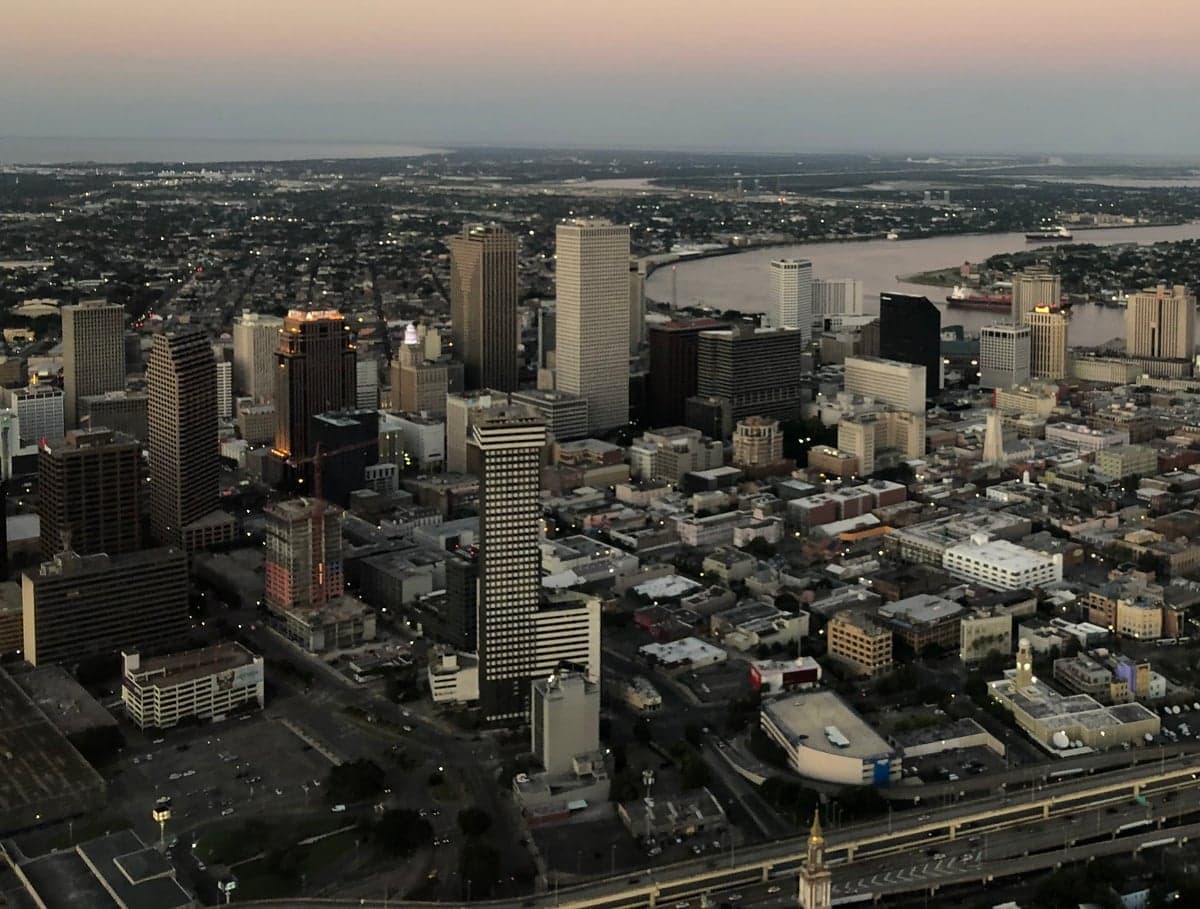
Photo: Wikipedia
Strategic Assessment of New Orleans, LA
Multiple tactical vulnerabilities. Population density, target proximity, or disaster risk are likely compounding. A retreat property and exit planning is required.
What does the Strategic Assessment tell us?
Our Strategic Assessment grades tactical survivability of an area. Major population centers, military targets, fallout zones, natural disasters, and border exposure all drive risk — lower exposure means a more defensible position in a crisis.
This is heavily inspired by Joel Skousen's Strategic Relocation book. Highly recommended you checkout the book ($)What does this tell us?
Our Strategic Assessment grades tactical survivability of an area. Major population centers, military targets, fallout zones, natural disasters, and border exposure all drive risk — lower exposure means a more defensible position in a crisis.
This is heavily inspired by Joel Skousen's Strategic Relocation book. Highly recommended you checkout the book ($)Strategic Pillars

Key Distances
Regional Safe Places
Below is our recommended "safe zones" in Louisiana and the surrounding area based on our strategic heuristics. For most people, it's unrealistic to live in a “safe zone” full-time due to work, family or other personal reasons. They tend to be more rural. However, many of these areas are perfect for second homes and retreat properties that double as a vacation home or even a short-term rental.

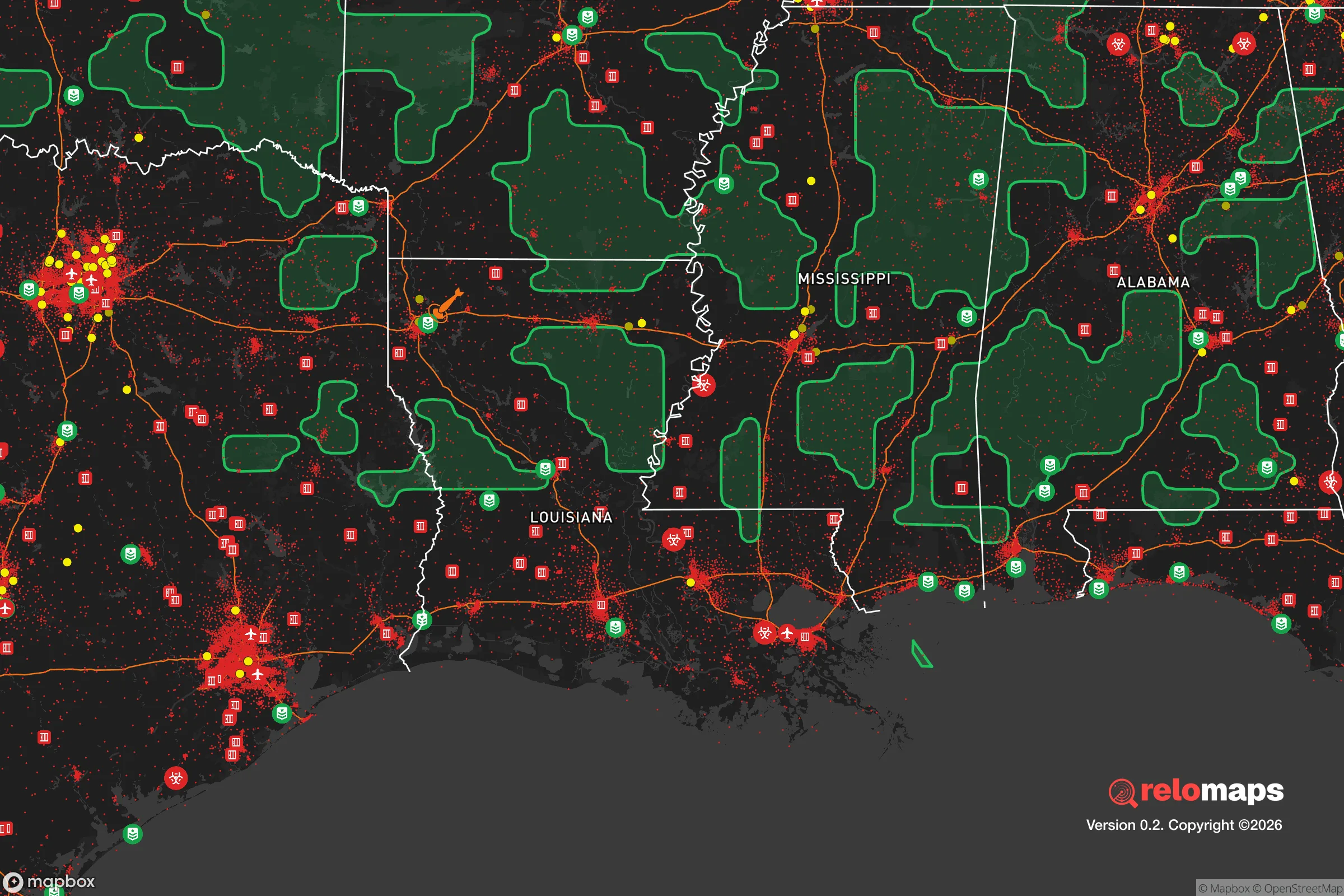


Important Note: For informational purposes only. This does not mean nothing bad ever happens in the green zones. Please use common sense. This is based on public data and modeled with AI. We tried to take a conservative approach but mistakes happen. We update this regularly as new information becomes available.
Solar Generator Recommendations
Backup power matters more here than in safer locations. We've picked three solar generators across budgets and capacity tiers — start with the budget unit if you only need a few essentials, or step up if you want to run a fridge and HVAC for days at a time.

Jackery Portable Power Station Explorer 300
Budget OptionPower on the Go: Weighing only 11 lbs, it's convenient to set up and store with book-sized foldable solar panels

BLUETTI Portable Power Station AC180
Designed for both indoor and outdoor scenarios, AC180 is highly capable as it has a robost capacity and continuous output power.

EF ECOFLOW DELTA Pro Ultra Power Station
Upgraded PickEcoFlow DELTA Pro Ultra is a whole-home energy system designed to grow with your family. Integrated with the Smart Home Panel 2, it scales to meet your evolving energy needs — keeping your home powered, intelligent, and secure through every stage of life.
We earn a commission, at no additional cost to you.
Strategic Assessment Analysis
New Orleans presents a uniquely challenging strategic picture for the conservative prepper or survivalist. While its deep-water port, energy infrastructure, and geographic position at the mouth of the Mississippi River offer undeniable logistical advantages, the city’s extreme vulnerability to natural disasters, its dense urban footprint, and its proximity to high-value strategic targets make it one of the most complex relocation assessments in the Gulf South. For a single individual or family prioritizing long-term resilience, New Orleans is not a straightforward recommendation—it is a high-risk, high-maintenance proposition that demands serious contingency planning.
Geographic position and natural advantages for strategic relocation
New Orleans sits at a critical chokepoint for American commerce and energy. The Port of New Orleans and the Louisiana Offshore Oil Port (LOOP) handle a massive share of the nation’s grain, steel, and petroleum exports. For a prepper, this means access to a deep labor pool in maritime and energy trades, as well as proximity to the Gulf of Mexico’s offshore oil and gas fields. The Mississippi River provides a reliable freshwater source—though heavily treated—and the surrounding swamps and bayous offer natural barriers to overland movement, which could slow civil unrest or mass migration from other regions. The city’s subtropical climate allows for year-round gardening, and the fertile alluvial soil of the river delta is among the richest in North America. However, these advantages are tightly coupled with severe drawbacks. The entire metro area is below sea level, protected by a levee system that failed catastrophically in 2005 and remains a single-point-of-failure risk. The city’s position at the end of the Mississippi River also means it is the first place to flood during a major upstream storm event, and the only evacuation routes—Interstates 10, 55, and 12—are limited and easily clogged.
Risks, exposures, and proximity to fallout-relevant landmarks
From a survivalist perspective, New Orleans’ risk profile is dominated by three overlapping threats: hurricane storm surge, industrial accidents, and its status as a potential secondary target in a national crisis. The city is surrounded by petrochemical refineries, chemical plants, and natural gas storage facilities along the Mississippi River corridor between Baton Rouge and the Gulf. A major hurricane or earthquake could trigger a cascade of toxic releases, fires, and explosions—what preppers call a “Natech” (natural hazard triggering a technological disaster). The 2021 Ida hurricane demonstrated this, causing widespread power outages and a refinery fire in Norco. More concerning is the city’s proximity to the Strategic Petroleum Reserve’s Bryan Mound and Bayou Choctaw sites, as well as the Louisiana Offshore Oil Port, which are plausible targets for sabotage or military strike in a conflict scenario. The Mississippi River itself is a strategic chokepoint; a bridge failure or deliberate blockage at the Huey P. Long Bridge or the Crescent City Connection could isolate the city for weeks. For a relocator, the key takeaway is that New Orleans is not a “bug-out” location—it is a potential epicenter of multiple failure modes. The city’s dense urban core, with over 380,000 people in Orleans Parish alone, means that any major event will trigger mass panic and gridlock. The 2005 Katrina evacuation remains the textbook example of how quickly order breaks down when the only roads out are flooded or jammed.
Practical resilience for a relocator: food, water, energy, and defensibility
For a prepper willing to accept the risks, New Orleans offers some practical resilience options, but they require significant investment and a shift in mindset. Water is the most critical vulnerability. The city’s drinking water comes from the Mississippi River, treated at the Carrollton Water Plant. A major storm or industrial spill could knock out treatment for weeks. A serious prepper would need a minimum of two weeks of stored water per person, plus a high-capacity filter system (Berkey or similar) and knowledge of local cisterns and rainwater catchment. The city’s high water table makes digging a well impractical in most neighborhoods. Food security is more achievable. The surrounding region has year-round growing seasons, and many neighborhoods have space for raised beds. The Vietnamese-American community in New Orleans East and the West Bank has a strong tradition of urban farming and community gardening, which could be tapped for knowledge and barter. Local fisheries in Lake Pontchartrain and the Gulf provide protein, but post-disaster contamination is a real concern. Energy is a mixed bag. Entergy’s grid is notoriously fragile, with frequent outages even in good weather. Solar panels with battery storage are a wise investment, but the city’s frequent cloud cover and hurricane winds mean panels must be securely mounted and supplemented with a generator. Natural gas is widely available, but pipelines are vulnerable to storm damage. Defensibility is poor in the urban core. The dense shotgun houses and narrow streets of the French Quarter, Marigny, and Bywater make for easy ambush points and difficult perimeter control. Suburban areas like Algiers, Gentilly, or the North Shore (St. Tammany Parish) offer more space and better line-of-sight, but they are still within easy driving distance of the city’s potential unrest. A better option for a prepper is to locate in a small town like Covington or Mandeville, across Lake Pontchartrain, where the population is smaller and the terrain is higher. Even then, the bridge crossings are chokepoints that could be blocked by authorities or mobs.
The overall strategic picture for New Orleans is one of high risk with conditional rewards. For a conservative-minded relocator who values self-reliance and community preparedness, the city offers a unique combination of maritime access, energy infrastructure, and agricultural potential—but only if you are willing to invest heavily in hardening your home, storing supplies, and building a network of like-minded neighbors. The city’s political culture is overwhelmingly progressive, and its crime rate remains among the highest in the nation, which adds a layer of social instability that a prepper must factor into their calculus. If you are looking for a place to ride out a national crisis with minimal disruption, New Orleans is not that place. But if you are a skilled tradesperson, a mariner, or someone with deep knowledge of coastal survival, and you are willing to treat the city as a base of operations rather than a fortress, it can be a viable option—provided you have a solid bug-out plan for the inevitable hurricane season. In short: New Orleans is a high-maintenance asset, not a safe harbor. Approach with eyes wide open, and never forget that the levee is only as strong as the last inspection.

* Values derived from national, state, county, city and local statistics and may differ in a specific area. Last updated: 2026-04-22T12:55:34.000Z
Narrative content on this page is AI-generated and may contain mistakes. Verify any details that matter before acting on them.
ReloMaps may earn a commission from affiliate links at no extra cost to you.

