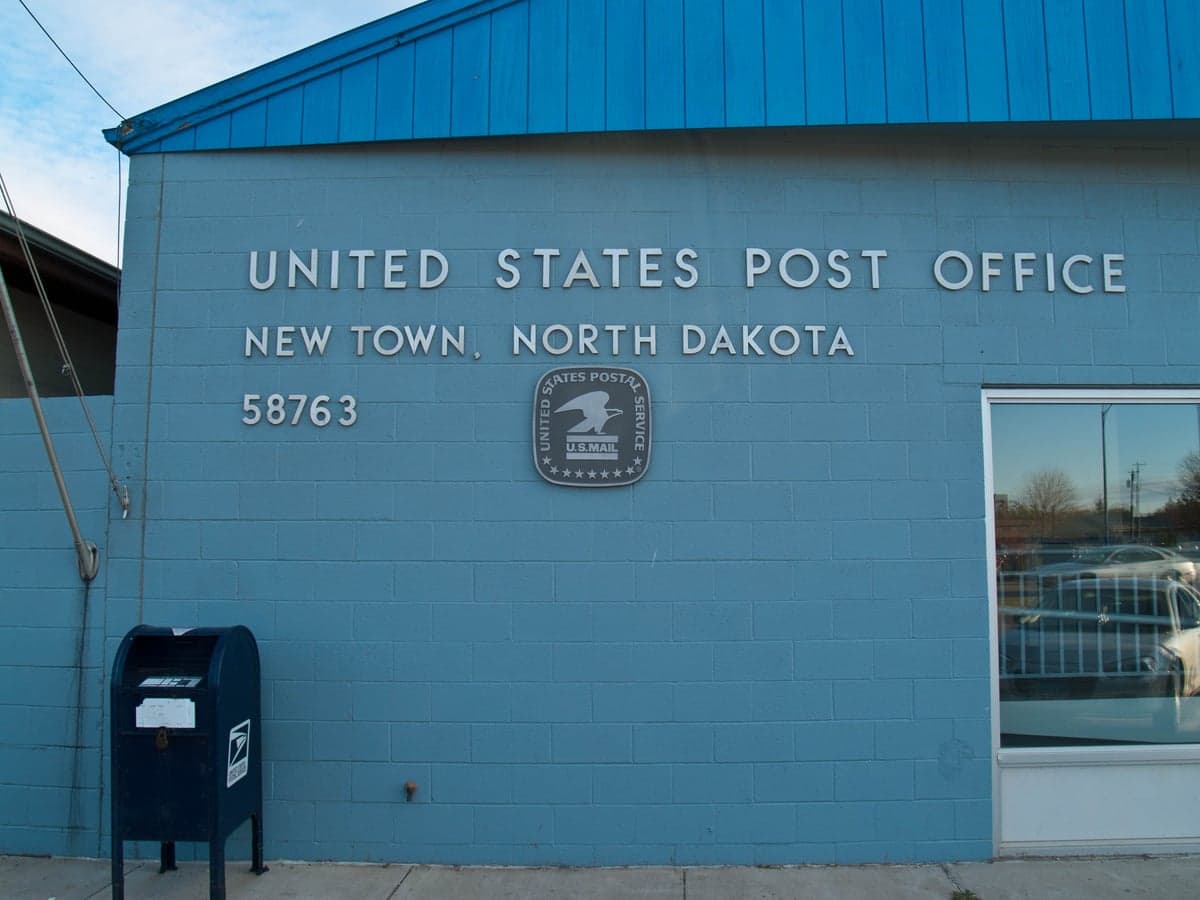
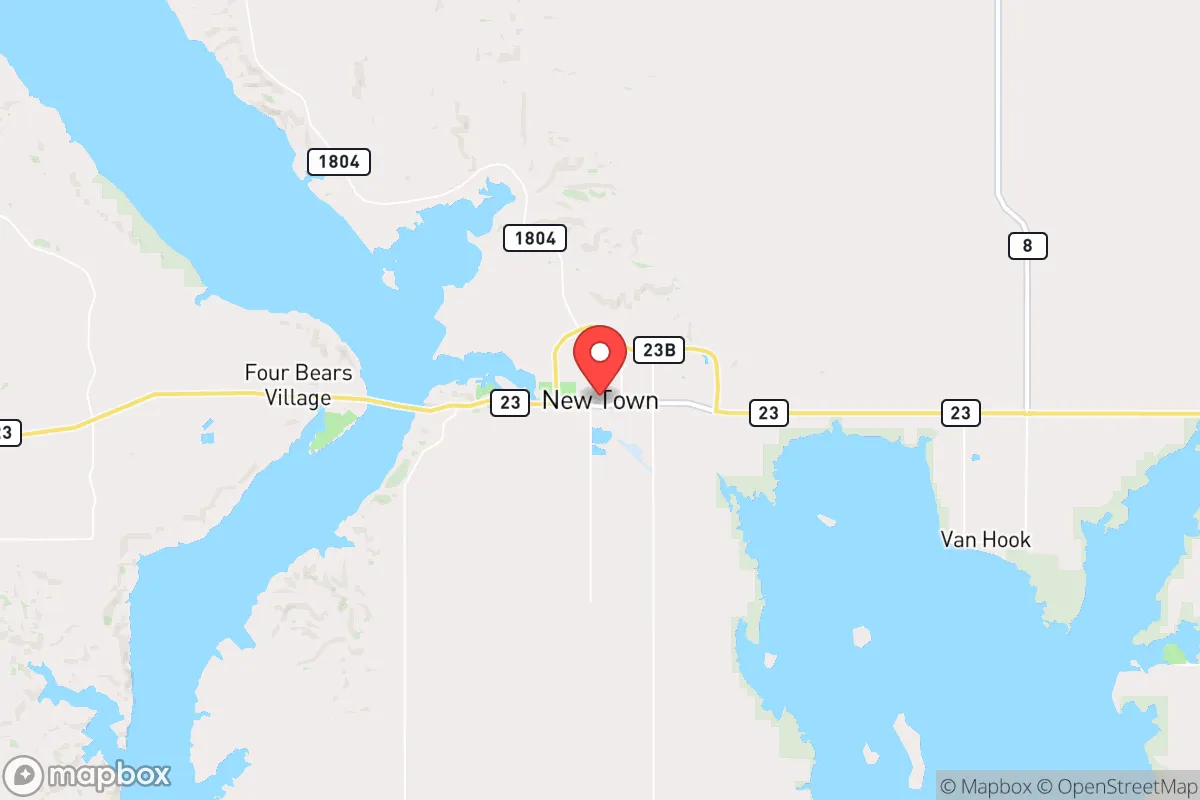
Photo: Wikipedia
Demographics of New Town, ND
Affluence Level in New Town, ND
A below-average socioeconomic profile. Incomes, home values, and educational attainment trail the U.S., with higher poverty and unemployment.
People of New Town, ND
New Town, North Dakota, is a small, tightly-knit community of 2,725 residents with a distinct identity shaped by its location on the Fort Berthold Indian Reservation. The population is overwhelmingly Native American, with 12.6% identifying as White, and a growing Hispanic presence at 10.6%. This is a place where tribal sovereignty, energy development, and agricultural roots intersect, creating a population that is younger and more family-oriented than the state average, but with a lower share of college-educated adults (22.2%).
How the city was settled and grew
New Town was officially founded in 1951 as a planned relocation community for the Mandan, Hidatsa, and Arikara Nation (the Three Affiliated Tribes) after the construction of the Garrison Dam flooded their historic bottomlands. The U.S. Army Corps of Engineers and the Bureau of Indian Affairs built the town to replace the lost communities of Elbowoods, Shell Creek, and others. The original residents were tribal members displaced by the dam, moving into a grid of new homes and government buildings. The first wave of non-Native settlers arrived shortly after, primarily as federal employees, teachers, and contractors working on the dam and the new reservation infrastructure. These early residents concentrated in the Original Townsite, the central core of New Town, which still contains many of the original 1950s-era homes and the main commercial strip. A second wave of non-Native families came during the 1970s and 1980s, drawn by the construction of the nearby Four Bears Bridge and the expansion of tribal government services. These families settled in the West Side neighborhood, a small area of newer single-family homes built on the western edge of town.
Modern era (post-1965)
The post-1965 era brought significant demographic shifts, though not from international immigration. The foreign-born population remains very low at 2.1%. Instead, the major change was the return of tribal members who had left for urban areas during the mid-20th century, drawn back by the oil boom in the Bakken shale formation starting around 2008. This energy boom brought a new wave of non-Native workers—mostly White and Hispanic—who arrived for high-paying jobs in the oil fields. The Hispanic population grew from negligible to 10.6% during this period, with many families settling in the East End neighborhood, a newer subdivision of modular homes and rental duplexes built to accommodate the oil workforce. The Black population (4.8%) and East/Southeast Asian population (0.6%) also arrived during this boom, primarily as contract workers and their families. These groups are dispersed across the town, with no single ethnic enclave forming. The South Ridge area, a cluster of homes on higher ground near the high school, became a preferred location for tribal government employees and professionals, while the Northside neighborhood, closer to the lake, remained predominantly Native American and more established.
The future
The population of New Town is likely to stabilize or decline slightly in the next decade as the Bakken oil boom plateaus. The Hispanic community, while growing, is not forming a distinct enclave but rather integrating into the existing neighborhoods. The Native American majority is expected to remain dominant, with a gradual increase in the share of mixed-race residents as intermarriage between tribal members and newcomers becomes more common. The town is not tribalizing into separate enclaves; instead, it is becoming more homogenized in terms of housing and daily life, though cultural distinctions persist. The Four Bears Village area, just south of town, remains a separate tribal housing community, but within New Town proper, neighborhoods are becoming less defined by ethnicity and more by income and housing age. For a newcomer, this means moving into a community where the dominant culture is Native American, the economy is tied to energy and tribal government, and the population is stable but aging slightly. The low college attainment rate (22.2%) suggests limited white-collar job growth, but the strong sense of community and affordable housing make it a viable option for families seeking a quiet, rural lifestyle with strong cultural roots.
New Town is becoming a more diverse but still predominantly Native American community, shaped by the legacy of displacement and the recent energy boom. For someone moving in now, it offers a tight-knit, family-oriented environment where tribal identity and local industry define daily life, and where the population is likely to remain stable rather than grow rapidly.

* Values derived from national, state, county, city and local statistics and may differ in a specific area. Last updated: 2026-04-19T05:38:44.000Z
Narrative content on this page is AI-generated and may contain mistakes. Verify any details that matter before acting on them.
ReloMaps may earn a commission from affiliate links at no extra cost to you.

