 Popular
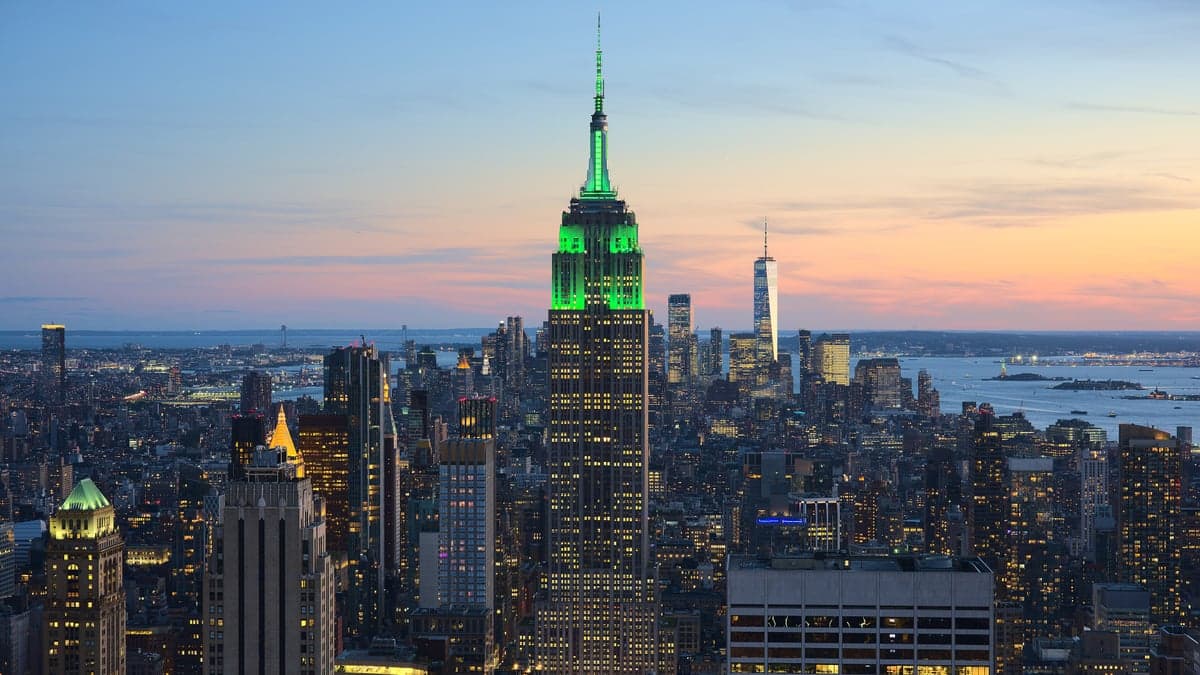
Photo: Wikipedia
Strategic Assessment of New York City, NY
High tactical risk. This location is likely close to major population centers, strategic targets, or sits in a high-disaster corridor. A retreat property and careful exit planning is required.
What does the Strategic Assessment tell us?
Our Strategic Assessment grades tactical survivability of an area. Major population centers, military targets, fallout zones, natural disasters, and border exposure all drive risk — lower exposure means a more defensible position in a crisis.
This is heavily inspired by Joel Skousen's Strategic Relocation book. Highly recommended you checkout the book ($)What does this tell us?
Our Strategic Assessment grades tactical survivability of an area. Major population centers, military targets, fallout zones, natural disasters, and border exposure all drive risk — lower exposure means a more defensible position in a crisis.
This is heavily inspired by Joel Skousen's Strategic Relocation book. Highly recommended you checkout the book ($)Strategic Pillars

Key Distances
Regional Safe Places
Below is our recommended "safe zones" in New York and the surrounding area based on our strategic heuristics. For most people, it's unrealistic to live in a “safe zone” full-time due to work, family or other personal reasons. They tend to be more rural. However, many of these areas are perfect for second homes and retreat properties that double as a vacation home or even a short-term rental.
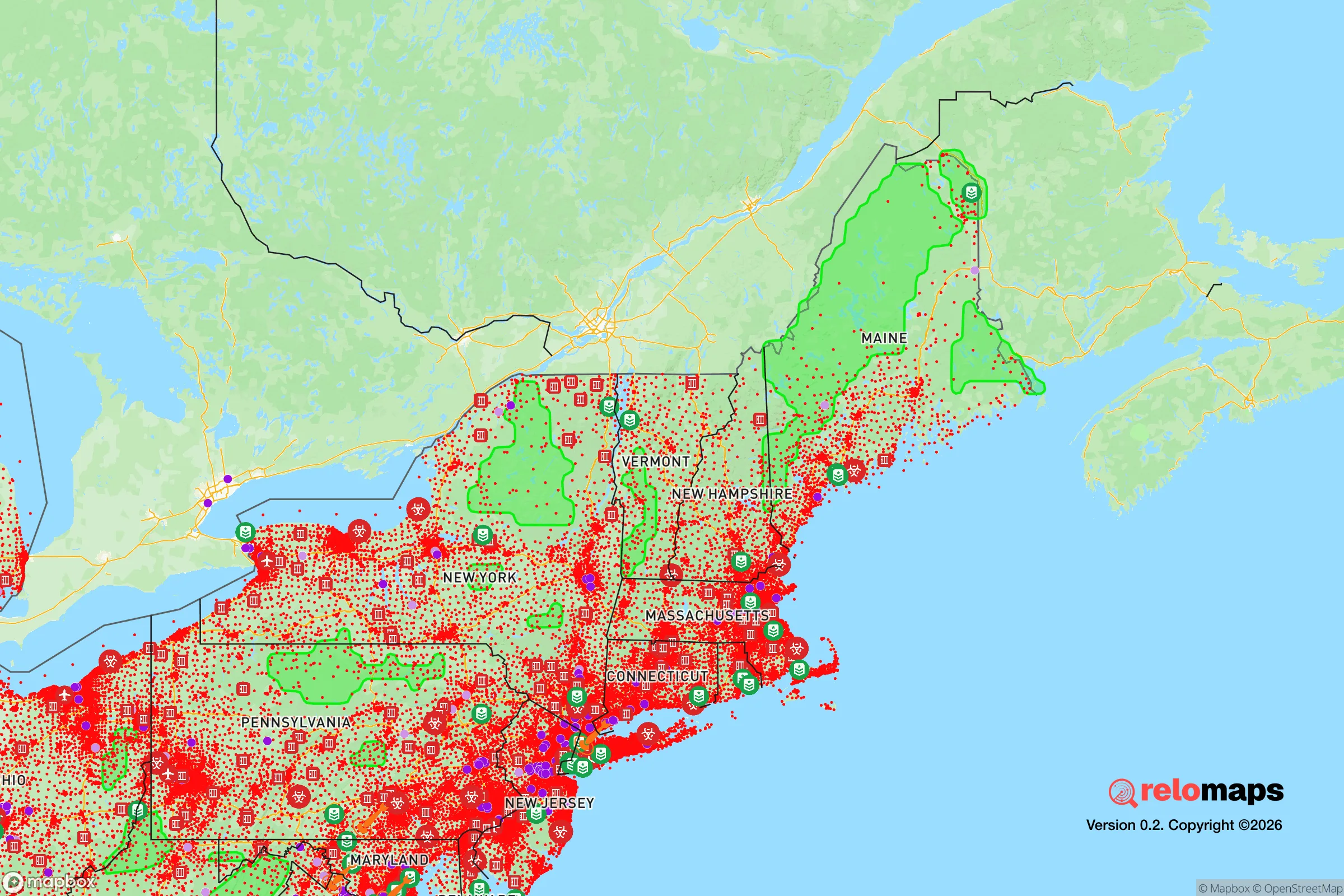
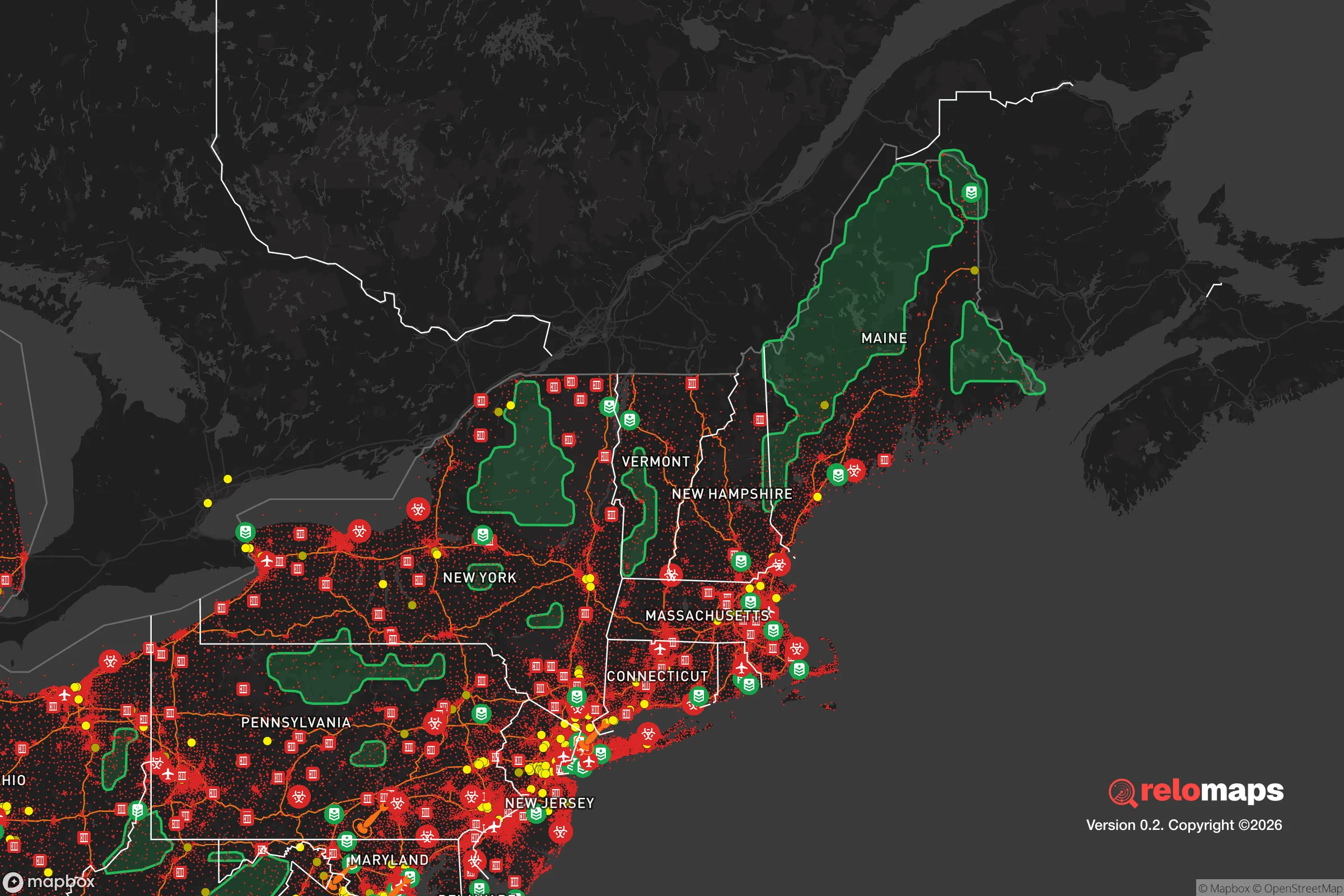


Important Note: For informational purposes only. This does not mean nothing bad ever happens in the green zones. Please use common sense. This is based on public data and modeled with AI. We tried to take a conservative approach but mistakes happen. We update this regularly as new information becomes available.
Solar Generator Recommendations
Backup power matters more here than in safer locations. We've picked three solar generators across budgets and capacity tiers — start with the budget unit if you only need a few essentials, or step up if you want to run a fridge and HVAC for days at a time.

Jackery Portable Power Station Explorer 300
Budget OptionPower on the Go: Weighing only 11 lbs, it's convenient to set up and store with book-sized foldable solar panels

BLUETTI Portable Power Station AC180
Designed for both indoor and outdoor scenarios, AC180 is highly capable as it has a robost capacity and continuous output power.

EF ECOFLOW DELTA Pro Ultra Power Station
Upgraded PickEcoFlow DELTA Pro Ultra is a whole-home energy system designed to grow with your family. Integrated with the Smart Home Panel 2, it scales to meet your evolving energy needs — keeping your home powered, intelligent, and secure through every stage of life.
We earn a commission, at no additional cost to you.
Strategic Assessment Analysis
New York City’s strategic position as a global hub is a double-edged sword for a relocator focused on resilience and self-sufficiency. While its coastal geography and dense infrastructure offer immense economic opportunity, these same features create profound vulnerabilities that make it a high-risk location for anyone prioritizing disaster readiness. For a conservative-leaning individual or family weighing long-term security, the city’s advantages in commerce and culture are heavily offset by its exposure to natural threats, man-made risks, and the practical challenges of maintaining independence in a hyper-dense environment.
Geographic position and natural advantages of New York City
New York City sits at the confluence of the Hudson and East Rivers, with a natural deepwater harbor that has historically made it a dominant port and trade center. This location provides access to the Atlantic Ocean and a network of inland waterways, which supports robust shipping and logistics infrastructure. The city’s five boroughs—Manhattan, Brooklyn, Queens, The Bronx, and Staten Island—occupy roughly 302 square miles, with a mix of islands and mainland that creates natural barriers to overland movement. The surrounding region includes the Appalachian foothills to the north and west, offering some elevation and forested terrain that could serve as a buffer or retreat zone. However, the city itself is largely built on reclaimed land and low-lying coastal plains, with an average elevation of just 33 feet above sea level. This flat, exposed geography offers little natural defensibility or concealment, and the dense urban fabric makes it difficult to establish a self-sufficient homestead within city limits. For a relocator, the primary natural advantage is proximity to water and the potential for maritime trade or evacuation, but this is offset by the lack of arable land, limited freshwater sources, and the sheer scale of the population that would compete for resources in a crisis.
Risks, exposures, and proximity to fallout-relevant landmarks
New York City faces a wide spectrum of natural and man-made risks that make it one of the most exposed urban areas in the United States. Hurricanes and storm surges are the most immediate natural threats, with the city’s 520 miles of coastline vulnerable to flooding from events like Hurricane Sandy in 2012, which caused $19 billion in damage and left hundreds of thousands without power. Sea-level rise is projected to increase flood risk by 50% by 2050, according to the New York City Panel on Climate Change. The city also sits near several seismic fault lines, including the Ramapo Fault, though major earthquakes are rare. Beyond natural hazards, New York City is a prime target for man-made disasters due to its concentration of high-value infrastructure and symbolic landmarks. The city is home to the United Nations headquarters, Wall Street, the Federal Reserve Bank of New York, and numerous corporate HQs, making it a high-priority target for terrorism or geopolitical conflict. Proximity to critical infrastructure like the Indian Point nuclear facility (about 35 miles north) and multiple airports (JFK, LaGuardia, Newark) adds layers of risk. For a relocator, the density of potential fallout-relevant landmarks—financial centers, government buildings, media hubs, and transportation nodes—means that any major disruption would have cascading effects on the entire metropolitan area. The city’s reliance on a complex web of tunnels, bridges, and subways also creates choke points that could be compromised in a crisis, limiting evacuation options.
Practical resilience for a relocator: food, water, energy, and defensibility
For a family or individual serious about self-sufficiency, New York City presents severe practical challenges. Food security is almost entirely dependent on external supply chains, with the city holding only about three days’ worth of food at any given time, according to a 2019 study by the New York City Food Policy Center. The city’s 8.5 million residents rely on a constant flow of truck and rail shipments, and any disruption—whether from a storm, fuel shortage, or infrastructure failure—would lead to rapid shortages. Urban agriculture exists but is minimal; community gardens and rooftop farms produce a negligible fraction of the city’s caloric needs. Water supply is more robust, with the city’s upstate reservoir system (the largest in the U.S.) providing about 1.2 billion gallons of high-quality drinking water daily. However, this system is vulnerable to contamination, drought, or sabotage, and the distribution network relies on aging pipes and pumps that require electricity to operate. Energy infrastructure is similarly fragile, with the city’s grid heavily dependent on natural gas and nuclear power from upstate and New Jersey. Power outages are common during heat waves and storms, and the city’s underground electrical systems are prone to flooding. For defensibility, the city’s density is a liability: high-rise apartments offer little in the way of secure perimeter or escape routes, and the sheer number of people makes it impossible to control access to resources. Evacuation is a major concern, as the city’s road and rail networks are easily congested; during Hurricane Sandy, many residents were unable to leave due to fuel shortages and traffic jams. For a relocator, the practical takeaway is that New York City offers almost no capacity for long-term self-sufficiency, and any crisis would require either pre-positioned supplies in a secure location or the ability to leave quickly—both of which are difficult to achieve in this environment.
Overall, New York City’s strategic picture for a resilience-minded relocator is poor. Its economic and cultural advantages are real, but they come at the cost of extreme exposure to natural and man-made risks, a fragile supply chain, and a built environment that is fundamentally incompatible with self-sufficiency. For a conservative-leaning individual or family prioritizing preparedness, the city is best viewed as a place to visit or work temporarily, not as a location to establish a long-term resilient homestead. If you must be in the region for career or family reasons, the wiser play is to live in a smaller, more defensible community within a two-hour drive—such as parts of the Hudson Valley or northwestern New Jersey—where you can maintain access to the city’s economy while keeping your family’s security in your own hands.

* Values derived from national, state, county, city and local statistics and may differ in a specific area. Last updated: 2026-08-13T19:18:24.000Z
Narrative content on this page is AI-generated and may contain mistakes. Verify any details that matter before acting on them.
ReloMaps may earn a commission from affiliate links at no extra cost to you.

