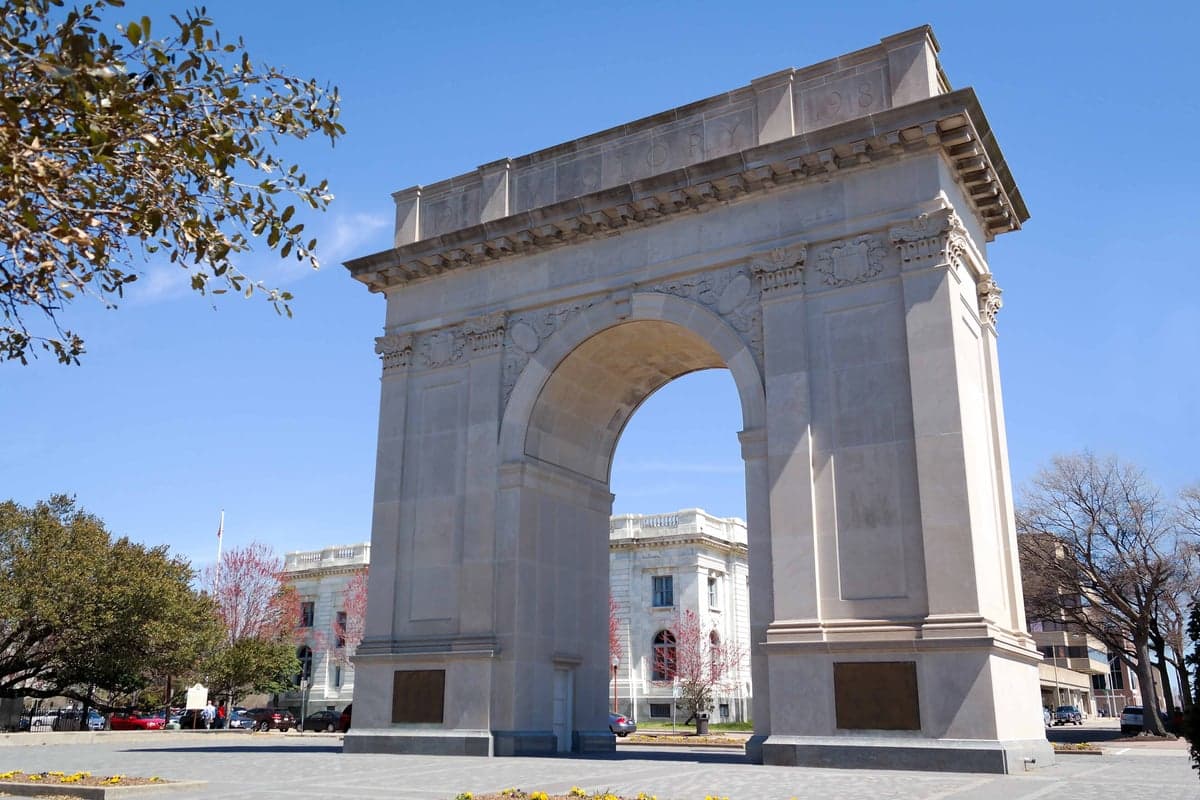
Photo: Wikipedia
Demographics of Newport News, VA
Affluence Level in Newport News, VA
A middle-class area roughly in line with national averages across income, home values, education, and employment.
People of Newport News, VA
Newport News, Virginia, is a city of 184,774 residents defined by its deep-rooted working-class character, shaped by shipbuilding and military service. The population is nearly evenly split between Black (40.4%) and White (39.8%) residents, with a growing Hispanic community (10.5%) and smaller East/Southeast Asian (2.9%) and Indian subcontinent (0.4%) populations. The city has a lower foreign-born share (3.6%) than the national average, reflecting a population that is largely native-born and multigenerational. With 29.1% holding a college degree, Newport News is a blue-collar city with a strong sense of place, where neighborhoods often trace their origins to specific industrial and migration waves.
How the city was settled and grew
Newport News was not a colonial settlement but a product of the late 19th and early 20th centuries, born from the convergence of railroads and shipbuilding. The city's founding is tied to the 1880s arrival of the Chesapeake and Ohio Railway, which established a coal pier at the mouth of the James River. This industrial anchor drew the first major wave of workers: White laborers from rural Virginia and North Carolina who settled in what is now Hilton Village, built as a planned community for shipyard workers during World War I. The Newport News Shipbuilding and Dry Dock Company, founded in 1886, became the city's economic engine, and its expansion during both World Wars triggered massive in-migration. African Americans from the Deep South arrived in large numbers during the Great Migration, particularly between 1910 and 1940, seeking industrial jobs. They established neighborhoods like East End and Brookville, which became the historic heart of the Black community. A smaller wave of European immigrants—primarily from Italy, Poland, and Greece—arrived in the early 1900s, settling in Downtown Newport News and the Southeast Community, where they worked in the shipyard and founded small businesses. By 1950, the city's population had swelled to over 42,000, overwhelmingly native-born and divided along racial lines by both custom and law.
Modern era (post-1965)
The post-1965 era brought significant demographic shifts, driven by the end of legal segregation and the expansion of the military-industrial complex. The 1970s and 1980s saw White flight to surrounding counties like York and James City, as Black families moved into previously restricted neighborhoods. Denbigh, a once-rural area in the northern part of the city, became a major destination for both Black and White families seeking newer housing, transforming into a racially mixed, middle-class suburb within the city limits. The Hispanic population began to grow in the 1990s, primarily Puerto Rican and Mexican families drawn to shipyard and construction jobs, settling in the Southeast Community and Denbigh. The East/Southeast Asian community, largely Vietnamese and Filipino, arrived in two waves: Vietnamese refugees after 1975 and Filipino military personnel and their families connected to nearby Langley Air Force Base and Naval Station Norfolk. They concentrated in the Oyster Point area and Denbigh, where several Asian grocery stores and restaurants now operate. The Indian subcontinent population remains very small (0.4%), with families primarily working in healthcare and technology, scattered rather than clustered in a single neighborhood. The Black population share has remained stable at around 40% since 2000, while the White share has declined from 52% to 39.8% as Hispanic and Asian communities have grown.
The future
The population of Newport News is slowly diversifying, but the pace is modest compared to other Virginia cities. The Hispanic share is projected to continue rising, potentially reaching 15-18% by 2040, driven by both domestic migration and births. The East/Southeast Asian community is likely to grow incrementally, particularly as the shipyard and nearby military bases continue to attract skilled workers. The Indian subcontinent population, while tiny, may see modest growth as healthcare and tech sectors expand. The Black and White populations are both aging and declining slightly in share, but the city is not experiencing rapid ethnic turnover. Instead, Newport News is becoming a more multiethnic, but still majority-Black-and-White, city. The key trend is suburbanization within the city limits: newer developments in Denbigh and the northern end of the city are attracting younger families of all backgrounds, while older neighborhoods like East End and Downtown are seeing population stagnation or decline. The city is not tribalizing into distinct ethnic enclaves; rather, it is slowly blending, with most neighborhoods becoming more mixed than they were 30 years ago.
For someone moving to Newport News today, the city offers a stable, working-class environment with a strong sense of community rooted in shipbuilding and military service. The population is predominantly native-born, family-oriented, and politically moderate-to-conservative. The city is not a high-growth, high-diversity hub like Northern Virginia, but a steady, grounded place where neighborhoods have clear identities and where new arrivals—whether from elsewhere in Virginia or abroad—will find a welcoming but established social fabric. The key is choosing the right neighborhood: Denbigh for a suburban feel, Hilton Village for historic character, or East End for deep community roots.

* Values derived from national, state, county, city and local statistics and may differ in a specific area. Last updated: 2026-04-19T20:10:22.000Z
Narrative content on this page is AI-generated and may contain mistakes. Verify any details that matter before acting on them.
ReloMaps may earn a commission from affiliate links at no extra cost to you.

